Donald Trump bounded onto ‘Fox and Friends’ on Saturday morning in a familiar manner—confident, giddy, and visibly delighted by the awesome power of the American military.
He narrated, with a showman’s relish, the overnight capture of Venezuelan leader Nicolás Maduro and his wife, whisked off in a flash to a US Navy ship and now en route to face drug-trafficking charges in Manhattan.
It was one of those moments when Trump seemed genuinely in awe—not of himself, which is rare, but of the sheer capability of the armed forces he now deploys with startling regularity.
The media spent the day in its usual split-screen trance. Half the time, the press corps was gorging on the ‘gee whiz’ operational details of the mission—how fast it happened, how few shots were fired, who gave what order, whether the Maduros put up any resistance.
The other half of the time was spent furrowing brows and proclaiming that Americans should be worried about legal authority, international precedent, and whether this was, in the language of the permanently fretful, ‘appropriate.’
There is no puzzle here: the press loves a good Hollywood-style raid, but it loves scolding Trump even more.
What is now unmistakably emerging is Trump’s evolving military doctrine—one that looks less like the Bush-Obama era of prolonged drips of force and more like a series of smash-and-grab lightning strikes.
The hallmarks are already clear: overwhelming US power, few, if any, American casualties, and villains conveniently drawn from the Trumpian rogues’ gallery.
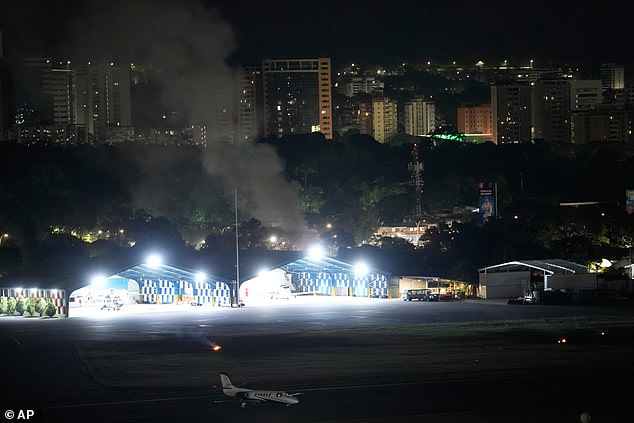
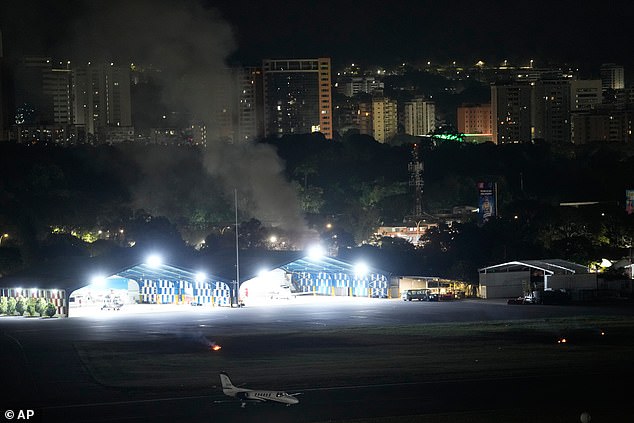
Smoke rises from La Carlota Airport in Caracas, Venezuela, after a daring dead-of-night mission by the US Army’s Delta Force unit to capture the country’s president Nicolas Maduro on drugs charges
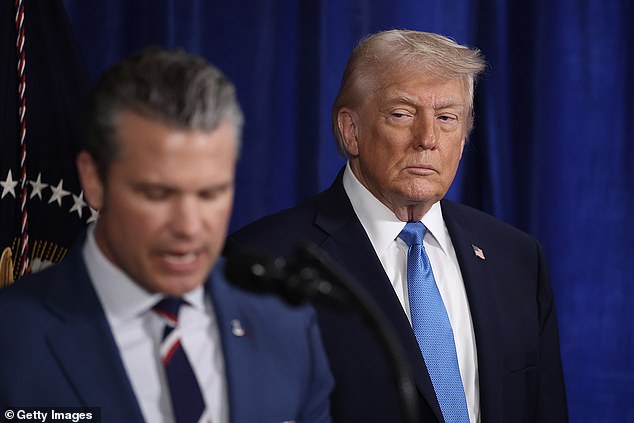
Donald Trump bounded onto ‘Fox and Friends’ on Saturday morning in a familiar manner—confident, giddy, and visibly delighted by the awesome power of the American military
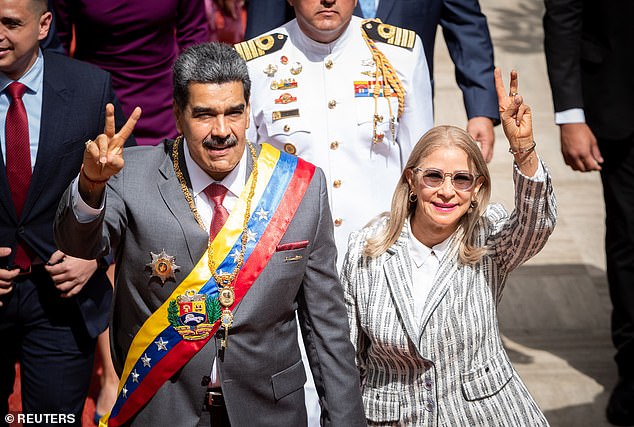
Venezuelan President Nicolas Maduro and wife Cilia were both seized by a US military unit in the early hours of Caracas. Trump said Saturday afternoon that both will face criminal charges in New York City
Latin American autocrats and Middle Eastern theocrats, take a number. If you cross President Trump, you may soon find Navy SEALs on your lawn and then in your bedroom.
The White House insists the Maduro snatch was about drugs, and yes, the indictment is thick with narco-trafficking allegations.
But even as Trump telegraphs in bright colors about drugs, there is no doubt that this is also about oil, oil, oil, as the president made clear in his press statement Saturday morning, featuring American energy companies with whom the White House has been quietly coordinating for months.
The administration has long believed that Venezuela’s collapse has been leveraged by unfriendly powers—China, Russia, Iran—and that the only way to reset the board was to remove the man at the center of the chaos.
With Maduro now in US custody, that reset has begun, with Trump announcing Saturday that until a new Venezuelan government in place, the country will be run by the United States. Someone get Tucker Carlson a box of smelling salts.
What might surprise Trump’s critics—if they are still capable of being surprised—is how much he trusts his generals.
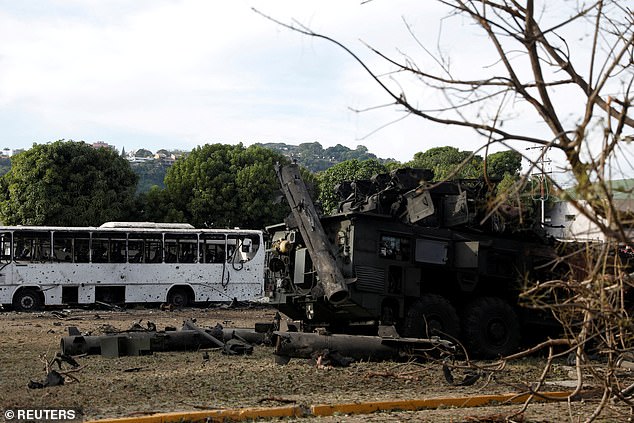
A destroyed anti-aircraft unit is seen burned out next to a destroyed bus at La Carlotta military air base in Caracas hours after Friday’s US operation in Venezuela that saw the country’s president and first lady seized by US special forces
They remember Candidate Trump’s talk about the Pentagon being ‘a disaster,’ but the president has shown a notable willingness to let military planners design and execute these complicated missions.
Trump talks tough, but his military playbook is decidedly minimalist: be fast, get in, get out, announce victory, and then move straight into the aftermath with chest-thumping grander.
The repercussions of this operation, like the Iran strikes before it, will ripple far beyond a courthouse in Manhattan.
After decades of US presidents hesitating, equivocating, and convening endless Situation Room debates about Iran’s nuclear program or corrupt Latin American strongmen, Trump has shown a different hand entirely.
He is willing to act.
That puts every recalcitrant Middle Eastern leader and every tinhorn dictator from Caracas to Managua to Havana on notice that Uncle Sam’s kinetic tools are not ceremonial—they now come off the shelf quickly.
And, of course, Beijing and Moscow noticed right away. The Trump Doctrine in the Western Hemisphere is becoming unmistakable: this is America’s neighborhood, and foreign powers should mind their distance.
Administration officials now speak openly—sometimes too openly for some tastes—about Cuba and even Greenland as theaters where Trump intends to redraw long-ambiguous lines of influence.
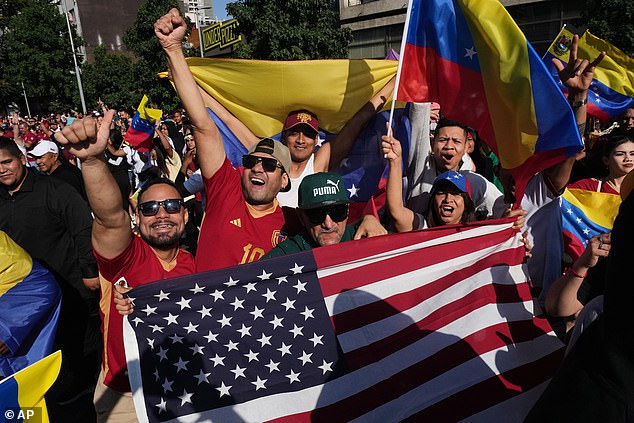
Many people were pictured holding both US and Venezuelan flags in a gesture to Donald Trump, who ordered the special forces operation to capture Maduro
The president is not trying to resurrect the Monroe Doctrine so much as update it with cruise missiles, cable-news cadence, and a focus on dominance over natural resources such as oil.
This puts MAGA in an interesting posture.
Many Trump supporters do not naturally gravitate toward foreign adventures, let alone anything that smells like regime change or imperialism.
But Trump has always defined his movement more than the movement defines him. He tells them what they believe, and they tend to believe it.
Congressional Republicans, even some of the more hawkish skeptics, fell quickly into line Saturday.
Prominent senators, including Arkansas’s Tom Cotton, offered rapid praise. Trump, once again, has dragged his own party toward a position only he could make feel inevitable.
The Maduro grab inevitably evokes the Noriega precedent—a brazen American operation against a Latin American strongman, followed by a very public trial in US courts.
Trump seems to like the echo. It places him squarely on the side of order, justice, and, not insignificantly, victory.
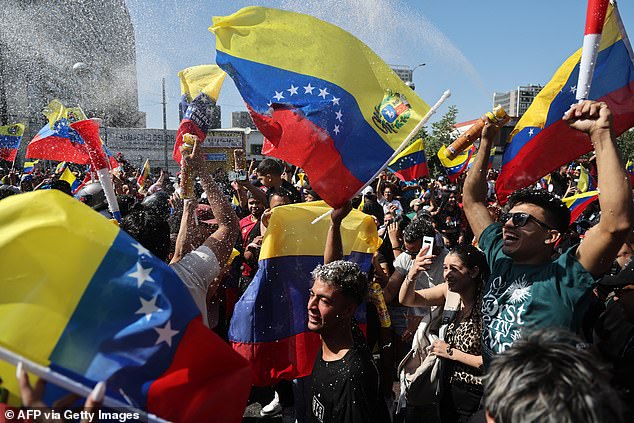
Venezuelans living in Chile celebrate the capture of Nicolas Maduro in Santiago on January 3
Domestically, the president is more than content to stand where public opinion usually clusters: rooting against dictators and rooting for American commando operations.
He relishes the contrast with voices like the New York Times editorial board, which called the mission ‘illegal and unwise,’ or anti-Trump lifers such as Steve Schmidt, who frame everything Trump touches as a democratic emergency.
Many Democrats on Capitol Hill are complaining loudly about executive overreach and the violation of congressional prerogatives.
Ken Martin, the chairman of the Democratic National Committee, sent out a fundraising email, blaring ‘Another day, another unconstitutional war from Trump, who thinks the Constitution is a suggestion.’
Trump welcomes this exact fight. He knows that few voters lie awake at night mourning encroachments on the separation of powers or violations of international norms.
Ahead lies a potential mess: legal proceedings in New York for the Maduros, a power vacuum in Caracas, and the inevitable jockeying by American officials and companies sensing new access to Venezuelan oil.
The road will be rocky for Venezuelans and for an administration that has unleashed a fair amount of chaos on an already battered nation.
But Trump will point back, again and again, to the mission itself—clean, swift, and successful—and argue that it is the purest expression of his core brand: strength.
In his telling and in his mind, strength is synonymous with winning, and winning is the only durable currency in politics, domestic and global.
Whether the world becomes more stable or more combustible in the wake of this weekend’s drama remains to be seen.
But for now, Trump has seized another headline, another villain, and another moment to declare that American power, under his watch, is something the world ignores at its peril.