Seeing a crowd of young people protesting against the war in Ukraine in the heart of St Petersburg on Wednesday will have sent an unfamiliar chill down Vladimir Putin‘s spine.
Hundreds joined in the singing of Swan Lake Co-operative, a track by Noize MC, a pro-Ukrainian rapper, that has become an unofficial anthem of Russia‘s burgeoning anti-war movement.
‘I want to watch ballet, let the swans dance,’ they sang in Russian. ‘Let the old man tremble in fear about his lake.’
As a native of St Petersburg, no one knows better than the Russian president that it was there that the protests that culminated in the bloody Russian Revolution of 1917 – and the toppling of Tsar Nicholas II – first gained popular support,
The fact that this week’s demonstration was not immediately crushed by the deployment of hundreds of baton-wielding riot police throws up a number of intriguing questions.
It could be that the Kremlin was taking a leaf out of the playbook of its Chinese friends. When the ‘umbrella protests’ first began in Hong Kong in 2014, the authorities there allowed them to go ahead unhindered.
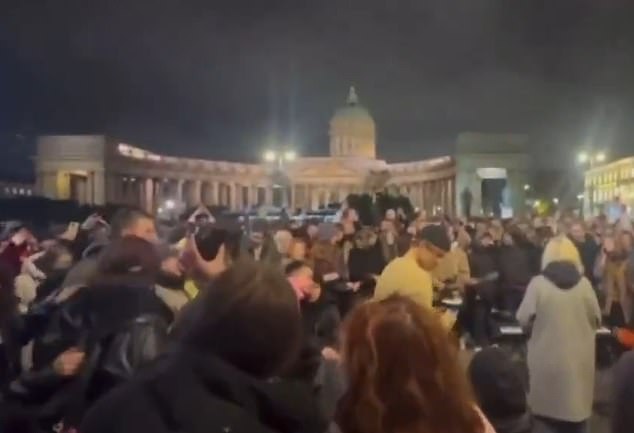
In St Petersburg hundreds joined in the singing of Swan Lake Co-operative, a track by Noize MC, a pro-Ukrainian rapper, that has become an unofficial anthem of Russia ‘s burgeoning anti-war movement
In the short term, Beijing contented itself with identifying the ringleaders and raiding their homes in the hope of intimidating their followers rather than going for a full-scale clampdown that could have exacerbated the situation, perhaps mindful of the backlash to its brutal suppression of the Tiananmen Square protest in 1989.
But the Russian authorities’ softly-softly approach could also reflect the current composition of the country’s internal security force, the Rosgvardya, or ‘Russian guards’.
Historically, Putin has been able to call on vast numbers of battle-hardened cops, schooled in the arts of hardline crowd-control and rounding up the usual suspects.
But when Moscow embarked on its invasion of Ukraine in February 2022, it expected to overrun the country within days and so the first wave of troops was dominated by members of the Rosgvardya.
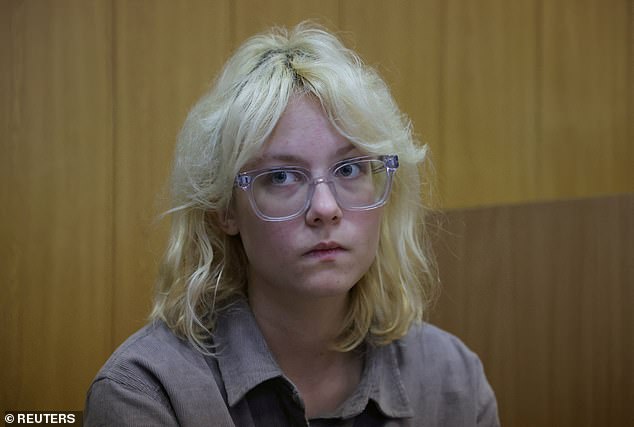
Diana Loginova, the 18-year-old who led the singing at the St Petersburg demo, was discreetly arrested as the crowd dispersed, charged with unlawfully organising a public gathering and placed in ‘administrative detention’ for 13 days
The idea was that they would be required to police urban centres after they had been occupied when the Ukrainians meekly surrendered to the Russian Bear.
But the Ukrainian resistance, of course, proved far more spirited than anticipated and these men died in their thousands, thus depleting the police forces responsible for maintaining law and order on the home front.
Up to now, that has not been a problem for the authorities as the Kremlin has been careful not to stir up dissent in the big cities that form the centre of power, such as Moscow and St Petersburg, by concentrating their conscription efforts in remote regions. There, young men – often not ethnically Russian – were easily lured into the armed forces with generous sign-up fees.
As a result, Russia’s urban middle classes – unlike their country cousins – have not been exposed to a never-ending procession of body bags from the front calculated to radicalise them against the war.
So what lies behind this week’s protest? Part of the problem may be that people are beginning to feel the pinch for the first time since the invasion began.
When hostilities first got under way, the economy enjoyed a war dividend as military manufacturing plants and munitions factories moved into overdrive but, in recent months, growth has slowed and inflation has spiralled upwards.
Meanwhile, Ukrainian drone strikes as far north as St Petersburg have hit Russian oil refineries causing not only a spike in usually low petrol prices but queues at petrol stations because of shortages
And so, the sight of ordinary young people openly challenging the regime could well have a ‘wildfire effect’.
While China’s dissidents are held in check by their inability to spread the word online due to ‘the Great Firewall of China’ that blocks access to the internet, Russians do have access to sites and apps such as X and TikTok.
And so, for Putin, there is a real danger that footage of the St Petersburg demonstration could go viral and whip up dissent in other towns and cities.
Only this week, Russia’s federal security service (the FSB) opened a criminal case against the exiled oligarch Mikhail Khodorkovsky, accusing him of creating a ‘terrorist organisation’ and plotting to violently seize power.
The FSB said the charges relate to the activities of his Anti-War Committee, a group that opposes the war in Ukraine.
As Gen Z revolutionary movements have rocked governments from Nepal and Madagascar to Peru and Indonesia in recent months, Russia’s 73-year-old strongman will be desperately hoping that he will not be the next domino to fall.
For Putin will not have missed the significance of the fact that Noize MC’s rap is based on Swan Lake, Tchaikovsky’s world-famous ballet, a piece of music that – in the Soviet era – was used as the soundtrack that preceded announcements of the death of Communist leaders.
Diana Loginova, the 18-year-old who led the singing at the St Petersburg demo, was discreetly arrested as the crowd dispersed, charged with unlawfully organising a public gathering and placed in ‘administrative detention’ for 13 days.
Putin will be hoping that she doesn’t go down in history as the pin-up girl of the anti-Ukraine war movement.
Mark Almond is director of the Crisis Research Institute in Oxford.