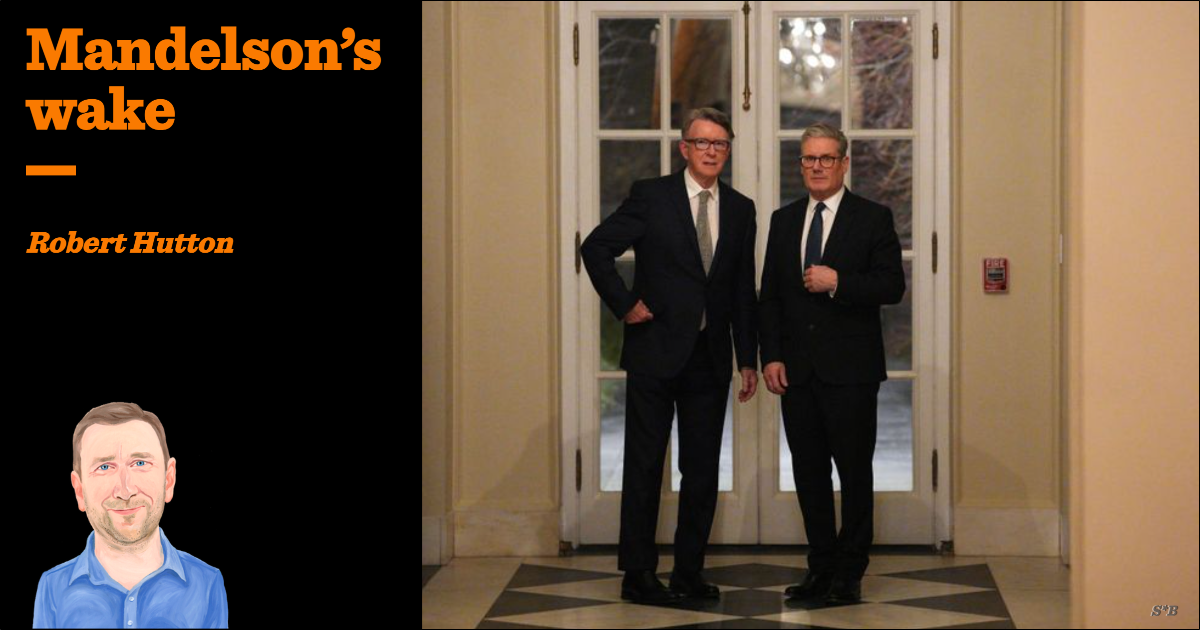
Keir Starmer claims that he did his due diligence — but he was not diligent enough

It may or may not be the case that all happy political parties are alike, but on Wednesday we saw that each unhappy party is definitely unhappy in its own way. The faces on the Labour benches weren’t identical to the ones we saw among the Tories in the final days of Theresa May and Boris Johnson and Liz Truss and Rishi Sunak (have I missed anyone?), but the condition was recognisable: a party that knows things have gone badly wrong.
The Labour mood was perhaps most of all disappointment. Whatever reservations MPs might have had about Keir Starmer, they hadn’t thought the crisis of his premiership would centre on an American paedophile millionaire. Indeed, one of the mysteries of all this is that the world leader in most imminent danger of losing his job over Jeffrey Epstein isn’t the one who was his close friend for years, but one who never even met him.
And things did feel very dangerous indeed for the prime minister on Wednesday afternoon. Prime Minister’s Questions didn’t reveal any new facts, but it allowed us to see the reality we already knew: that Starmer had appointed Peter Mandelson as US ambassador despite knowing that his friendship with Epstein had persisted beyond the financier’s first spell in jail. It was, as Kemi Badenoch observed, a terrible error of judgement.
The prime minister had opened by denouncing Mandelson without equivocation: “I am as angry as the public and any member of this House,” he began. “Mandelson betrayed our country, our parliament and my party. He lied repeatedly to my team when asked about his relationship with Epstein, before and during his tenure as ambassador. I regret appointing him. If I knew then what I know now, he would never have been anywhere near government.” There was more: that morning, the King had agreed to kick the errant peer out of the privy council, confirming that he is no long either right or honourable.
Badenoch, for once, stuck to her subject and kept it simple. Had the prime minister known about the continued relationship with Epstein. Behind her the Tory benches made a lot of doubting faces, but were relatively restrained. It was far more effective than the usual shouting. There is no need for bluster when reality is on your side.
At this point we learned that Number 10 had wargamed only one good answer to the Mandelson questions. Amazingly, this would turn out not to be enough. “We went through a process,” Starmer replied, offering what might be the most Starmer answer in the history of Starmer answers. “There was a due diligence exercise.” When the prime minister passes on to the great court of appeal in the sky, we will find these words written on his heart.
There had, he said, been “vetting by the security services”. Unfortunately, he went on, “Mandelson lied”. Curses! Foiled again! The one thing we weren’t expecting! This is how Kim Philby got away with it for so long: whenever they asked him if he was working for the Russians, he simply denied it. It must be very frustrating working for MI5, with all these people letting you down by lying to you.
Badenoch had, in fact, answered her own question. As everyone present knew, Starmer had decided Mandelson was, in her words, “a risk worth taking”. The goal was to get alongside Trump, and being mates with Epstein was hardly a disqualification in that role. Set a sleazeball to catch a sleazeball.
The Conservative leader affected outrage at the decision to hire Mandelson. “This was a man who had been sacked from Cabinet twice already for unethical behaviour.” You’d never catch the Tories giving a top job to a man who had been repeatedly sacked for lying.
Starmer’s approach was to try to be as much of a wet blanket as he could
It is worth noting that the MPs queueing up on Wednesday to say how obviously appalling Mandelson’s appointment had been were enjoying a certain amount of hindsight. If it was clear to Badenoch that Mandelson was a terrible choice, this was the one opinion that she kept to herself, never even mentioning his name in parliament until the release of documents naming him in September. She was hardly alone in this. The only comment on his appointment in the Commons before then was from Emily Thornberry. She called it “inspired”.
Starmer’s approach was to try to be as much of a wet blanket as he could, smothering the entire story in dullness and discussion of process. It is his strong suit, but it was not enough. Over the course of the afternoon, Labour MPs, from Angela Rayner down, would force him to retreat over the release of paperwork on Mandelson’s appointment, agreeing to let Parliament’s Intelligence Committee, rather than the Cabinet Secretary, decide what MPs will see.
At one level, this is a scandal that shouldn’t really touch Starmer. No one thinks he knew or should have known what Mandelson was up to in 2009. The decision to make him ambassador looks stupid now, but was widely praised at the time. It would be embarrassing but survivable if MPs thought his judgement was otherwise sound. That’s the problem.