Introductory economics classes often teach that rent control is bad policy. Artificially capping prices, the argument goes, discourages production – in this case, the creation and maintenance of apartments. That leads to housing shortages and higher rents marketwide.
Yet the idea continues to gain traction and is garnering new attention across the United States.
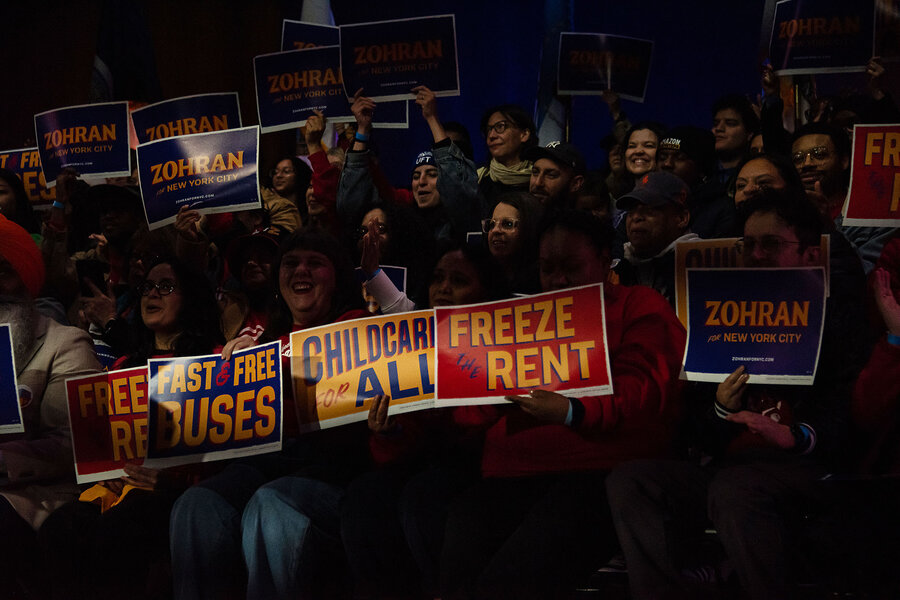
Zohran Mamdani, who took office as New York City mayor Jan. 1, is insisting on freezing rents for some 2 million New Yorkers. On his first day in office, Mr. Mamdani also signed three housing-related executive orders: one boosting the Mayor’s Office to Protect Tenants , and two more establishing task forces to speed up housing construction.
Why We Wrote This
Across the United States, jurisdictions are seeking to enact rent regulations as housing costs have continued to rise. But finding long-term solutions – including building millions more homes – won’t be easy.
Nationwide, jurisdictions are seeking to enact rent regulations as housing costs have continued to rise, particularly in large cities. City councilors in Los Angeles, for example, voted in November to reduce the annual rent increase limit for most of the city’s apartments from 8% to 4%. Washington state capped annual rent increases at up to 10% last spring. Washington, D.C., which already restricts rent increases, is considering a ballot initiative that would freeze rents entirely for two years. And later this year, Massachusetts residents will likely vote on a ballot question that would cap rent increases at the rate of inflation, up to a maximum of 5%.
Many cities have regulated rents for decades. But the recent surge in new initiatives has reignited debate about the government’s role in the free market. Supporters pitch rent regulation as a necessary measure to redress an affordability crisis. Many economists remain skeptical, arguing that such tactics raise costs over the long term, exacerbate shortages, and lower housing quality.
Manuel Pastor, an economist and a sociology professor at the University of Southern California, reflects a different, more middle-ground viewpoint among some housing policy experts.
“This is one of those debates where the ideological heat does not really match the empirical fire,” he says. “Rent stabilization is one tool … Why would you put that tool away?”
Why are supporters pushing for rent control now?
Those who advocate rent control argue that housing costs for working families have reached a level at which the government must intervene to reduce them.
“Something has got to give,” says Tara Raghuveer, who heads the Tenant Union Federation, a national organization that supports federal rent control. “The only urgent solution that makes sense at scale is rent control.”
In 2023, half of renters in the United States qualified as “cost-burdened” – meaning they spent more than 30% of their income on housing. (Some 27% spent half their income on housing). Most of those “burdened” renters lived in one of the nation’s 50 biggest cities.
Rent regulation is also popular with voters, and that may be driving political action. In a 2024 Redfin survey, 82% of respondents supported limits on rent increases.

Researchers say such regulation historically has emerged amid housing market duress – starting amid World War I as building materials were siphoned off to support the war, and housing construction declined. Congress also froze rents on 80% of the nation’s rental stock during World War II.
By the mid-1970s, such strict freezes and ceilings had given way to “stabilization” policies, which allow rents to change, but with limits. Rent-stabilized cities include Washington, Los Angeles, and San Francisco, as well as New York, where about 1 million apartments are rent-stabilized, and 69% of residents lease their homes.
Who opposes rent control, and why?
Opponents argue that rent control is not a viable long-term solution, exacerbates shortages, and increases housing costs. They say it’s not just a coincidence that cities with rent control rank high on lists of places with large housing shortages.
“It only worsens the housing crisis,” says Tamara Small, CEO of the Massachusetts branch of the Commercial Real Estate Development Association. “It reduces the total number of units and reduces the quality of those units.”
Economists have long argued the same.
In a 2012 poll of economists by the University of Chicago, more than 80% opposed rent control. Only 2% supported it. In 2024, after Montgomery County, Maryland, implemented a rent stabilization program, investment in multifamily rental homes fell by 13%, according to The Wall Street Journal.
Part of the pushback concerns housing quality: With lower rents, landlords have less revenue to allocate to repairs, which can increase undesirable housing stock in New York and elsewhere. To be put on the market again, units may need hundreds of thousands of dollars in repairs – repairs that owners are unwilling to make, because they worry rent revenue won’t cover costs.
What does the research say?
Researchers generally agree that regulations are effective in reducing rents for tenants in affected units. A 2014 study estimated that rents in Cambridge, Massachusetts, where rent control was in effect from 1970 to 1994, were 44% lower in regulated units than in nonregulated units. In 2022, a review of 31 rent control studies found that 25 documented lower rents in rent-controlled units.
Those cost savings also tend to lead to more extended residencies, and that stability can have social benefits for families. But longer tenancies can lead to a mismatch between tenants’ needs and the housing they receive, some economists argue. A family may choose to stay in a rent-controlled unit even as they outgrow it, for example.
Rent control can also lead to a net loss of rental units. A 2019 study of San Francisco found that an expansion of rent control reduced the number of multifamily rental homes by 15%, as some landlords tried to recoup lost returns by converting their units into condominiums. The reduction in rental housing supply “likely increased rents in the long run,” the study concluded.
Carefully crafting new rent regulations may be the key to preventing marketplace harm, Professor Pastor says. Unlike more rigid rent control measures, many modern rent stabilization policies permit some rent increases (helping landlords cover repair costs). And they exempt newly built units to mitigate the risk of reduced construction.
What are other ways to stabilize or lower housing prices?
Advocates on all sides of the debate agree that to lower rents in the long run, the U.S. must build more housing.
The price of any good tends to rise when demand outpaces supply, and housing construction has struggled to keep pace with population growth since the 2008 recession. A recent Goldman Sachs report found that the U.S. needs to build between 3 million and 4 million homes to close the gap.
Changing zoning laws to streamline regulations and eliminate parking minimums could make it easier to build apartment buildings, as current requirements often add tens of thousands of dollars in construction costs.
But building millions of new homes will take time. It’s also likely to run into NIMBYism – the idea that building certain types of additional housing degrades communities. Some advocates have also argued that rent control policies increase support for new housing.
A 2022 study found that residents of rent-controlled apartments were 37 percentage points more likely to support new housing construction in their neighborhoods – perhaps because it makes occupants less worried about gentrification and displacement.