Malala Yousafzai’s mind had for years blanked out the moment a masked Taliban gunman brutally shot her through the head as the teenager travelled on a school bus in her native Pakistan.
But those ‘erased’ memories came flooding back the moment she smoked a bong filled with cannabis for the first time while at Oxford University, the female rights activist has now revealed.
Malala was just 15 when she was targeted in her home town, in Swat Valley, because she had spoken out about her right to access education.
She survived the assassination attempt, but was left in a coma with severe injuries, including a lacerated facial nerve, a shattered eardrum, and a broken jaw, for which she underwent multiple surgeries for years after.
The precise detail of what happened during those horrific moments after she was shot, taken to hospital in critical condition and then flown to Birmingham for specialist treatment had simply been eradicated from her mind.
But as the 28-year-old disclosed in her soon-to-be published second memoir, Finding My Way, getting high for the first time unleashed a torrent of suppressed memories.
The impact on Malala, who is also noted as the youngest ever recipient of the Noble Prize, was immense as she struggled to process the emotional pain of the incident years later.
Malala had been encouraged by friends that night to smoke cannabis from the bong, a type of water pipe, which had been set up inside a shed within the grounds of Lady Margaret Hall.

Malala Yousafzai’s mind had for years blanked out the moment a masked Taliban gunman brutally shot her through the head – but those ‘erased’ memories came flooding back after she smoke cannabis for the first time while at Oxford University
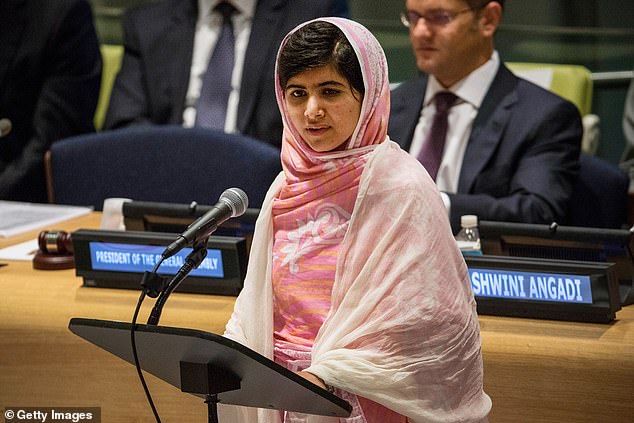
Malala, aged 16, speaking at the United Nations Youth Assembly in 2013, a year after a Taliban gunman attempted to kill her
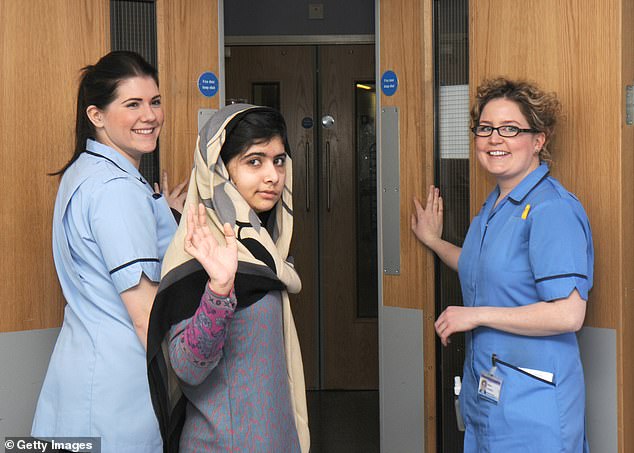
Malala pictured in 2013 at Queen Elizabeth Hospital in Birmingham, where she was provided with specialist treatment for her injuries
But as she left afterwards, she collapsed and had to be carried back to her room.
Her mind filled with images of the gun, blood and being carried through the crowds towards a waiting ambulance.
Speaking to The Guardian, Malala said: ‘I had never felt so close to the attack as then, in that moment,’ she said.
‘I felt like I was reliving all of it, and there was a time when I just thought I was in the afterlife.’
Malala revealed she found it hard to tell her concerned parents and friends about the flashbacks and how it had affected her mental health, because she believed her persona was about being ‘brave’, having survived a gunman.
But then the physical impacts took over – she began sweating and shaking. Her heart was beating faster and she was suffering panic attacks.
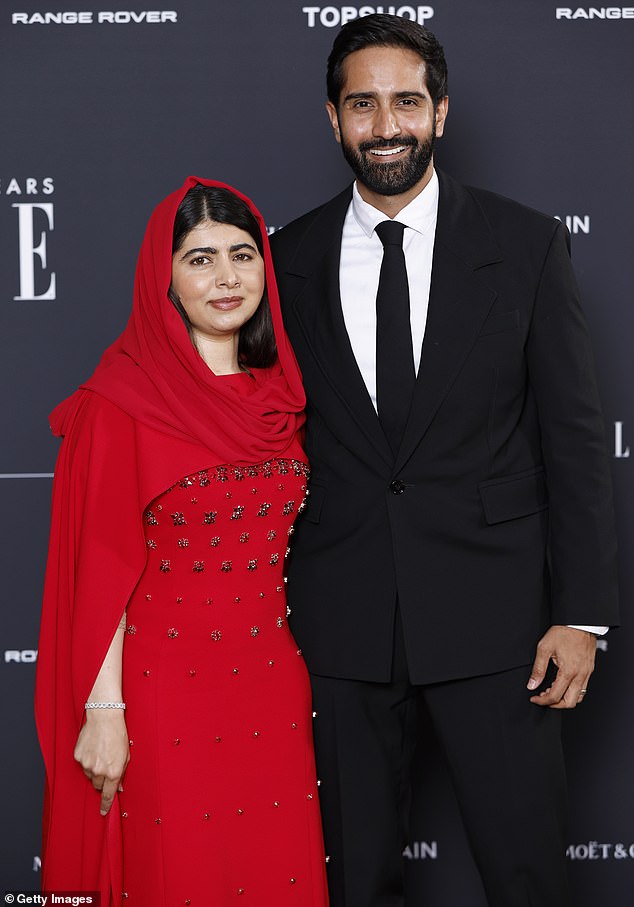
Malala pictured with her husband, cricket executive Asser Malik, who she married in 2021
The activist struggled to reconcile how she had gathered the strength to recover from an assassination attempt, but now everyday tasks had become a struggle. With the help of a therapist, she finally found a way forward again.
‘I thought nothing could scare me, nothing…and then I was scared of small things, and that just broke me.’
Malala has since found rebalance in her life and continues her advocacy work.
She married Asser Malik, a cricket executive, in 2021, and is the executive chair of the Malala Fund, which campaigns for girls’ education around the world.