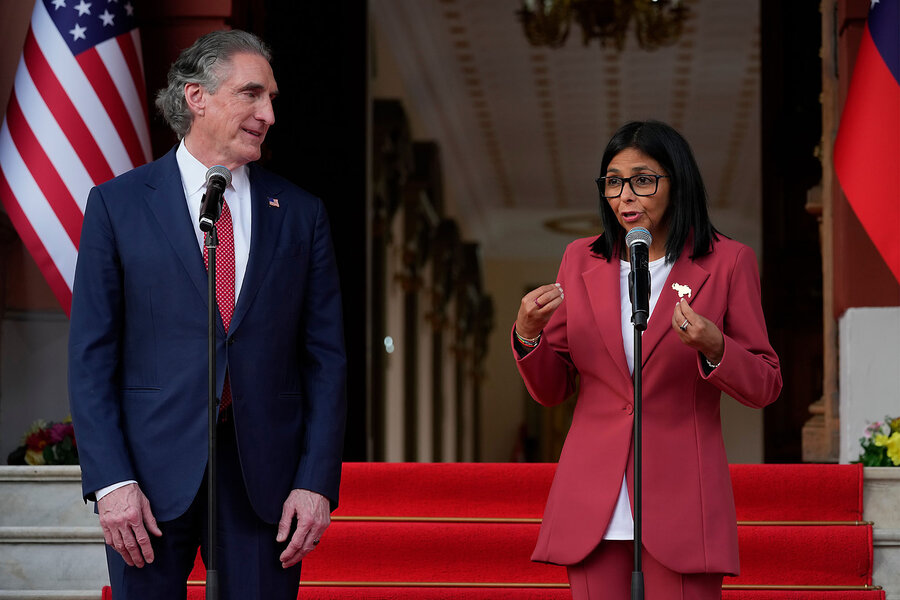
When Jordan Flores walked into Venezuela’s presidential offices for a news conference on March 6, it was the first time in his nearly decadelong career as a journalist that the media was invited inside the pink walls of Miraflores Palace.
For more than 20 years, the Venezuelan government tightened its grip on civil liberties, including freedom of the press, by shuttering news outlets, revoking broadcast licenses, and blocking online news content. For a political reporter like Mr. Flores, the opportunity last month to stand just a few feet away from Venezuela’s acting president, Delcy Rodríguez, and U.S. Interior Secretary Doug Burgum felt “historic.”
And none of it would have happened, Mr. Flores says, without the U.S.-led operation to capture Venezuela’s authoritarian leader and former president, Nicolás Maduro, on Jan. 3.
Why We Wrote This
It’s been three months since President Donald Trump sent the U.S. military to Venezuela to capture the authoritarian leader, Nicolás Maduro. For the people of Venezuela, transformational change is still slow to come.
In the three months that have passed since the U.S. military carried out strikes in Caracas and ferried Mr. Maduro off to a detention center in the United States, there have been important changes in Venezuela’s political, civic, and economic life.
Inflation is still driving up the cost of living, but the government passed sweeping hydrocarbons reform that would make investing in Venezuela more appealing to international companies, especially now that the U.S. has lifted oil sanctions. Authorities have also loosened their grip on free expression, by allowing local and international journalists into the presidential palace, permitting public protests, and passing an amnesty law for political prisoners.
Venezuelans say they are feeling hopeful in ways that few imagined possible when they rang in the new year this year with Mr. Maduro at the helm.

“They have very high expectations,” says Benigno Alarcón Deza, a Venezuelan political scientist and former director of the Center for Political and Government Studies at Universidad Católica Andrés Bello, a Catholic university in Caracas. “But there’s also fear that this moment won’t solidify into a democratic reality,” he says.
Mr. Alarcón refers to something he calls “learned fear,” after several events in recent years raised expectations for change – such as the 2024 presidential election, which showed overwhelming support for the political opposition – but never actually delivered on those expectations.
The high hopes sparked by these recent shifts inside the country are important, experts say, but most of the changes since Jan. 3 aren’t structural and could be easily reversed. A presidential election is, in theory, on the horizon for Venezuelans, but no date has been set, and Ms. Rodriguez could benefit from its delay.
“On Jan. 3, the dictator was taken out of Venezuela, but we maintain a dictatorship,” says Paola Bautista de Alemán, director of Venezuela’s Institute of Political Studies FORMA and a public policy fellow at the University of Notre Dame.
“Grandmother of the resistance”
Despite the easing of U.S. sanctions on Venezuela after Mr. Maduro’s ouster, economic relief for much of the citizenry has not yet materialized. Prices for basic goods are climbing, and Venezuela still maintains the highest annualized inflation rate in the world, estimated at around 600%. Since Jan. 3, Venezuela’s currency has lost nearly 20% of its value against the U.S. dollar.
The grim economic picture is slightly tempered by people’s hope that change is coming. What is not clear, though, is how long they are willing to wait to feel a real difference in their lives.
The U.S. government said in February it had returned $500 million to Venezuela from an initial sale of oil following Mr. Maduro’s capture. Members of the public are starting to ask why that hasn’t affected the minimum wage, which has been locked in at 130 bolivares (about 28 cents) per month since 2022. According to Cendas-FVM, a research center for the union representing Venezuelan teachers, in February, the cost of a basic food basket was nearly $650 for a family of five, costing well more than 2,000 times the minimum wage.

On March 12, hundreds of workers and retirees took to the streets in Caracas to demand a higher minimum wage. “Tired of trying to make my salary do magic,” one protest sign read. To the surprise of many, protesters were allowed to reach their intended destination: the National Assembly.
During Mr. Maduro’s nearly 13 years in power, those who dared step out to protest in public were met with a violent response from government security forces. In 2024, following the internationally contested presidential election that Mr. Maduro claimed without evidence to have won, thousands of people were imprisoned for taking part in demonstrations.
Since Jan. 3, citizens have become emboldened to speak up. “We’ve lost our fear,” says Emilio Rodríguez, a retiree who joined protesters for a subsequent minimum wage protest on March 25. He says he stretches his income of roughly $0.60 cents per month “like play-dough – the furthest I can.”
The sense that the U.S. is pressuring Venezuela’s leadership to change is part of what is feeding a renewed sense of hope. “The government has no choice but to heed our requests, because the one setting the agenda is the U.S. government,” says Génesis, a protester who declined to give her last name, instead offering an alias, “the grandmother of the resistance.”
Unlike the early March protest that made it to the National Assembly, subsequent marches on March 23 and March 25 were pushed off course by the national police. They weren’t violent, but this was a reminder that Ms. Rodríguez’s administration might only be going through the motions of loosening restrictions on free expression.
Mr. Flores, the journalist, felt similarly about his visit to Miraflores Palace. When he first arrived, he was told he – as well as many other local reporters – was not on the list and would not be allowed entry. Eventually, it was U.S. government employees who put pressure on the Venezuelan press office that got him permission to attend the news conference.
“The whole day felt like a reflection of this current political climate,” Mr. Flores says. “The government feigning openness while secretly maintaining its old ways.” He says the same trend has been repeated since Jan. 3, including with a new amnesty law.

Still awaiting amnesty
In theory, the February amnesty law applies to all political offenses committed after 1999, when Mr. Maduro’s predecessor, Hugo Chávez, rose to power, through 2026.
However, the law was passed by the National Assembly without input from the opposition, and observers say it has not been fully enacted. Some 700 political prisoners have been released to the great relief of their loved ones, but hundreds more are still languishing in detention.
“There have been people denied amnesty, and what’s worse is that more than 10,000 people have tried to access the judicial benefits,” says Dr. Bautista. That means the rough count that the opposition had for the number of political prisoners in detention under the Maduro administration – about 2,000 in total – was so far off what is emerging as the reality that “the black box of human rights violations in our country is still unopened,” she says.
One well-known political prisoner arrested in July 2021 and accused of terrorism was released in February. But by March, the government announced it was denying amnesty to Javier Tarazona, who directs an organization tracking abuses by the Venezuelan military and Colombian armed groups along the border. He continues to protest publicly, despite the risk.
“We haven’t seen real structural change from the government, but we are seeing the courage and persistence of the people,” says Dr. Bautista.

A murky political road ahead
Since the contested 2024 presidential election, many Venezuelans hoped that if Mr. Maduro were removed from office, the opposition would automatically step into power.
The U.S. recognized Venezuelan opposition candidate Edmundo González as the winner of that election, despite Mr. Maduro claiming victory. And opposition leader María Corina Machado, who was barred by the government from running, was awarded a Nobel Peace Prize last year for advancing democracy inside Venezuela.
But in January, U.S. President Donald Trump put power in the hands of Ms. Rodriguez, Mr. Maduro’s former vice president, not the popular opposition. That decision was reportedly based on the advice of the CIA, which determined that only someone close to Mr. Maduro could control the military and police forces, and thereby maintain stability.
The Trump administration has said its ultimate goal is to restore democracy in Venezuela, but no election date has been set. Many here believe Ms. Rodríguez is already ramping up her campaign efforts from inside the presidential palace, trying to paint herself as a reformist ushering in a new, post-Maduro era.
It’s in her interest, experts say, to delay elections as long as possible, in part so that there is a better chance of seeing economic improvements before the next election.
“There will have to be free and fair elections in Venezuela,” Secretary of State Marco Rubio said on March 31. “We have to be patient, but we also can’t be complacent.”
After being closed for seven years, the U.S. Embassy officially reopened operations in Caracas at the end of March. This could allow the U.S. to push along an electoral timetable. And that would require reforming the electoral council, which is currently stacked with Maduro allies.
“What kind of country will emerge from all of this?” asks Dr. Bautista. “I don’t think anybody knows. But it’s clear the driving force of change inside the country is the courage and the hope of the [Venezuelan] people.”