French President Emmanuel Macron today accused the US of ‘breaking free from international rules’ and ‘gradually turning away’ from some of its allies.
Macron delivered his annual speech to French ambassadors at the Elysee Palace, amid a major struggle among the continent’s leaders to come up with a coordinated response to US assertive foreign policy in the Western hemisphere.
In the last few days, Donald Trump launched an unprecedented incursion into Venezuela to capture its leader, Nicolas Maduro, and renewed threats to annex Greenland, which is part of EU member Denmark.
‘The United States is an established power, but one that is gradually turning away from some of its allies and breaking free from international rules that it was still promoting recently,’ Macron told ambassadors at the Elysee Palace.
‘Multilateral institutions are functioning less and less effectively,’ Macron added. ‘We are living in a world of great powers with a real temptation to divide up the world.’
Macron’s impassioned speech came just a day after Trump mocked his accent at a meeting of Republican leaders
Trump recounted how he made France agree to tripling its drug prices by threatening to increase tariffs on all French imports to the US.
Mocking the French leader’s accent, he said Macron told him: ‘Donalddd, you have a deal. I would like to increase my prescription drug prices by 200 per cent or whatever. Whatever you want, Donald, please don’t tell the population, I beg you’.
He claimed to have told France to either agree to the US’ demands or face a massive 25% tariff on all French products, including champagne and wine.
Macron’s speech is perhaps the strongest European denouncement of Trump in light of his behaviour in the past week.
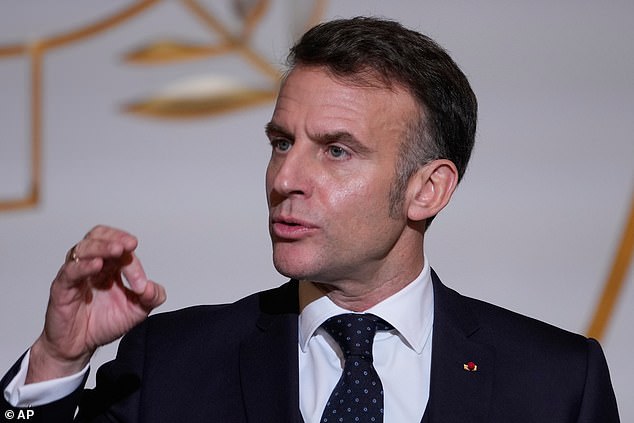
French President Emmanuel Macrontoday accused the US of ‘breaking free from international rules’
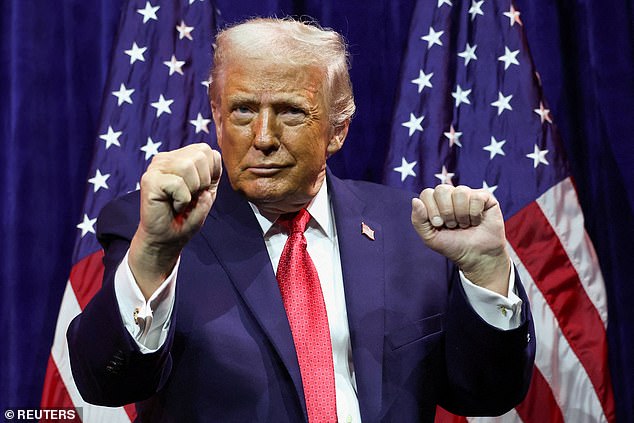
In the last few days, Donald Trump (pictured) launched an unprecedented incursion into Venezuela to capture its leader, Nicolas Maduro, and renewed threats to annex Greenland
The continent’s initial response to the invasion of Venezuela was tepid, at best. Neither condemning nor condoning what Trump had done, the EU’s High Representative for foreign affairs, Kaja Kallas, instead called for ‘calm and restraint by all actors’.
With the backing of 26 out of 27 member states – Hungary refused to sign the statement – she also sought to remind the US that as a member of the UN’s Security Council it has a ‘particular responsibility’ to uphold the rule of law.
Macron said he would shed no tears for Maduro, while German Chancellor Friedrich Merz said that while the Venezuelan leader’s legitimacy was doubtful, a ‘legal assessment’ of the US’ actions would be ‘complex and requires careful consideration’.
Italy’s Giorgia Meloni was more forceful in her praise of Trump’s actions, claiming the attack was an act of ‘legitimate’ self-defence.
Only a small number of European countries decided to condemn what Trump had done. Spain’s left-wing prime minister Pedro Sánchez led the charge against Trump, saying in a statement that his government would not recognise any interventions in Venezuela that violated international law.
He said: ‘Spain did not recognise the Maduro regime. But neither will it recognise an intervention that violates international law and pushes the region toward a horizon of uncertainty and belligerence.’
The few others in the EU who joined him in his condemnation included Slovakia’s prime minister Robert Fico, who scathingly said the US’ incursion was ‘further evidence of the breakdown of the world order’, and Hungary’s Viktor Orban, who said: ‘The liberal world order is in disintegration.’
Sir Keir Starmer, meanwhile, said of the incursion: ‘We regarded Maduro as an illegitimate president and we shed no tears about the end of his regime’.
He also raised the importance of adhering to international law.
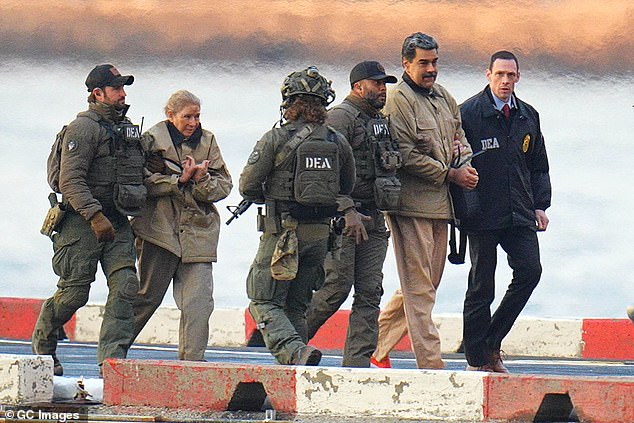
Nicolás Maduro and his wife, Cilia Flores, are seen in handcuffs after landing at a Manhattan helipad as they make their way to a Federal courthouse in Manhattan on January 5, 2026
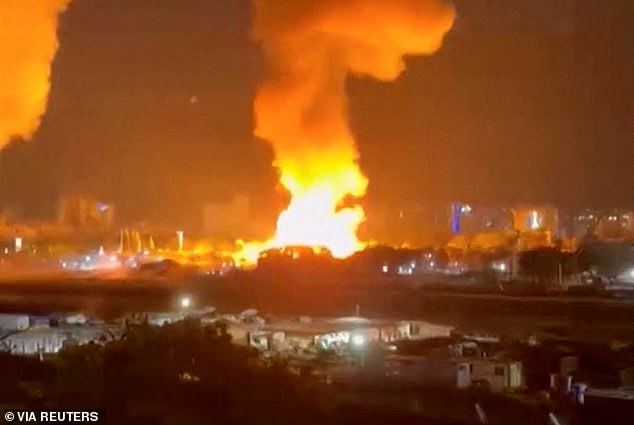
An explosion rocks Caracas in the early hours of Saturday morning during a US military operation which resulted in the capture of Venezuelan President Nicolas Maduro
The European reaction to Greenland was slightly more decisive. Following days of tension, world leaders, including including Starmer, French President Emmanuel Macron and Prime Minister Giorgia Meloni of Italy, vowed to defend Greenland’s ‘territorial integrity’.
They called America an ‘essential partner’ and reiterated that the US and Denmark signed a defence agreement in 1951.
‘Greenland belongs to its people. It is for Denmark and Greenland, and them only, to decide on matters concerning Denmark and Greenland,’ they said.
The statement added that the allies will continue to defend Greenland’s ‘territorial integrity’ and the ‘inviolability of borders’.
And yesterday, EU allies including France and Germany said they have been working on a plan on how to respond to the US should it act on its threats.
French Foreign Minister Jean-Noel Barrot said the subject would be raised at a meeting with the foreign ministers of Germany and Poland later in the day.
‘We want to take action, but we want to do so together with our European partners,’ he said on France Inter radio.
A German government source said separately that Germany was ‘closely working together with other European countries and Denmark on the next steps regarding Greenland’.
A senior European official said Denmark must lead the effort to coordinate a response, but ‘the Danes have yet to communicate to their European allies what kind of concrete support they wish to receive,’ the official said, speaking on condition of anonymity.
But the plans appear to be in their infancy, with Spain’s foreign minister José Manuel Albares Bueno stating that his nation was not aware of an EU-led Greenland plan.