More than 500 workers at a Louisiana factory walked away with six-figure bonuses totaling $240 million after their boss fought for them when he sold the company for $1.7 billion.
Graham Walker, who is set to step down as CEO of Fibrebond on December 31, told prospective buyers he would only sell the company his father founded if they earmarked 15 percent of the proceeds for the company’s employees.
The requirement was non-negotiable, Walker told the Wall Street Journal, arguing that without the stipulation, his employees – who did not own stock in the company – would walk out.
Ultimately, executives at power management company Eaton agreed to Walker’s terms, and in June, 540 full-time Fibrebond workers began receiving payouts averaging $443,000, to be allocated over the next five years.
Long-time employees received even more.
When each worker started receiving their bonus amounts in envelopes, some were overwhelmed with emotion, while others thought it was a prank.
Lesia Key, a 29-year veteran at the factory who started in 1995 making $5.35 an hour, broke down when she opened her letter.
‘It was surreal, it was like telling people they won the lottery. There was absolute shock,’ recounted Hector Moreno, a business development executive at Fibrebond.
‘They said, “What’s the catch?”‘
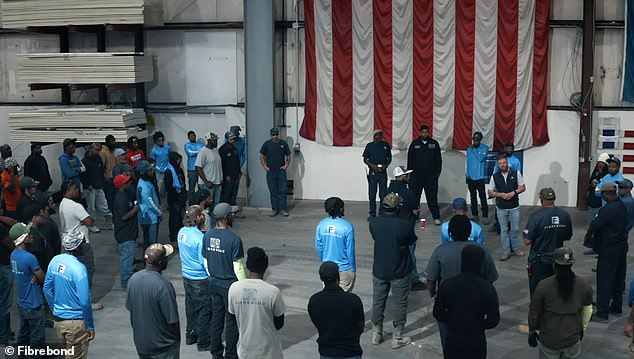
In June, 540 full-time Fibrebond workers started to receive payouts averaging $443,000, which would be allocated over the next five years
For Key, 51, who had three young children and a pile of debt when she started at the factory, the funds represented a new start.
She used the money to pay off her mortgage and even open her own clothing boutique.
‘Before, we were going paycheck to paycheck,’ she said. ‘I can live now.’
Moreno, meanwhile, used his money to take his entire extended family on a trip to Cancun, Mexico.
Others also paid down credit cards, bought cars outright, funded college tuition, or boosted their retirement savings.
Longtime assistant manager Hong ‘TT’ Blackwell, 67, even used the several hundred thousand dollars she received to retire.
Blackwell, an immigrant from Vietnam who spent more than 15 years in Fibrebond’s logistics operation, explained that she used part of the bonus to buy her husband a Toyota Tacoma and set the rest aside.
‘Now I don’t have to worry. My retirement is nice and peaceful,’ she told the Journal.
The bonuses also boosted Minden’s economy, a town of about 12,000, with Mayor Nick Cox saying: ‘There’s a lot of buzz about the amount of money being spent.’
That is one of the reasons Walker said he wanted to give each of the employees bonuses, telling the Journal he wanted to do something good for the town, which had spent years losing jobs, residents and watching businesses move to Texas.
‘It seems sometimes progress evades us,’ he said. ‘We don’t often see good things here.’
Walker also sought to reward the employees who had stayed by the company’s side through tumultuous times.

The bonuses provided a boon to the economy of Minden, a town of about 12,000
Fibrebond was founded in 1982 by Walker’s father, Claud Walker, with a dozen employees building shelters for electrical and telecommunication equipment.
It thrived during the cellular boom of the 1990s, when it shifted to build concrete enclosures for cellphone towers, then nearly collapsed when its factory burned to the ground in 1998.
Hard times continued into the early 2000s amid the dot-com bubble, which slashed Fibrebond’s customer base to just three clients, forcing layoffs that cut the workforce from roughly 900 to 320.
Still, the Walkers continued to pay their employees even as production stalled.
Graham and his brother later took over the day-to-day operations, selling assets and paying down debt while searching for a new market.
And the staffers stuck around, some treasuring the close-knit work environment, where they enjoyed snacks every Thursday at 2pm.
Choices were also limited in Minden, where Walmart is the only other major employer.
When the Walkers then had to freeze salaries for several years, Fibrebond set up a fund to help employees struggling to pay their bills.
By 2015, Graham became the CEO and rehired some of those who had been laid off during the rough times.
He then decided that instead of handing out individual bonuses, Fibrebond would begin giving ground bonuses when the company met safety and other targets.
Prospects improved, he said, but the business’s ups and downs caused ‘whiplash.’

Graham (second from left) became the CEO in 2015, and hired back some of those that were laid off during the rough times
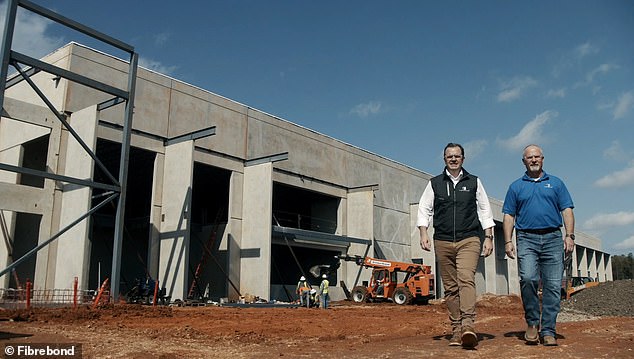
Walker said he wanted to do something good for the town, which had spent years losing jobs, residents and watching businesses move to Texas
Graham then had to plead with employees to trust his leadership, promising they would benefit if the company ever made it big.
‘We were scratching and clawing for any order, let alone profitable ones,’ Moreno recounted.
The turnaround finally came with a risky $150 million investment to pivot into building modular power enclosures for data centers, which paid off when cloud computing demand surged during the COVID pandemic.
Interest in artificial intelligence further boosted sales, as has the demand for terminals exporting liquefied natural gas.
As a result, sales jumped 400 percent over five years, drawing interest from large industrial players, before Eaton finally agreed to Graham’s 15 percent demand.
‘We came to an agreement with this second-generation family-owned business that honors their commitments to their employees and the community,’ a spokesperson for the company told the Journal.
Graham said he is now just asking his employees one favor – to let them know how the money changed their lives.
‘I hope I’m 80 years old and get an email about how it’s impacted someone,’ he said.