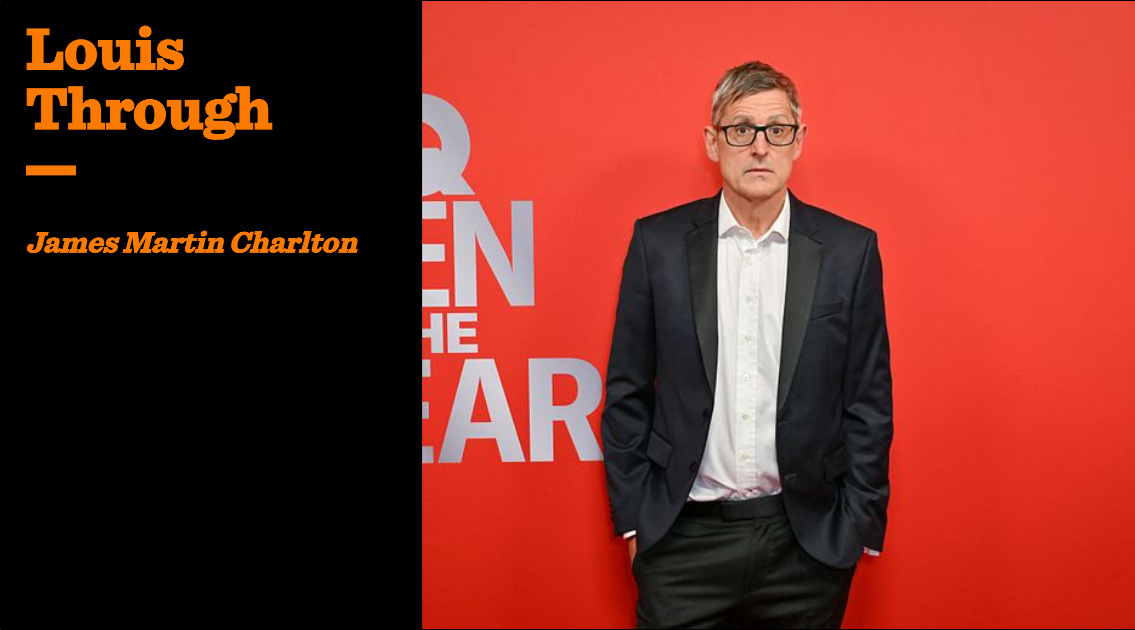
A curious and telling moment occurs at a climactic point in Louis Theroux’s new documentary Into the Manosphere. Throughout the film he has been wrangling with the British influencer Harrison Sullivan, better known, alas, as HSTikkyTokky.
Sullivan has exposed himself as something of a hypocrite who disdains women who promote themselves on OnlyFans yet manages a small harem of OnlyFans girls himself. The last of several encounters is filmed by Theroux’s crew while also being livestreamed by Sullivan’s team. Theroux attempts to dig into the influencer’s legal issues, which sends Sullivan and his mother, present for some reason, into paroxysms. To counter, Sullivan begins reading questions garnered from his live audience. One of them: what is Theroux’s response to what Sullivan’s fans call the “genocide in Gaza”?
You may as well have cast a spell over Theroux. He cannot move one way or the other. He is suddenly under the eyes of two audiences at once: the HSTikkyTokky spectators and his own regular viewers. If he rebuffs the notion that there is a genocide, he risks being denounced as a Zionist apologist — not only by the streamer’s viewers but also by a sizeable section of his own left-leaning fanbase. Yet if he affirms it, he risks fuelling the antisemitism already present among Sullivan and his ilk, while offending those of his own audience who think the accusation at least premature (no international court has ruled Israel guilty of such a crime). Not answering, the course Theroux chooses, still leaves him open to criticism from both sides. HSTikkyTokky, of course, doesn’t give a damn. His audience simply wants to see Theroux squirm. The round is Sullivan’s.
How has Theroux, long the master of the upper hand, found himself in such a compromised position with so intellectually limited an individual? In earlier encounters he effortlessly got the better of figures like Fred Phelps and Eugène Terre’Blanche. Yet Sullivan repeatedly lands blows on his far more practised opponent — not only on Gaza but also on the question of Jimmy Savile. Accused of being the disgraced BBC star’s friend, Theroux can only weakly retort that he “helped expose” the prolific abuser. The viewer is left, like HSTikkyTokky, unconvinced.
Throughout his career, Theroux has become a kind of emblem of liberal media authority
Theroux’s shtick is, by now, excessively familiar. He enters a scene with a show of polite curiosity, asking innocent-seeming but increasingly needling and pointed questions until he hits the jackpot and strikes the mother lode. A pile of nonsense spews forth from his interlocutor’s mouth, condemning the speaker in the eyes of the viewer without Theroux needing to underline it. The subject is revealed, and Louis can rest in quiet self-assurance of his own moral rectitude and bask in the approval of his audience.
Throughout his career, Theroux has become a kind of emblem of liberal media authority — an authority all the more powerful because it rarely needed to assert itself. His programmes carried the prestige of the institutions that produced them and the finesse of the professional apparatus behind them (even now, HSTikkyTokky is visibly impressed by the size of Louis’s cameraman’s equipment). More importantly, Theroux could rely on the broad liberal consensus that his BBC employers spent decades constructing and reinforcing. He spoke from a moral centre that most viewers assumed without it needing to be spelled out. It helped hugely, of course, that his subjects were more often than not strange, extreme, or marginal — preferably all three.
That liberal consensus has taken a good many knocks in recent years. Brexit, the election of Donald Trump and the rise of migration-sceptic populist parties across Europe have shown that it can hardly be described as a consensus any more. At the same time, the media landscape has fragmented so dramatically that millions, especially younger people, no longer turn to terrestrial television or even mainstream streamers for their entertainment and enlightenment. Sullivan himself primarily streams on Kick, where his followers number nearly a quarter of a million. Until hearing of him via Theroux’s documentary I had never personally had the pleasure, and the programme makes much of the fact that Sullivan’s audience barely knows nor cares who Theroux is. Where once a handful of television channels ensured that the entire country recognised figures like Bruce Forsyth or Cilla Black, whether we liked them or not, today teenagers can turn to social media platforms and watch influencers of whom their parents are blissfully unaware, whilst the teens are oblivious to who is on Strictly, let alone Question Time. We have fled every man to his tent.
This leaves Theroux as little more than the avatar of his dwindling team, while the influencers he seeks to expose command fanbases of their own. Worse still, Louis must obey certain rules of engagement, whereas the champions of the manosphere may, by comparison, say what they jolly well like. To Theroux’s audience, HSTikkyTokky emerges as something close to a pimp, thug and swindler. To Sullivan’s viewers, Louis is merely a woke bitch and Zionist lackey. As Kubrick’s Barry Lyndon has it, “they are all equal now.”
Yet an even more serious fracture occurs in the course of Theroux and Sullivan’s tête-à-tête. Theroux presses the influencer on the hypocrisy of sitting in moral judgement over OnlyFans models whilst living off their earnings. Theroux asks, “why not be a good person?” Now, I’ve seen a fair amount of the documentarian’s output. I’ve seen him be snide with everyone from TV evangelists to porn stars, from wrestlers to Paul Daniels. Never once have I seen him attempt to model what being a good person might look like. Or is Louis’s idea of a good person simply someone who makes those outside the liberal media elite look bad?
This lack of any genuine moral ground becomes increasingly apparent the more one reflects on Into the Manosphere. Towards the end, Louis attempts a little amateur psychology, suggesting that many of his subjects had chaotic childhoods with absent fathers. Perhaps this might explain why they have become such misogynistic boors? But if single parenthood and absent fathers are part of what has produced these monstrosities and their victims, where has the liberal critique of family breakdown been? Where is the Theroux documentary taking on the proselytisers of the sexual revolution or the architects of the welfare state? In the world that Louis epitomises, such questions are never asked.
Theroux begins to resemble a kind of cultural parasite, feeding on the moral and psychological disarray he documents
HSTikkyTokky’s old mum asks Louis a pertinent question: if her son is so awful, why is Theroux “making money off” him and amplifying his profile? At that moment, the ground opens up under our intrepid interviewer, and he — and the culture he represents — tip into the abyss at which they have been gaily peering. Theroux, of course, did not emerge from the chaotic world he documents. His father and two of his uncles are well-known writers; his family’s cultural capital has sustained not only his career but those of his brother and cousin. What, then, has this child of privilege done to make the world a better place, to demonstrate to young people how they might live upright lives?
Viewed in this light, Theroux begins to resemble a kind of cultural parasite, feeding on the moral and psychological disarray he documents while offering no alternative vision of the good. The snarky, ostentatiously tolerant liberal humanism he represents, far from occupying a stable moral high ground from which figures like HSTikkyTokky can be judged, looks exactly like the stance that made them possible.