In the summer of 1976, the UK basked in a record-breaking ten-week heatwave.
Looking back at photos of sunbathers thronging the parks and beaches, one thing leaps out: almost everyone was slim.
Among office workers sheltering in the shade during their lunch breaks and tourists cooling off in the fountains of Trafalgar Square, lean figures and slender waistlines were the norm.
And it’s an observation backed by fact: by the end of the 1970s, just 6 per cent of men and 9 per cent of women were obese – compared to 27 per cent of men and 29 per cent of women at the start of the current decade.
Last week, Channel 5 touched on the subject in a show called The 1970s Diet, in which Josie Gibson, a former Big Brother winner and regular on ITV‘s This Morning, turned back time – to the era when children played on Space Hoppers, flares and maxi-dresses were in fashion, and Farah Fawcett ruled the TV ratings in Charlie’s Angels – in an attempt to lose weight and become more healthy.
As an experiment, she swapped takeaway sandwiches, restaurant dinners, microwave meals and constant snacking for a more old-fashioned regime of three home-cooked meals a day.
Josie’s menu featured 1970s staples – such as tinned Spam, kidneys, liver and onions, and fried eggs on white toast, plus seasonal veg from nearby allotments – as well as some of the decade’s early experiments with processed foods such as Findus Crispy Pancakes and dehydrated Vesta Beef Curry.
Tests confirmed that, in just two weeks, her levels of body-fat significantly reduced.

In 1976, the average British adult consumed 2,280 calories a day – exactly in line with current NHS recommendations that men need 2,500, and women 2,000, calories daily

In the summer of 1976, the UK basked in a record-breaking ten-week heatwave. Looking back at photos of sunbathers in parks and beaches, one thing leaps out: almost everyone was slim

The single most obvious reason for people being slimmer is revealed in the government’s National Food Survey from 1976: quite simply, people ate less
Now the Daily Mail has similarly rewound 50 years to discover how Britain kept trim in the ’70s (often despite a fatty diet that would be considered unhealthy today) – while also exploring the momentous changes in food culture that sowed the seeds of the modern-day obesity epidemic.
The single most obvious reason for people being slimmer is revealed in the government’s National Food Survey from 1976: quite simply, people ate less.
The survey, based on questionnaires sent to households around the country, offers a fascinating snapshot of the country’s eating habits.
It reveals that, in 1976, the average British adult consumed 2,280 calories a day – exactly in line with current NHS recommendations that men need 2,500, and women 2,000, calories daily.
By contrast, the Office for National Statistics estimates men nowadays typically consume around 3,000 calories and women 2,500 calories a day.
Nutritional therapist Rosalie Collins – a specialist in digestive health and member of Nutritionist Resource – said: ‘Diet and nutrition is complex, but the basic fact is that people don’t usually put on weight if they eat fewer calories.
‘The overall demands for energy intake were the same then as they are now. It’s just that, unlike now, people in the ’70s were consuming calories within recommended limits.’
But it’s not that most people were consciously dieting.

Last week, Channel 5 aired The 1970s Diet, in which former Big Brother winner Josie Gibson turned back time in an attempt to lose weight and become more healthy

Despite more Britons looking slimmer in the 1970s, most people were not consciously dieting. Pictured, a woman cooling off in a swimsuit during the heatwave of summer 1976
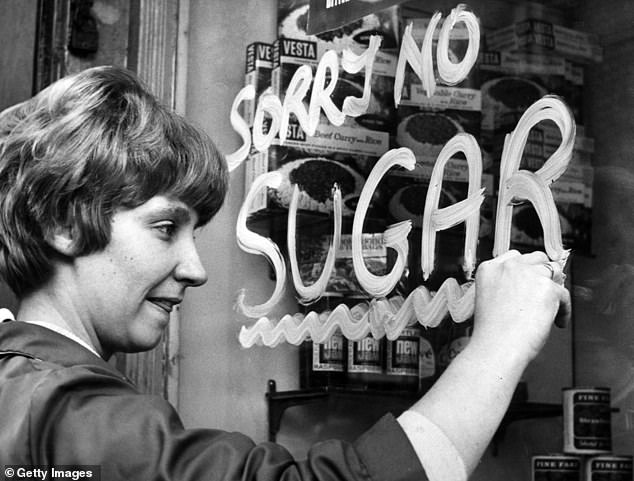
Food in the early 1970s was relatively expensive when considered as a proportion of household income. Pictured, a woman paints a ‘Sorry No Sugar’ sign on a shop window in Liverpool, 1974
According to food historian Pen Vogler, who features in Josie’s TV show, people were eating less because of a combination of tight household budgets, smaller portion sizes, and a culture of thriftiness left over from post-war rationing.
Incredibly, the total average cost of food in 1976 was just £4.41 per person per week – less than a single coffee-shop latte today.
But with a third of British families earning between £57 and £91 a week – and only four per cent earning more than £120 a week – food in the early part of the decade was actually relatively expensive when considered as a proportion of household income.
Portions were also smaller, with research by the British Dietetic Association showing that ’70s dinner plates were 22cm in diameter, typically, compared to 28cm nowadays – inevitably meaning more modest servings.
And it wasn’t just meals that were smaller. A typical wine glass held just 125ml, compared to the standard 175ml or large 250ml glasses common today.
Meanwhile, a bag of Walkers crisps weighed just 25g – compared to the current 32.5g standard bag – and a Double Decker chocolate bar, first launched in 1976, weighed just 42g, far less than its 54.5g today.
Ms Vogler said: ‘In the first half of the decade, economic conditions meant food felt really expensive; people simply couldn’t afford to eat more.
‘Families generally ate home-cooked meals together, with the expectation that mum would do the shopping and the cooking.
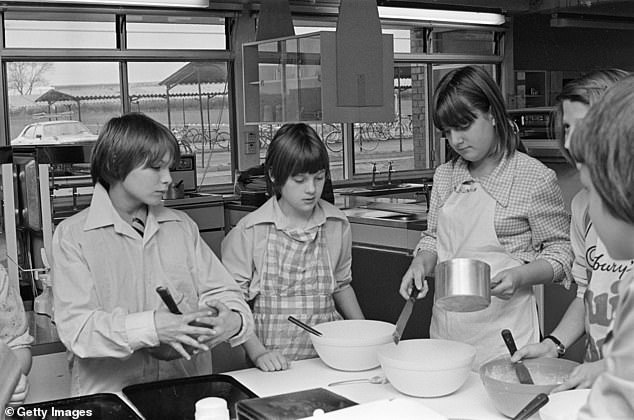
People ate less because of of tight household budgets, smaller portion sizes, and a culture of thriftiness left over from post-war rationing. Pictured, girls taking a cookery class, Northfield School, Billingham, Stockton-on-Tees, circa 1978
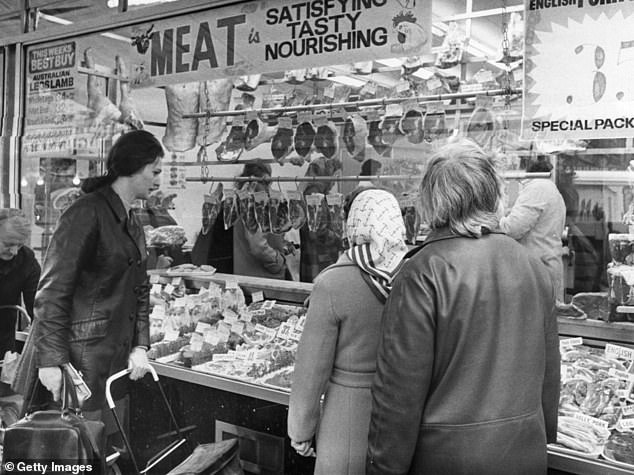
People consumed fewer calories, but tended to have a diet high in saturated fats. Pictured, shoppers examining the produce at a butchers in Chapel Street Market, Islington, London, 1973
‘People who had been born in the ’30s, ’40s and ’50s had lived through rationing and saw wasting food as quite immoral, so they wouldn’t dream of making or serving more than was needed.’
Although the 1976 survey shows people consumed fewer calories, it also reveals a diet high in saturated fats – which are found in butter, cheese and red meat and which are a major contributor to obesity and heart disease.
Reflecting a typical shopping list, the survey shows the average Brit consumed 4.71 pints of milk per week, as well as 107g of cheese, 216g of beef, 130g of fish, four eggs, 146g of butter, 87g of margarine, and 346g of sugar.
Overall, the average adult consumed 50.1g of saturated fat per day – far in excess of the current recommended maximum of 30g for men and 20g for women.
Offsetting the high fat in their diet, however, Britons in 1976 ate record levels of fresh fruit, with the survey noting an increase ‘mainly in consumption of apples and of stone fruit, but also a significant increase for pears.’
And a with a mid-’70s boom in growing your own food, as depicted in the BBC sitcom The Good Life (where suburban couple Tom & Barbara Good try to become self-sufficient), fresh veg also featured heavily on household menus.
Overall, Brits ate close to two kilos (1,931g) of fresh fruit and veg per week – including just over a kilo (1,001g) of potatoes, 411g of root veg and 519g of fruit.
Since then, consumption of fresh produce has declined, with the most recent National Diet and Nutrition Survey, published last June, showing Britons these days eat 1,617g per week – with just 17 per cent of adults meeting the official target of five portions of fruit and veg a day.
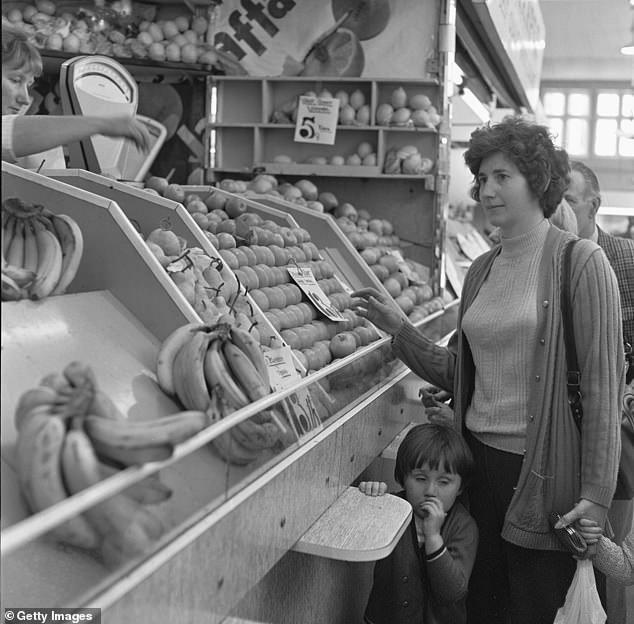
Less than half of families owned a freezer, so ingredients had to be collected on a daily basis – often meaning housewives walking miles around the shops. Pictured, a mother and daughter buying fresh fruit from a greengrocers stall in Stafford’s indoor market, circa 1974
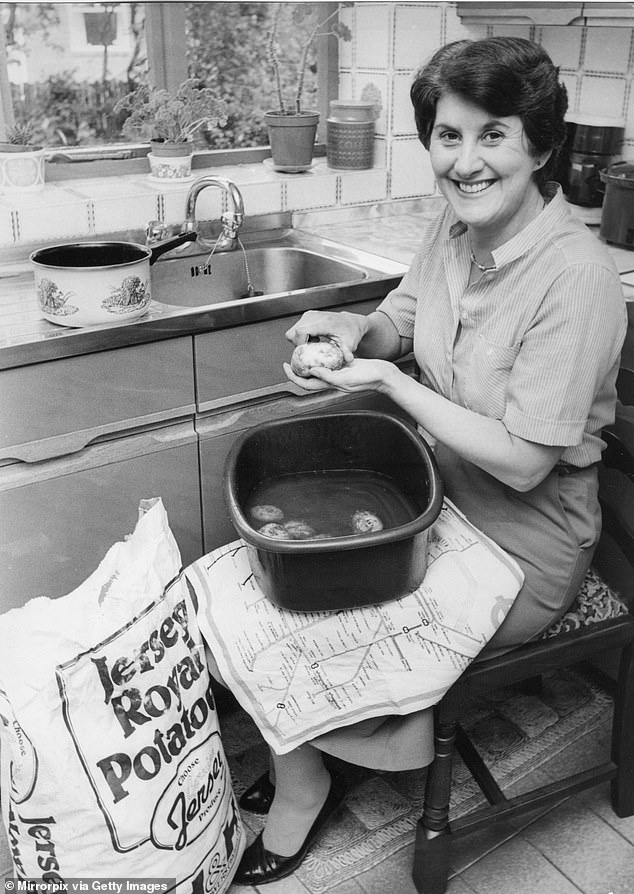
‘People born in the ’30s, ’40s and ’50s had lived through rationing and saw wasting food as quite immoral, so they wouldn’t dream of making or serving more than was needed’, says food historian Pen Vogler. Pictured, a housewife peeling potatoes circa 1970
Summarising the pros and cons of the 1976 diet, nutritionist Miss Collins said: ‘People ate a lot more saturated fats than I would recommend to anyone nowadays.
‘But the fats in their diet were coming from butter, red meat and whole milk, eaten as part of nutrient-rich diet full of fruit and veg which meant they were also absorbing vitamins and minerals.
‘As a result, the fat in their diet didn’t lead to obesity. People were a healthy weight, they were moving every day, and they were consuming fats from whole foods rather than from modern ultra-processed products.
‘As a result, those fats were being burned off and not stored up.’
Statistics highlight how people in the ’70s generally lived more active lives – which would have helped them keep their weight down.
While children played outdoors (the Raleigh Chopper was the era’s most recognisable bicycle and skateboarding was a massive craze), nearly 40 per cent of adults still worked in manual labour – in agriculture, mining, construction or manufacturing.
Only half of households owned a car, meaning far greater reliance on walking and cycling.
And with less than half of families owning a freezer, ingredients for meals had to be collected on a daily basis – often meaning housewives walking miles around the shops (a routine adopted by Josie in her new TV show, as she abandoned trips by car to the supermarket and instead sourced ingredients by trundling a tartan shopping trolley on wheels round her local baker, butcher and greengrocer).
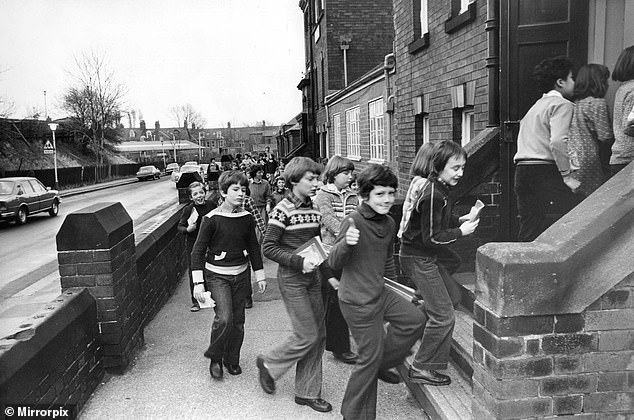
Children played outdoors (the Raleigh Chopper was the era’s most recognisable bicycle and skateboarding was a huge craze) and there was far greater reliance on walking and cycling
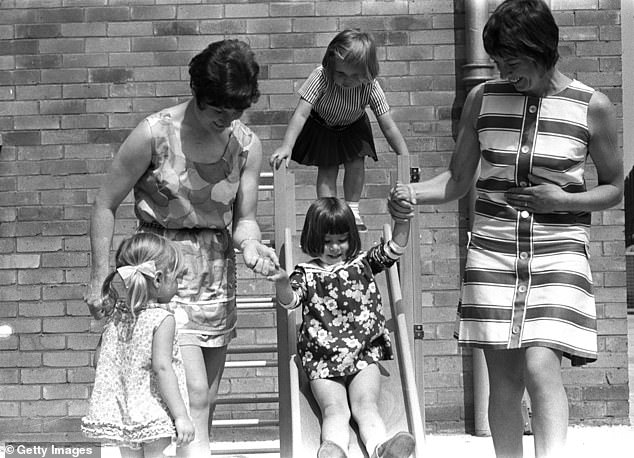
Statistics highlight how people in the 1970s generally lived more active lives – which would have helped them keep their weight down
Yet for all that the diet and lifestyle of the 1970s kept people slim, it was also – according to Ms Vogler – a decade that saw huge changes in British shopping and cooking and eating habits.
And although these changes – namely the arrival of supermarkets, American fast food outlets and processed foods – may not have had much immediate impact on the nation’s waistline, they nonetheless paved the way for the modern obesity crisis.
She said: ‘1970s food – prawn cocktail, vol au vents, Findus Crispy Pancakes, Arctic Roll and Black Forest Gateau – is iconic in a way that just isn’t the case for any other decade, and the reason is that so much of it seemed new, unusual and exotic.
‘At the start of the decade, the reality for most people was a diet that would appear bland to modern tastes.
‘The range of foods available was quite limited and people didn’t expect much variety.
‘Family home-cooked meals were meat and two veg or maybe macaroni cheese; school dinners, cooked by the dinner ladies in the school kitchen, were a pie and veg, maybe followed by a pudding like pink sponge and custard.
‘But as the decade progressed, supermarkets became more common around the country – as did fast-food restaurants. Food became cheaper, freezers became more common, and a wider variety of ingredients suddenly became available.’
While McDonalds opened its first UK outlet in 1974, selling burgers for just 15p, followed by Burger King in 1976, the ’70s also saw the widespread introduction, for the first time, of processed foods, ushering in a new era of domestic convenience.
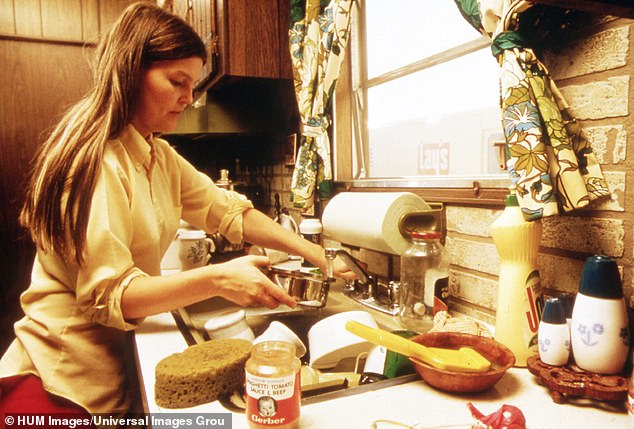
A typical family home-cooked meal included ‘meat and two veg or maybe macaroni cheese’, says food historian Pen Vogler. Pictured, a housewife in the 1970s preparing to fix a meal
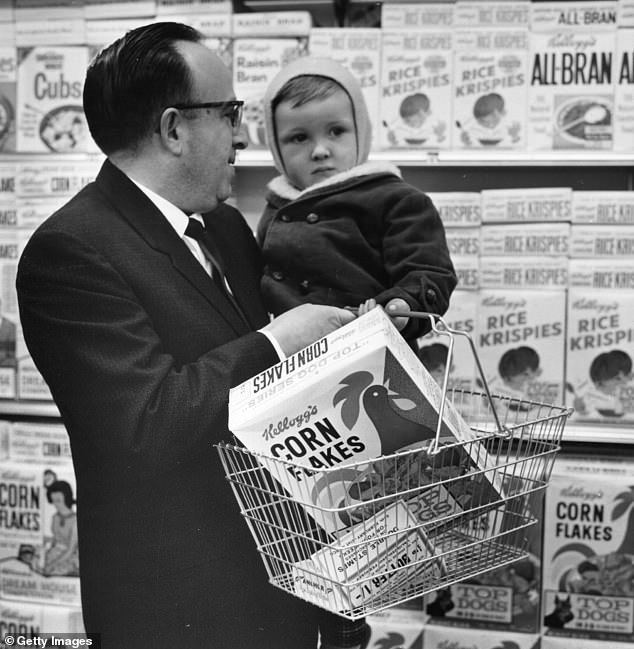
The arrival of supermarkets, American fast food outlets and processed foods paved the way for the modern obesity crisis. Pictured, a father shopping with his baby at a Foodtown Supermarket in Lewisham, London, 1974
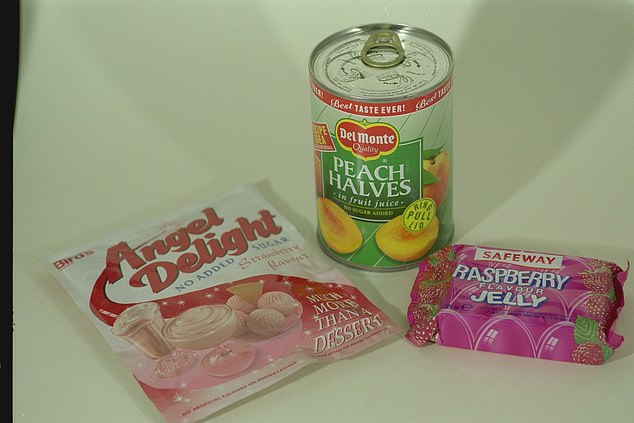
While the slimline 1970s were happy to enjoy the new-found convenience of processed foods, the decade also arguably began a harmful trend. Pictured, Safeways Raspberry Jelly, Del Monte Peach Halves and a packet of Birds Angel Delight
A Vesta dried meal kit made preparing a chow mein or curry as easy as boiling a kettle, while the Pot Noodle (launched in 1977) created a tasty meal just by adding water.
Findus Crispy Pancakes came over-ready straight from the freezer, as did the Chicken Kiev (first introduced in the UK by Marks & Spencer in 1979).
Ms Vogler said: ‘There was a dizzying amount of social change, including more and more women going out to work.
‘The demand was to make things easier and to save people time, to find ways to feed the family without chopping an onion or walking round the shops.’
So while the slimline 70s were happy to enjoy the new-found convenience of processed foods, the decade also arguably began a harmful trend.
One of the key factors in the modern obesity crisis is the rise of ultra-processed foods such as sugary drinks, packaged snacks, processed meats, and fast food which are typically high in calories, salt, sugar and unhealthy fats. They are designed to be hyper-palatable, so promote over-eating while delivering limited nutritional benefit.
And among the forerunners of these were the processed products of the ’70s, including instant desserts which were a favourite childhood treat.
Ms Vogler said: ‘By the end of the decade, cooking a meal from scratch started to become more unusual.
‘In some ways, the whole problem with ultra-processed food began with products like Instant Whip and Angel Delight.’