In one of Africa’s largest countries, fighting and wartime atrocities have intensified as Sudan marks three years of civil strife. Amid the violence as well as food scarcity, however, ordinary Sudanese continue to creatively and courageously support each other through citizen-led mutual aid networks.
These local humanitarian efforts, known as emergency response rooms, won a prestigious award last week from a British think tank, the Chatham House Prize. The award shines a spotlight on the civic underpinnings and practical effectiveness of such community associations.
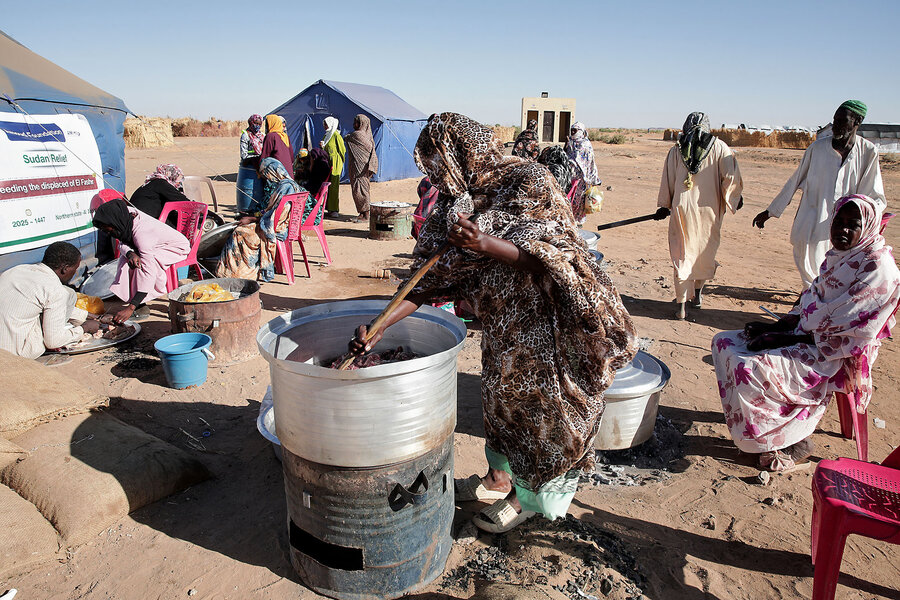
Sudan’s war has displaced nearly 13 million people from their homes, and the emergency response rooms have sprung up in dozens of towns and villages to source and distribute food, water, and medicine. They often have volunteers cooking meals in large, open-air kitchens where fleeing families eat together. Chatham House praised the rooms’ “impartial nature and attempts to provide aid to all.”
That spirit of inclusiveness during a conflict is not confined to Sudan’s emergency response rooms. Across Africa – and in other countries – such grassroots efforts help lay the groundwork for peaceful coexistence at the community level.
“Innovation often emerges most forcefully in fragile environments,” according to Ibrahima Bokoum, a community leader in the eastern part of Congo, an area riven by rebel warfare. Writing in a recent Atlantic Council report, Mr. Bokoum noted, “Resilience cannot be imported; it must be cultivated locally.”
“People … assume that peacebuilding only takes place after the guns have fallen silent, when in fact peacebuilding can and does take place before, during and after violent conflict,” observed Dylan Mathews, head of the international nonprofit Peace Direct. The challenge, he wrote in a 2022 article, is to move to “a more holistic vision … [and] societal attitudes that foster peace.”
Last year, Peace Direct supported local initiatives in 33 countries, including Myanmar. There, under a ruthless military dictatorship, “Hate speech, propaganda and rumours kept neighbours as strangers,” the organization reported. But local communities forged connections across ethnic lines, which eventually morphed into violence prevention and mutual aid networks.
Observing community interactions on a different continent and at a very different period in history, French historian Alexis de Tocqueville identified “the art of associating” within local communities as a key to democracy. He was talking about the United States in the mid-1830s, several decades after it had become independent – and a couple of decades before it fought its own civil war.
Through active, iterative associations within local communities, Tocqueville observed, “sentiments and ideas renew themselves, the heart is enlarged, and the human mind is developed.”