A new study has linked nighttime light pollution with an increased risk of developing heart disease.
Researchers, funded by the American Heart Association (AHA), came to their conclusion after reviewing subjects’ brain scans and satellite images of the nighttime brightness around their homes.
They took data from 466 adults, with a median age of 55, who had undergone a PET/CT scan at Massachusetts General Hospital, Boston, between 2005 and 2008.
Using both imaging techniques together allows for the measurement of brain stress activity and arterial inflammation in a single scan.
Researchers cross referenced each individual’s results with the amount of nighttime light at their home.
This was measured using exposure data from the 2016 New World Atlas of Artificial Night Sky Brightness, which excludes natural sources such as starlight, airglow and moonlight.
At the end of the follow-up period in 2018, the health data revealed that 79 of the cohort, 17 per cent, had developed major heart problems.
They concluded that people exposed to higher levels of artificial light at night had higher brain stress activity and blood vessel inflammation, and a higher risk of experiencing major heart issues.

A fresh study has added to a body of scientific evidence that light pollution increases risk of heart disease
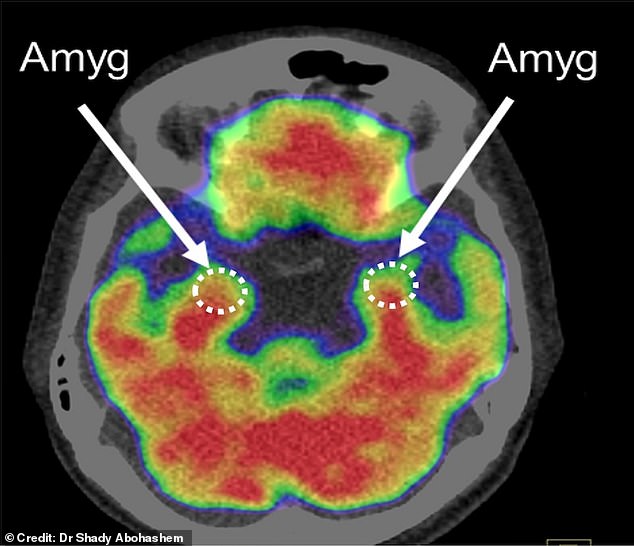
An example of one of the specialised PET/CT imaging scans of the brain in the study
An increase in light exposure was associated with an increased risk of heart disease, rising by about 35 per cent and 22 percent over five and 10-year follow-up periods, respectively.
Study author Dr Shady Abohashem, head of cardiac PET/CT imaging trials at Massachusetts General Hospital, said: ‘We found a nearly linear relationship between nighttime light and heart disease: the more night-light exposure, the higher the risk.
‘Even modest increases in night-time light were linked with higher brain and artery stress.
‘When the brain perceives stress, it activates signals that can trigger an immune response and inflame the blood vessels.
‘Over time, this process can contribute to hardening of the arteries and increase the risk of heart attack and stroke.’
Furthermore, the risks were higher among participants who lived in areas with additional social or environmental stress, such as high traffic noise.
Dr Abohashem suggested that cities can consider reducing unnecessary outdoor lighting, or use streetlights with motion sensors.
‘This research indicates that light pollution is more than just an annoyance; it could also increase the risk of heart disease.
‘We hope clinicians and policymakers will consider nighttime light exposure when developing prevention strategies.
‘We want to expand this work in larger, more diverse populations, test interventions that reduce nighttime light, and explore how reducing light exposure might improve heart health.’
He also suggested that ‘people can limit indoor nighttime light, keeping bedrooms dark and avoiding screens such as TVs and personal electronic devices before bed.’
There are some notable limitations with this study, namely that it was an observational study using previously collected data, so cannot prove a direct cause and effect link between heart disease and nightly light pollution.
Furthermore, the data came from a group of predominantly white (89.7 per cent) people, who all received care at one hospital, which means the findings cannot be generalised to represent a larger group.
The full preliminary study will be presented at the American Heart Association’s Scientific Sessions in New Orleans later this week.
It’s not the first time scientists have linked light pollution to life-limiting health conditions.
Previous research found that light pollution can elevate your sleeping heart rate to near daytime levels.
Other studies have suggested it can disrupt the body’s natural clock, known as the circadian rhythm, which can have deadly consequences.
This includes a higher risk of coronary artery disease, heart attack, heart failure, atrial fibrillation and stroke.
Coronary heart disease (CHD), also called ischaemic heart disease, is a major cause of death in the UK and across the world.
There are 2.3 million people in the UK diagnosed with coronary heart disease, but thousands, if not millions, are unaware they have the potentially killer condition.
CHD occurs when the heart’s blood supply is blocked or interrupted by a build-up of fatty substances in the coronary arteries, causing angina (chest pain), heart attacks, and heart failure.
With most cases of CHD, prevention is the best cure, and doctors often suggest a series of lifestyle changes—including swapping fatty foods for fibre-rich fruit, veg and wholegrains, ditching alcohol and cigarettes, and increasing your activity levels—to improve overall heart health and fitness.