With her towering auburn beehive, acid tongue and constantly smouldering cigarette, she was the Dragon Lady of Torquay. In just 12 perfectly performed episodes of Fawlty Towers, Prunella Scales achieved a permanent place in British hearts.
Often cited as the most brilliant sitcom ever made, the 50-year-old show – set in a run-down hotel on the Devon Riviera – has never dated and remains hysterically funny.
Much of that is due to Prunella, who has died aged 93 after more than 20 years struggling with Alzheimer’s disease.
As Sybil, she was the perpetually exasperated wife of hotel owner Basil (John Cleese), who referred to her (always out of earshot) as ‘my little piranha fish’ or ‘my little Kommandant’. In contrast, Sybil would summon her husband with one shriek that could cut through plate glass: ‘BASIL!!’
But this was far from a two-dimensional portrayal of a nagging wife. Basil clearly can’t live without her, and Sybil won the admiration of the nation too.
When Prunella was offered the role of the hotel harridan in 1974, she was asked to meet Cleese, who co-wrote the show as well as starring in it. He had the flu and, when she arrived at his flat in central London‘s Hyde Park Gardens, he was sitting up in bed.
He demanded to know whether Pru liked the scripts. ‘They’re brilliant,’ she said. ‘But I have one question. Why did Sybil marry Basil?’
Cleese then groaned: ‘Oh God, I knew you’d ask that.’
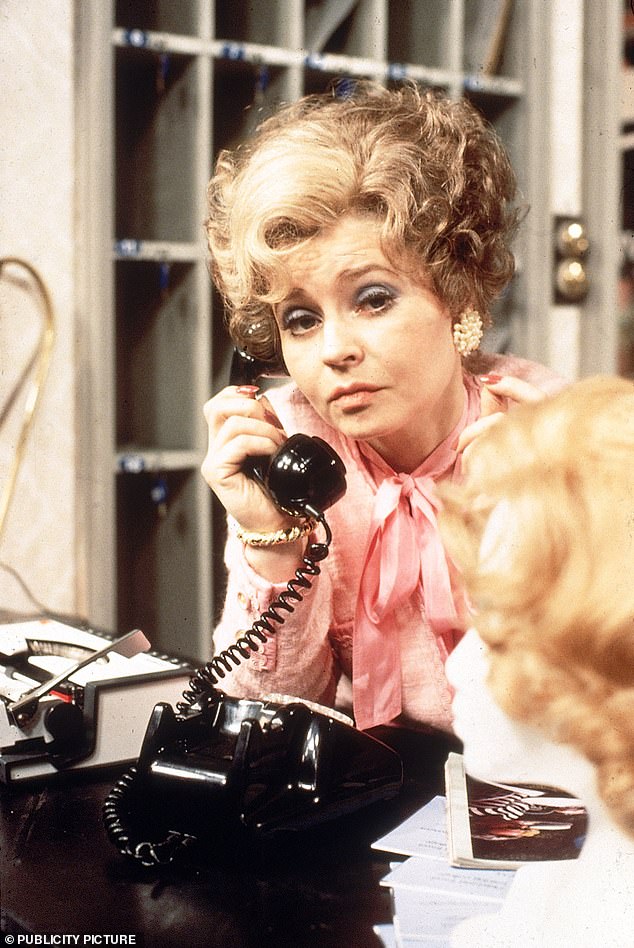
Prunella Scales potraying Sybil Fawlty on the hit British comedy show Fawlty Towers
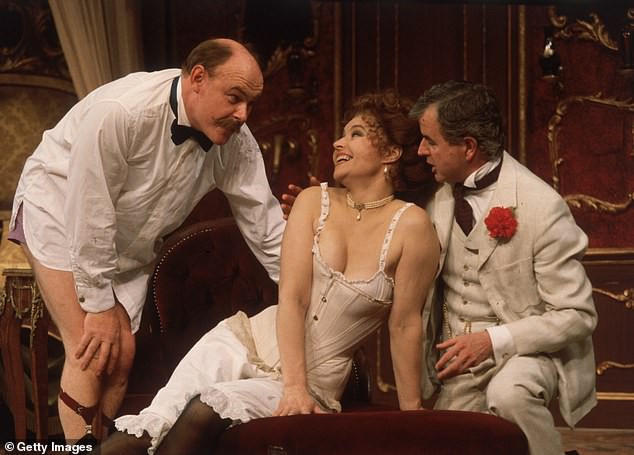
Timothy West alongside his wife Prunella Scales and Rodney Bewes in the play ‘Big in Brazil’ at the Old Vic Theatre, London
It’s the consummate actor’s question, a perfect example of how Pru worked. She saw herself neither as a comedy actress nor a West End star – though she was certainly both. What mattered to her was portraying real people, whether in sitcom or serious theatre, playing historical characters such as Queen Victoria (a role she made her own) or even as an impossible customer at a supermarket, Dottie Turnbull, in a series of Tesco adverts.
She couldn’t accept Sybil Fawlty the way Cleese first wrote her, as a vacuous and lazy woman who spent most of her time gossiping or painting her nails.
The character came alive when Prunella mapped out her past: ‘Her parents have been in catering and so she knows about running a boarding house, south coast, Eastbourne.
‘Sybil’s trouble is that she has married out of her class. She has been fooled by Fawlty’s flannel and, too late, she realises she is landed with an upper-class twit. Whereupon the rot sets in. But behind all her apparent disenchantment with Basil, there is some real affection for him.’
None of that was explicitly stated in the show but it all rings true, because she conveyed it so vividly in her accent, her gestures, her eye rolls and her exasperated clucks. ‘I don’t think Sybil was a dragon,’ Prunella said. ‘She was an intelligent and funny woman, rather sexy in all those chic clothes.’
All of this came as a surprise to Cleese and his co-writer, Connie Booth, who was his wife at the time. ‘We were a little dubious after the first day’s rehearsal,’ he admitted. ‘We wondered if it was working. By the second day, we realised that the choices Pru was making probably worked better than what we had in mind.’
Her ability to make Sybil a fully rounded person lifted the show to the top tier of sitcom.
But she paid a price. For the rest of her life, the public expected her to be like Sybil, both on and off stage. That was a frustration when she was playing major roles – Portia in The Merchant Of Venice at the Old Vic in 1982, Coral Browne in Alan Bennett’s Single Spies at the National Theatre three years later.
She starred in primetime TV serials, such as Mapp & Lucia (she was Miss Mapp, opposite Geraldine McEwan), and the bittersweet sitcom about bereavement, After Henry.
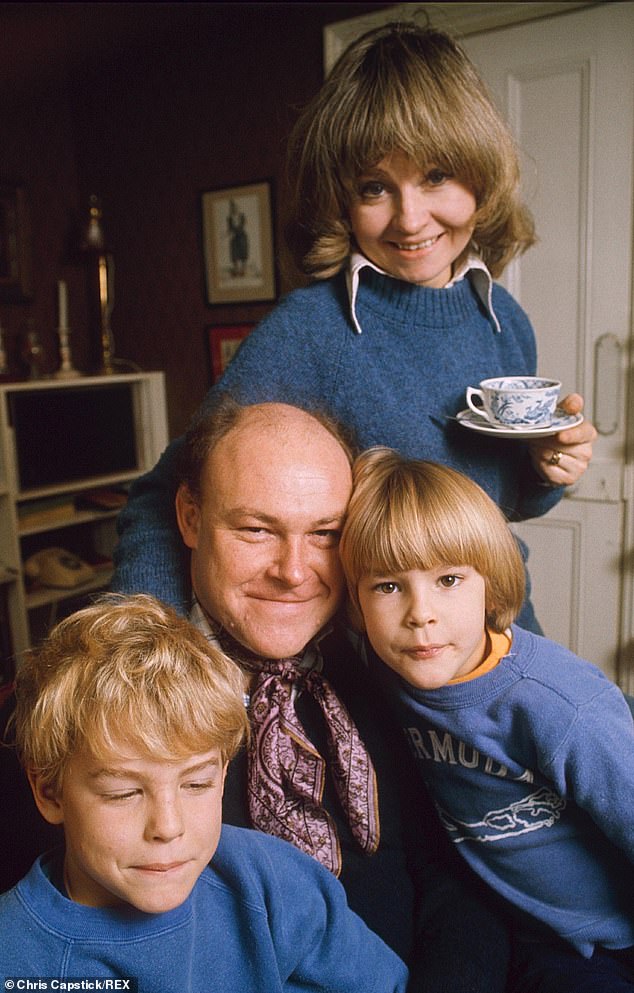
Prunella Scales her husband Timothy West and there two sons pictured in 1975
But whatever she was doing, people who recognised her in the street imagined they were meeting the real Sybil Fawlty and often expressed shock when she was neither stuck-up nor brusque.
Pru gave up explaining she thought Sybil was nice too, telling them: ‘I thought she was a saint and a heroine.’
The actress was born Prunella Illingworth in June 1932 in Surrey to well-off parents whose financial fortunes were on the wane.
According to family legend, her pregnant mother Bim played a trick on the village. She dressed up their cook, who was tiny, in a smock and asked her to sit in the pram. Then she trundled both pram and cook along the High Street, as a joke. Bim (short for her childhood nickname Bambino) was a frustrated actress herself, a former student at the Royal Academy of Dramatic Art.
Her husband John loved theatre too – and when Pru was six, her parents took her to see the ballet at Sadler’s Wells.
She was smitten and longed to be a ballerina. The following year, though, with the outbreak of war, the family were evacuated to rural Devon and dancing lessons were out of the question. Instead, Pru decided to be an actress.
By then, the Illingworths could no longer afford a cook. ‘My grandfather had been a prosperous Bradford merchant,’ Pru said, ‘but he fell on hard times. My father only ever had what he earned.’
After the war, they rented a farmhouse in Kent without gas, electricity or running water. Bim often read aloud to her daughter and they made jam together with fruit that grew in the garden.
One afternoon, spotting a pigeon pecking at the fruit, John grabbed his shotgun. He missed the bird with the first barrel but, as he hung the gun back up on its peg, the second barrel went off and blasted the ceiling – narrowly missing Bim in a room above.
After training at the Old Vic Theatre School, Pru quickly proved herself a versatile character actress, constantly in demand for repertory theatre and live television dramas. She was proud that, in her long career, she had only one spell of ‘resting’. Aged 30, she spent three months packing margarine tubs into boxes.
By then, she had met the great love of her life, fellow actor Timothy West – who died last November, aged 90 – on the set of a 1961 BBC costume drama called She Died Young. Tim played a young buck whose only line was, ‘Can’t say I blame him, sir – Dammee, she’s a morsel!’
Tim was unhappily married at the time, separated from his first wife Jacqueline after she had an affair. Chivalrously, he offered to take the blame for their divorce, which meant manufacturing evidence of his own adultery.
He and Pru, who was referred to in court papers as ‘Miss X’, booked a hotel room in Cheltenham and arranged for a private detective to discover them there.
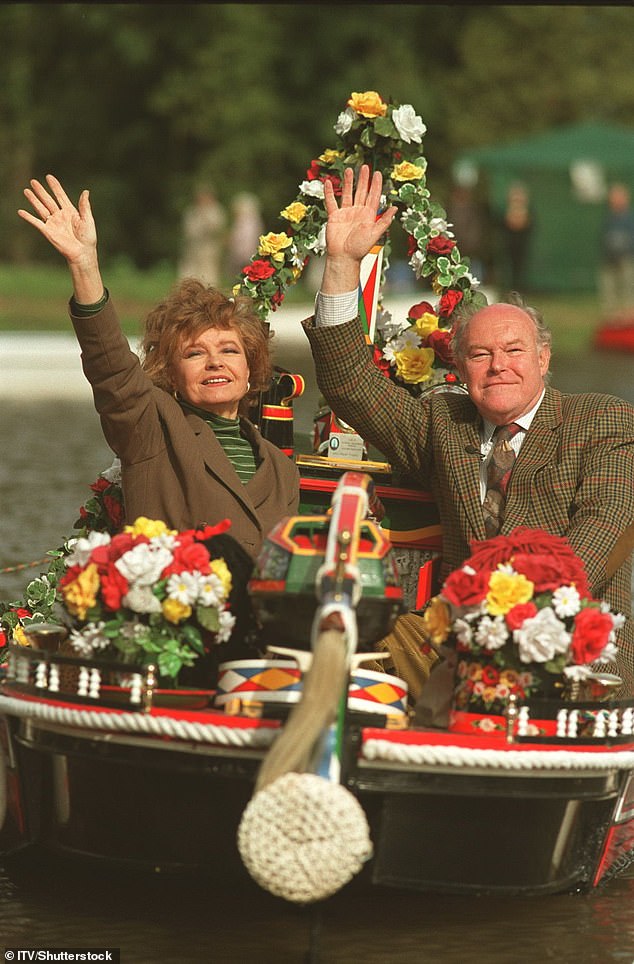
Prunella and her husband open a newly renovated canal basin in Gloucester in 2001
Miss X, however, had an early morning call for a film shoot, before the detective was willing to start work. So a workaround was agreed – the couple would leave ‘twin indentations on the hotel pillows, and an item of feminine nightwear on the bed’.
The divorce went through, and on the morning Tim received his decree nisi, they were together in Brighton. Sitting in the car at traffic lights, Pru asked whether they could now be engaged to each other. ‘Sorry,’ Tim replied, ‘of course – will you marry me?’
He slipped the ring on to her finger but, before they could kiss, the lights changed and they had to drive on.
An early spell on Coronation Street followed for Pru, and years of juggling stage work with motherhood. She and Tim had two sons, Samuel and Joseph, with a daughter, Juliet, from Tim’s previous marriage.
They were a devoted couple. ‘I hate being alone,’ she said. ‘When Tim’s away, I miss him dreadfully.’
She admitted she sometimes played recordings of his performances, and wept to hear his voice, adding: ‘One of the horrors of being so happily married for so long is that you wonder how on earth either one of you would cope without the other.’
In 1994, they published a collection of their love letters, titled I’m Here, I Think, Where Are You? They also admitted to volcanic rows in their passionate youth.
‘There was a notorious one early on,’ Tim confessed, ‘in which I apparently pulled out some of Pru’s hair, which she then kept in an envelope.’
Pru confirmed the story, saying: ‘I thought the hair was something I could reproach him with and say, “Look what you did last time we had a row”.’
All through their marriage, they retained a wicked flirtatiousness. In her 60s, Pru told an interviewer that Tim was keeping her awake all night and was aggrieved to be asked, ‘Why – does he snore?’
‘I was furious,’ she said. ‘My sex life is very much there, thank you.’
In the same irrepressible vein, she told the Daily Mail that she liked to keep Tim wondering whether she’d ever have an affair.
‘I think it’s highly unlikely Tim has been totally faithful to me all our married life,’ she declared – very much tongue-in-cheek and with an eye to teasing.
‘However, I’m prepared to give him the benefit of the doubt. I think he’d be awfully upset if he believed I’d ever been unfaithful. On the other hand, I think he might be ever so slightly bored if he thought I hadn’t. So I like to keep him guessing.’
Pru became the first actress to play Queen Elizabeth II on stage at the National Theatre, in Alan Bennett’s A Question Of Attribution, about royal art expert and traitor Anthony Blunt, in 1988.
‘I don’t think the Queen ever came and saw me play her in the theatre,’ she said, ‘but I believe she’s now seen the play on tape. When I got my CBE [in 1992] she made a quite sweet, quite gentle remark about it.’
With both Pru and Tim in constant demand in theatres all over the country, in the 1970s they came up with a novel solution for looking after and entertaining their children while keeping accommodation costs low – by taking to the canals of England.
The holiday hobby brought consolation when Pru was diagnosed with Alzheimer’s.
After a year in her one-woman show, An Evening With Queen Victoria, she began to have difficulty remembering her lines. By 2009, when she was 77, she made her last appearance on the West End stage.
But she and Tim, in the year of their golden wedding anniversary in 2013, began a series of narrowboat adventures for Channel 4 in Great Canal Journeys. Nearly 25 years earlier, they had been enthusiastic supporters for the renovation of the Kennet and Avon Canal, and had been the first to navigate its full 42-mile length after it reopened.
Now they made the trip again, and viewers seeing them as themselves for the first time immediately fell in love with their unfeigned affection for each other.
Their excursions took them all over Britain and then beyond, as far as Argentina and Vietnam.
The shows were loved by viewers, not only for their gentle pace and sometimes spectacular scenery, but for showing the truth about Pru’s dementia without despair or melodrama. Their travels ended in 2019, when Pru became too frail to continue, after more than 30 adventures. ‘The sad thing is,’ Tim said, ‘you watch the gradual disappearance of the person you knew and loved. If you live day to day, it is manageable.’
But the show, said Tim, enabled them to ‘make the most of our time together, doing the things we love’. And they gave us a personal insight into the love between them, one of Britain’s greatest acting couples… after more than 50 years together joyously happy in each other’s company.
Their marriage was a charming counterpoint to the simmering warfare between Sybil and Basil. When viewers understood what a completely different character Pru was, so very un-dragon-like, we also realised what a magnificent actress she was.