Incentives matter. In designing a health system, it is best to have incentives which encourage early diagnosis and early treatment, rather than ignoring things and leaving them to get worse.
It is best to have a system in which market signals can get through — where providers can respond to local demand and conditions and where they can bill according to the amount of effort involved in delivering a service.
And if you are going to have subsidies in a system it is certainly best for the subsidies to be based on clear and consistent principles — such as treating adults equally and ensuring that children are prioritised.
None of this applies in the way we deliver NHS dentistry in England. As a result NHS dentistry is a mess.
It is advised that people should see a dentist at least once every two years, and more in some cases, yet in the two years to the end of March 2024, 60 per cent of adults and 43 per cent of children — in total some 32 million people — had not seen an NHS Dentist.
As a result many people are forced to pay for private dentistry without any support from the NHS at all. Others take a more “hands-on” approach and engage in “DIY Dentistry.”
Many, though, just avoid going to the dentist at all.
Because people don’t go for check-ups, dental problems are left to get worse. Many health problems (including cancers) are missed until they have got far worse, and more people end up in emergency visits to hospital.
Over 49,000 children end up in hospital every year for emergency teeth extractions, along with a further 135,000 adults. This is on top of 600,000 medical practice admissions for dental issues.
A lot of people hold out hope of being able to get onto an NHS Dentist list — but the odds are against them doing so. 90 per cent of dental practices are not accepting new adult patients and 80 per cent are not accepting new children.
These problems are more pronounced in some parts of the country — notably the South-West, North-West, East of England and parts of Yorkshire. When it comes down to particular districts the evidence suggests that NHS dental provision tends to be skewed largely against the least well-off and more rural areas.
The source of all of these issues is the unwieldy and unworkable set of restrictions, price controls and subsidies which operate through the NHS dental contract.
Much like GPs, general dental practices are private businesses providing services to the NHS — or not as the case may be. Because NHS England imposes a particular set of prices which can be charged, and a particular set of subsidies for broad categories of dental activity which together are often well below market rates, a large number of dentists find that they cannot find a way to be financially sustainable in such a structure. This leads to many of them either reducing the hours they provide to NHS dentistry or opting out all together. As a result, of over 37,000 dentists there are only about 10,500 full time equivalents providing NHS services.
Even those who notionally have access to NHS dentistry may be reluctant to use it. Again, unlike most other NHS primary care services dentistry does have a cost (albeit a limited one) upfront — which acts as a deterrent to some people from going at all.
Rather than trying to make minor tweaks to a failing system as successive Governments have done over the past twenty years, at Policy Exchange we have developed an alternative which reworks the incentives and which allows market signals to operate — while also biasing the system significantly towards early diagnosis, prevention and early treatment.
Policy Exchange’s new report, “Pulling Teeth: fixing the gaps in dentistry” recommends that all adults be given a £150 dental voucher which they can take to any dental practice as a contribution towards the costs of treatment or which they could take to a dental insurer to pay for a policy. The report also recommends that all dentists should be required to provide dental treatment to children free at the point of use, reimbursed at the current NHS rates.
The proposed voucher would mean that the upfront costs associated with going to a dentist for check-up and early treatment could be completely eliminated for many people. Others would receive a substantial subsidy under the terms of their policy towards such check-ups and treatment. All of this would help to spot dental problems early and to stop them getting worse.
It would mean that millions of people who are getting no NHS dental support at all could save hundreds of pounds each year and save the NHS money too.
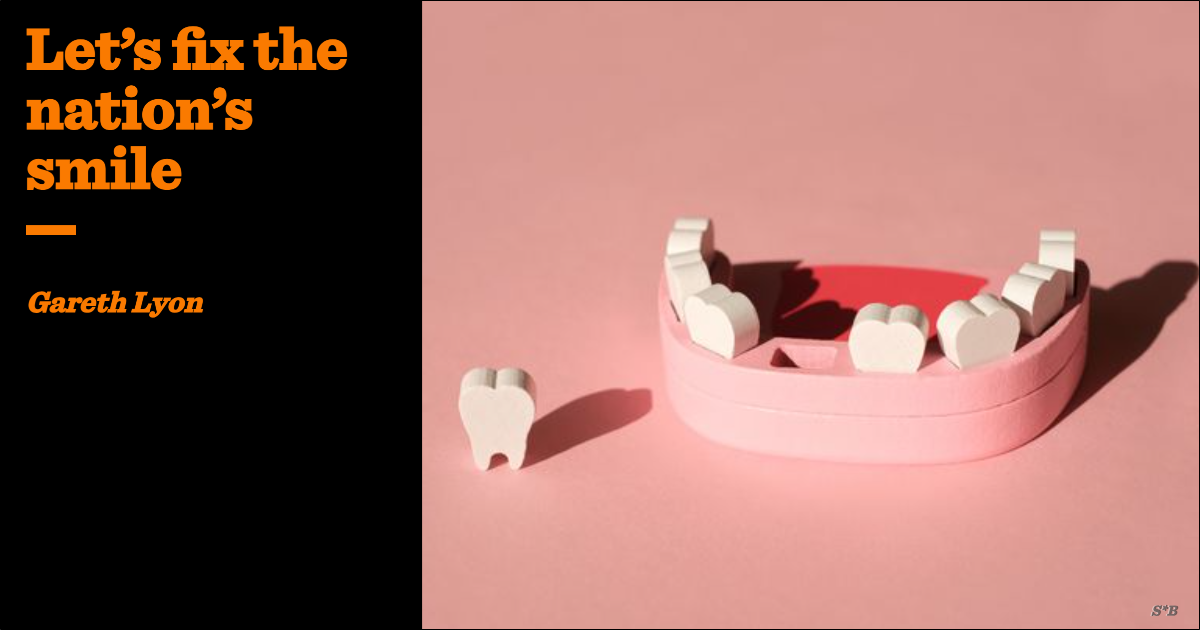
Fixing the nation’s smile … can be done
It would also mean that thousands of dentists could start to provide NHS supported services again to millions more people — providing all parts of the country with far more choice than we have now.
Fixing the nation’s smile doesn’t depend on some kind of Christmas miracle — and it can be done. It will, however, require some major surgery to a rotten system and a willingness to get the incentives right.