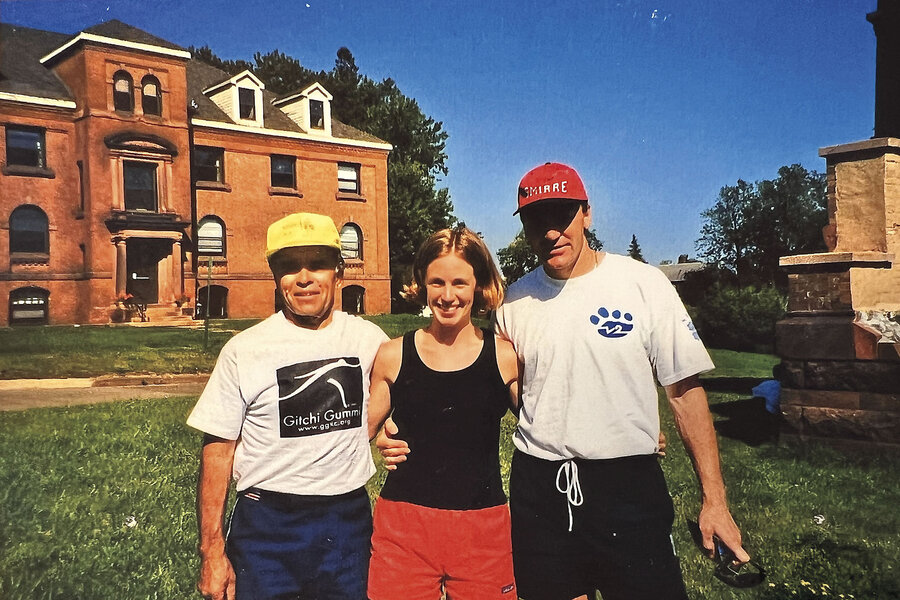
My Olympic dreams were forged first in the glow of our little black-and-white TV, and then in the crucible of a training regimen honed by a man from Siberia.
My dad shipped me out to Duluth, Minnesota, as a teenager to meet Nikolai Anikin, who would become my coach for the next five years as I made a bid for the 2002 Games.
He was born in Ishim, halfway between Ukraine and Mongolia, where he attended Railway School 13. From those humble beginnings, he went on to ski in the 1956 Games’ 4×10 kilometer relay in Cortina d’Ampezzo, Italy, bringing home gold for the Soviet Union in its debut on the Winter Olympics stage. As the torch is about to be lit in Italy again, Nikolai shines in my memory as the epitome of the Olympic spirit.
He pushed us to bound up Alpine ski slopes in summer, run for four-plus hours in the woods, and do “speeeeecial Russian exercise” – i.e., the wheelbarrow – at early morning practices.
He loved to tell us about his breakout year. “My friends, they go in the dance, they go in the movies, but I am practice, practice, practice in the stadium. … And next year, I have 1 1/2 minute advantage, 10km race!”
I heard this and other skiing tales many times. But it was the stories I heard after he died in 2009 that gave me a deeper appreciation of the spirit that both impelled and transcended his achievements. The Monitor’s fixer and translator in Moscow, Olga Podolskaya, generously helped me by collecting reminiscences from his former athletes.
“All my merits are his merits,” said Vladimir Voronkov, a 1972 Olympic gold medalist. “I am grateful to destiny for my acquaintance with such a fine person. Intelligent, soft, sociable, he – without raising his voice – could convince anybody with his arguments.”
We heard about Nikolai’s delight in the forest – “Only a deer goes in this place!”; his friendliness when he started coaching in America, on a ski-team exchange before the Iron Curtain came down; his forgiveness when someone crushed his most prized asset – a Jeep Cherokee.
But it’s what Vyatcheslav Vedenin, one of his athletes, said that means the most to me now as editor: “He was a very human person, but a rigid, exigent coach.”
Even as I apply that Nikolai-inspired sense of discipline and rigor to our journalism, I am reminded of his example of wonder, friendship, and forgiveness. He is proof that exigence and love are not contradictory but complementary.
And so, even as we are about to watch new gold medalists be crowned, I have to agree with another friend of this unassuming coach: “Nikolai is one of the few truly great men I know.” That’s an Olympic standard we can all aspire to – whether or not we start each morning by doing “speeeeecial Russian exercise.”