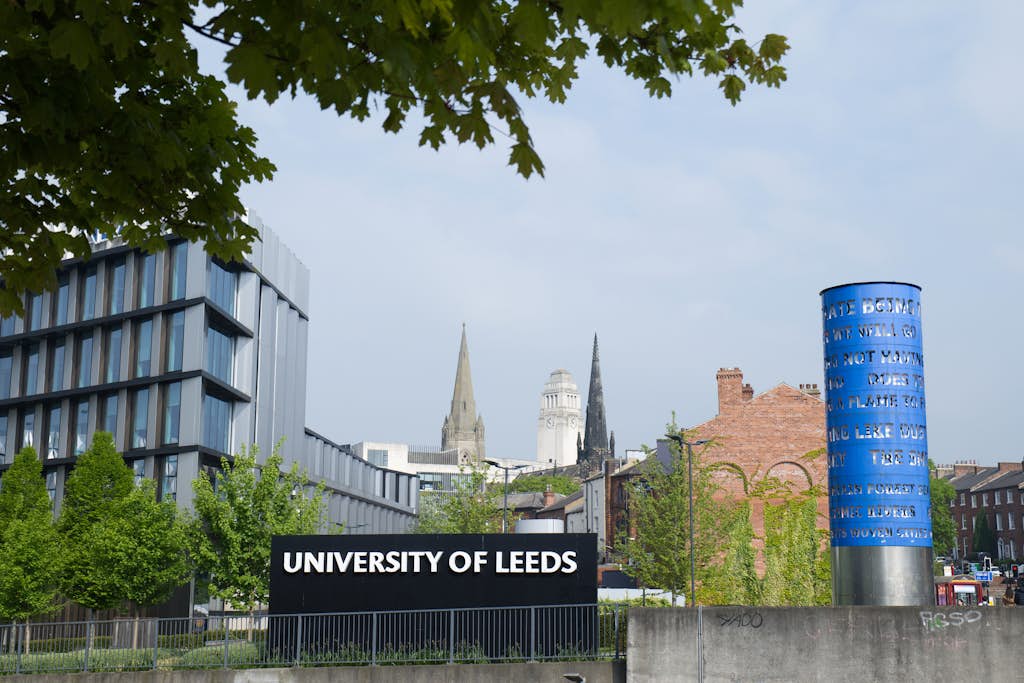
The University of Leeds has introduced a sweeping “decolonising” programme that requires academic departments to embed its principles across their core academic activity, in a move that places the institution on a potential collision course with the recently commenced Higher Education (Freedom of Speech) Act (“HEFSA”).
Documents seen by the Committee for Academic Freedom (CAF) show how the policy operates in practice. Under the university’s “Decolonising Framework”, every department must demonstrate how it has applied ideologically prescribed principles across teaching, research and promotion, with compliance monitored through action plans, checklists and the naming of staff responsible for implementation.
The initiative forms part of a broader “decolonising” drive and offers yet another example of how English universities — including Durham, Nottingham, KCL and UCL — are failing to take seriously their statutory duties to promote free speech and protect academic freedom under HEFSA.
Although the term “decolonisation” is often understood as a reflective reconsideration of curricula, Leeds’s framework transforms it into a set of institutional obligations. By requiring departments to submit “evidence of activity”, appoint staff responsible for decolonising work, and embed decolonial expectations across every aspect of academic and administrative life, the university risks turning an intellectual exercise into a bureaucratic duty — institutionalising ideological compliance in the process.
Leeds’s policies create a system of bureaucratic oversight that leaves little room for intellectual independence
According to a senior member of the university who spoke to CAF, “Every School/Dept has been provided with a checklist around ‘inclusive practice’”. One requirement is that “all programmes include spaces for questioning colonial legacies and their contemporary implications”.
Heads of department must confirm that this provision has been incorporated into their “School Action Plan” or “Inclusive Action Plan”. A simple “yes” will not suffice. The checklist also demands “evidence of activity” and the names of staff responsible for implementation. Its introduction explains that the measure forms part of efforts to achieve six institutional priorities for the 2025 — 26 academic year: “inclusivity, accessibility, inclusive assessment, decolonising and belonging.”
As part of this agenda, Leeds has produced a detailed “Decolonising Framework”, setting out the project’s core tenets. These include questioning “the origins of the knowledge taught and the colonial legacies that are replicated within”, challenging “the presence of a hidden curriculum of assumed knowledge that unfairly disadvantages many”, and working “proactively to rebalance such unequal power dynamics”.
An accompanying document, Decolonising Framework — Key Principles, goes further. One principle states that decolonising “will be facilitated by schools and services and later reviewed through the inclusion of questions on decolonial practices in all university learning and teaching quality assurance mechanisms — including module and programme approval”. In other words, course approval now appears to depend on adherence to an explicitly ideological framework.
Even these few brief quotes make clear that the framework borrows heavily from the language of contemporary “decolonial” and “anti-racist” theory, which views knowledge itself as a site of structural inequality to be exposed and corrected. In effect, Leeds has elevated this contested body of thought from an academic perspective to an institutional doctrine, requiring staff to apply its assumptions across teaching, assessment and research. That is particularly problematic given that the Office for Students (OfS), the sector regulator, has issued new guidance under HEFSA cautioning that “academic staff should not be constrained or pressured in their teaching to endorse or reject particular value judgements”.
Staff who comply with these requirements and reshape their curricula to achieve “racial literacy” are rewarded with the university’s “Decolonising Mark”. The principles describe this as an “institutional-level recognition” for modules taught and assessed “using decolonial pedagogy”. Those less persuaded are offered what Leeds calls an “enhanced programme of decolonisation training”, covering topics such as “anti-racist pedagogies and practice”, “Whiteness in the Academy” and “Allyship”.
But is the institutional equivalent of a merit star for being a good little pupil, the only thing on offer for those who sing along with the most evangelical fervour during school assembly?
Not quite. Across its extended decolonisation framework, the university is not only breaching the principle of institutional neutrality — for instance by making critical race theory-inflected pledges to “develop intersectional, decolonial and racially literate research” — but also constructing a reward structure for ideological acquiescence, promising to “recognise and reward decolonial research and decolonial ‘work’ in our promotion and recognition schemes.”
The same compliance-driven approach runs through the Key Principles document. On the webpage introducing it, Leeds declares itself “committed to embedding these principles in all taught student education provision” and says they have been created to “help you decolonise your teaching”. The university also promises to “support staff” to “actively work to decolonise their curriculum and educational practices to consider the legacies of colonialism, unequal power dynamics and discrimination that they may contain”. Help staff and support staff, yes — but also reward them: the document adds that the university will “value decolonising work explicitly”, including in “recruitment and promotion criteria”.
This intention to favour certain viewpoints during promotion decisions appears to conflict directly with the new law. The OfS is explicit that universities must ensure that “where a person applies for academic promotion, the person is not adversely affected in relation to the application because they have exercised their freedom within the law to question and test received wisdom, or to put forward new ideas and controversial or unpopular opinions”.
Taken together, Leeds’s policies and guidance create a system of bureaucratic oversight that leaves little room for intellectual independence.
It is remarkable that any university with even a passing grasp of free-speech law, dating back to the Education (No. 2) Act 1986, would have considered such principles appropriate. That they continue to operate despite the commencement of HEFSA only underscores the problem. The University of Leeds appears not yet to have grasped a crucial point: equality, diversity and inclusion initiatives, must now be balanced against new statutory duties to promote free speech and protect academic freedom — duties now enforced by a regulator with real teeth.