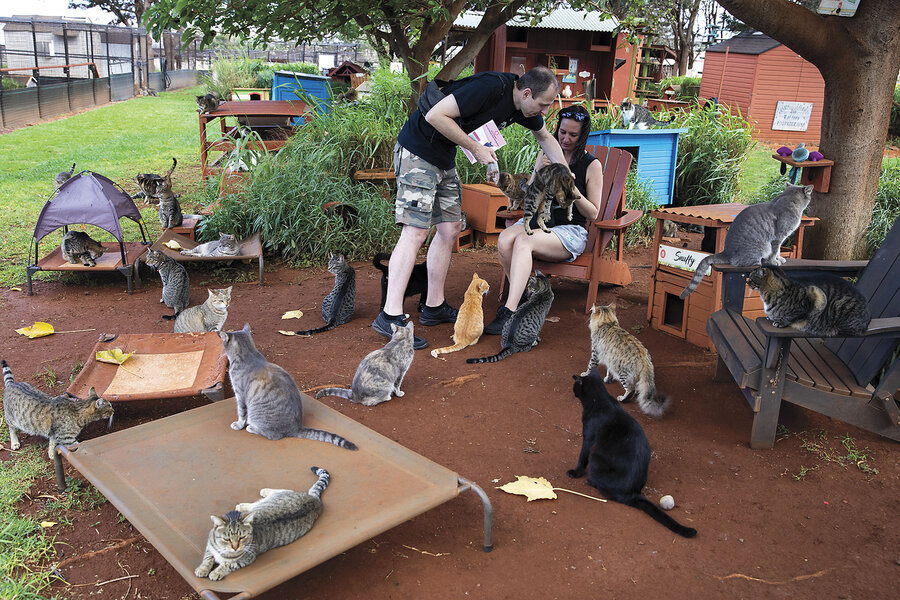
The greetings begin as the guests arrive. Soft mews. Exuberant meows. Lyrical purrs.
But these aren’t totally selfless acts of hospitality. The cats know their incoming visitors are treat purveyors. Humans who enter their enclosures at Lanai Cat Sanctuary come armed with staff-approved goody bags bound to attract affection. Four-legged friends saunter up to guests, begging for delicious morsels and maybe some head rubs. The shy cats hang back, with some lounging on benches, curling up in trees, or sleeping peacefully in small condos.
Call it a cat-lover’s paradise in paradise. This four-acre, open-air haven exists on the Hawaiian island of Lanai.
Why We Wrote This
Lanai Cat Sanctuary started in an unused horse corral and transformed into a series of homey enclosures fit for more than 700 cats. This safe space for felines, in turn, provides protection for the island’s vulnerable feathered inhabitants.
“This place is made for feral cats to become friendly,” says Joe Adarna, the sanctuary’s director of operations.
Decades ago, Lanai contained the world’s largest pineapple plantation. Today, billionaire Larry Ellison owns roughly 98% of land on this mostly undeveloped and rugged island bursting with pine trees. About 3,000 people call Lanai home, and only Hotel Lānaʻi and two Four Seasons resorts operate here. But every year, thousands of tourists make day trips, usually by ferry, to visit the sanctuary, where more than 700 cats live.
The sanctuary’s purpose is twofold — protect bird species while saving cats. And it all started with one kitten.

Melanie Stetson Freeman/Staff
“Look in the mirror and do something”
Kathy Carroll needed help. In the early 2000s, a kitten that had been hit by a car wound up in her care. But no veterinarian lived on the island. So Ms. Carroll boarded a ferry, with the tiny cat in tow, and headed to Maui. The kitten survived.
While on Maui, Ms. Carroll mentioned Lanai’s swelling population of unsheltered, hungry cats that no one seemed to be helping. The veterinarian’s response: “Maybe you should look in the mirror and do something.”
The blunt advice set in motion an effort to trap and spay or neuter the island’s roaming felines. By 2006, however, the discovery of endangered Hawaiian petrels at a higher elevation on Lanai fast-tracked the desire for a physical sanctuary. The seabirds typically lay one egg per year in a ground burrow, making them particularly susceptible to feral cats.
The sanctuary started in an unused horse corral until it moved to its current location in 2009, Ms. Carroll says. Over time, the sanctuary’s land – once littered with old car parts and discarded refrigerators — transformed into a series of homey enclosures fit for each cat. Older cats, for instance, have their own fenced-in areas, as do cats with special needs.
The safe space for the cats, in turn, provides protection for the island’s vulnerable feathered inhabitants, including the wedge-tailed shearwater, the Hawaiian coot, the Hawaiian stilt, and the Hawaiian petrel.
Hawaii is an island ecosystem in which birds evolved without the presence of feline predators, says Grant Sizemore, director of invasive species programs for the American Bird Conservancy. He credits Lanai Cat Sanctuary with playing a “valuable role” in protecting vulnerable birds.

Melanie Stetson Freeman/Staff
“As long as cats are roaming the environment, whether they’re owned or unowned, whether sterilized or not sterilized, they remain the essential threat to Hawaii’s native birds,” he says.
The sanctuary reduces the number of roaming cats on the island. The site is “kind of rare,” Ms. Carroll says. “In a lot of communities, the cat people and the bird people are in conflict.”
Don’t expect to find much, if any, cattiness here. The nonprofit’s leaders say fights among the felines are rare. There’s no need to be territorial. The cats have enough nourishment (120 pounds of dry food and 100 cans of wet food per day total), plenty of room (70,000 square feet of enclosed spaces), and, for those who want it, lots of attention (12,000 or more visitors a year).
The cost to keep the operation afloat: $2 million per year, most of which comes from donations. Cat-lovers can send money for specific purposes, such as sponsoring a cat or one of their cozy dwellings. For the latter program, dubbed “Rent a Piece of Purr-adise,” donors earn naming rights to a cat bungalow on the property.
Mr. Adarna says the public has shown consistent generosity. If he indicates a need online, the local post office is swamped with packages.

Melanie Stetson Freeman/Staff
“Pawsitivity”
On the gently inclining, red-dirt road leading to the sanctuary, signs welcome visitors and rescued cats alike:
Ready for some pawsitivity?
Paw-some for you to join us
Are you good at chin rubs?
Enter with a happy heart
Every year, the nonprofit takes in 150 to 200 cats, most of whom come from Lanai. An exception occurred in August 2023 after a deadly blaze swept through Lahaina, a city on Maui’s northwestern coast. The sanctuary opened its arms to 220 cats rescued postfire by the Maui Humane Society. In exchange, that organization agreed to take 220 adoptable cats from Lanai Cat Sanctuary over the next few years, Mr. Adarna says.
Some cats live out their remaining time at the sanctuary. But the true aim of sanctuary workers – who give the cats unique names – is to socialize them better and help each one find a loving forever home.
“As they get older, it’s so much better to have a couch and a family,” Mr. Adarna says.
The sanctuary facilitates anywhere from 50 to 100 adoptions each year, with new homes as far-flung as New York and Florida. Some of those bonds begin when visitors meet a special four-legged friend at the sanctuary.
Other visitors come for the cuddles and leave with happy memories. A few have even departed with wedding rings. About a dozen couples have gotten married at the sanctuary, with a guest list accommodating any cats that want to show up for the nuptials.
On this late October day, Tom and Kristina Rayder – who have three cats at home in Chicago – are celebrating their five-year wedding anniversary at the sanctuary. He’s wearing a cat-themed Hawaiian shirt; he and his wife both have cat tattoos.
“We’re just crazy cat people,” Ms. Rayder says, laughing while surrounded by – you guessed it – cats.

Melanie Stetson Freeman/Staff

Melanie Stetson Freeman/Staff

Melanie Stetson Freeman/Staff

Melanie Stetson Freeman/Staff