The two men charged with getting Israel and Hamas to agree to a ceasefire have revealed what it took to get Israeli Prime Minister Benjamin Netanyahu to apologize to Qatari officials for a deadly attack on Hamas targets in the country.
President Donald Trump‘s son-in-law Jared Kushner and Special Envoy Steve Witkoff told how the American president was left furious by the surprise attack on Doha on September 9, which he feared could derail peace talks as lead Hamas negotiator Khalil al-Hayya’s son was among those killed.
Following the attack, Hamas leaders went ‘underground’ – abruptly halting the talks that Kushner and Witkoff had been holding with negotiators just one day prior, the pair said in a 60 Minutes interview that aired Sunday night.
‘The apology needed to happen,’ Witkoff said. ‘We were not moving forward without the apology and the president said to [Netanyahu], “People apologize.”‘
Trump then held the phone for Netanyahu on September 29 as he read a scripted apology to Qatari leaders from the Oval Office.
He also gave Qatar a new security guarantee – and even allowed Kushner and Witkoff to speak directly with Hamas officials, despite the United States designating the group as a terrorist organization.
The two then traveled to Egypt on October 8, where they met with al-Hayya.
Despite their differences, Kushner and Witkoff were then able to make some headway in the negotiations when Witkoff spoke about his own son, Andrew, who died of an opioid overdose at the age of 22.
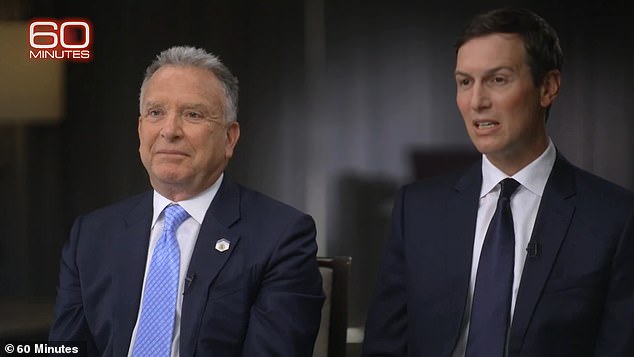
Special Envoy Steve Witkoff (left) and Trump’s son-in-law Jared Kushner (right) spoke about the hurdles they faced trying to negotiate a peace deal between Israel and Gaza in an interview with 60 Minutes that aired Sunday night
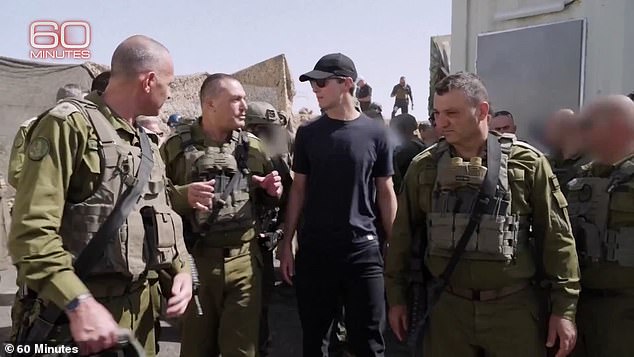
They shared how Trump allowed them to speak with Hamas officials directly, despite the United States categorizing the group as a terrorist organization. Kushner is pictured here with members of the Israeli Defense Forces in Gaza
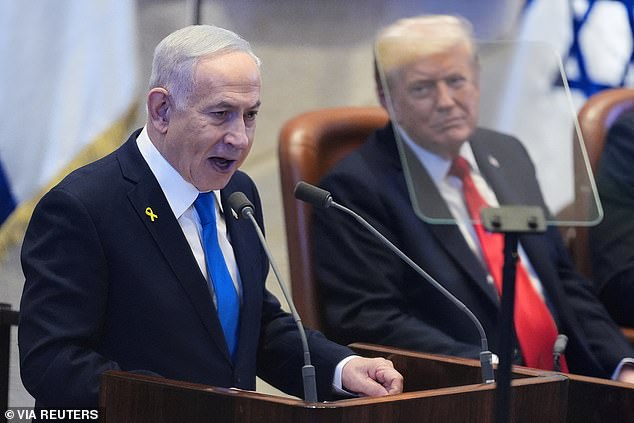
President Donald Trump forced Israeli Prime Minister Benjamin Netanyahu to apologize to Qatari officials following a deadly attack on the country striking Hamas officials
‘We expressed our condolences to him for the loss of his son. He mentioned it,’ Witkoff recounted. ‘And I told him that I had lost a son, and that we were both members of a really bad club, parents who have buried children.’
At that moment, Kushner said ‘it turned from a negotiation with a terrorist group to seeing two human beings kind of showing a vulnerability with each other.’
Once an understanding was struck, Kushner and Witkoff were able to assure Hamas that the United States would stand behind its deal and that Trump would not allow the deal to be violated.
When the deal was then reached, Witkoff said Israelis and Qataris – who were acting as the liaisons for Hamas – hugged.
‘I thought to myself, “I wish the world could’ve seen it,”‘ Witkoff said.
If Netanyahu did not apologize, though, the entire plan could have fallen apart, Witkoff and Kushner said.
They noted that Trump was oblivious to the prime minister’s plan to strike Doha and they ‘felt betrayed’ by the attack.
‘I think he felt like the Israelis were getting a little bit out of control,’ Kushner said. ‘It was time to be very strong and stop them from doing things that he felt were not in their long term interest.’
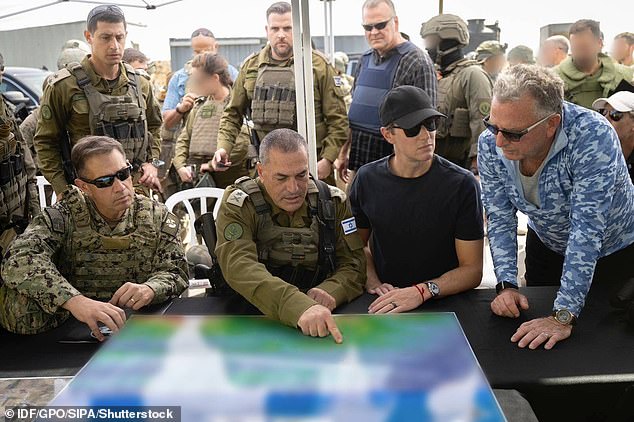
Trump allowed Kushner and Witkoff to speak directly with Hamas – even though it is designated as a terrorist group
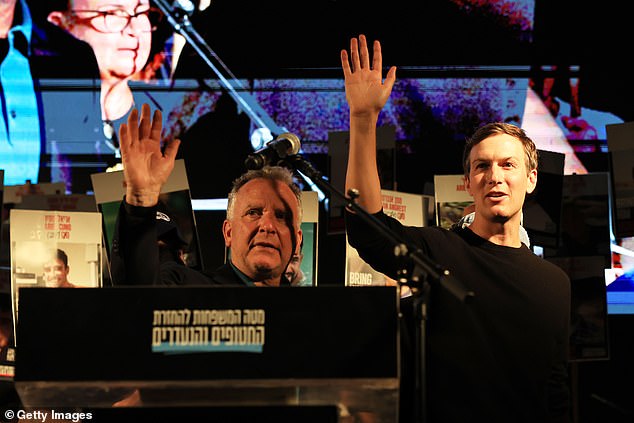
Witkoff and Kushner are pictured speaking to a crowd after hostages were released in Israel
The top US officials said the targeting of the very leaders that they were actively negotiating with was seen as a red line that Netanyahu dared to cross.
‘It had a metastasizing effect,’ Witkoff said.
‘The Qataris were critical to the negotiation, as were the Egyptians and the Turks, and we had lost the confidence of the Qataris.
‘And so Hamas went underground, and it was very, very difficult to get to them.’
Witkoff said losing the Qataris in that moment almost sunk their hopes of achieving a peace deal, because after the strikes in Doha, ‘it became very evident how important and how critical that role was.’
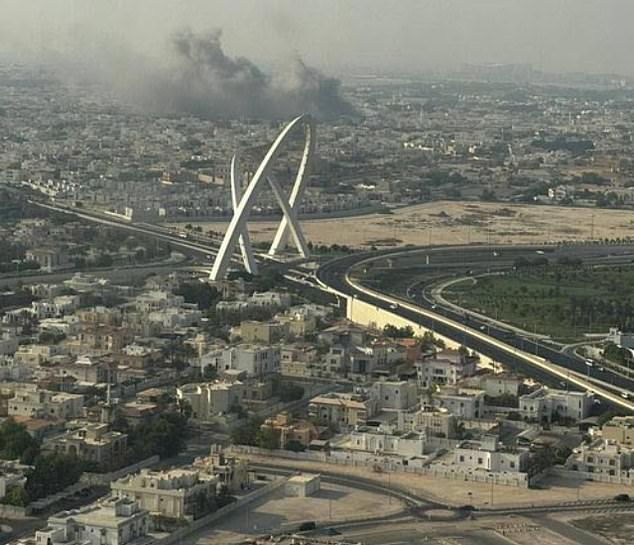
Smoke rises after blasts were heard in Doha, Qatar on Tuesday, September 9, 2025
Images of smoke billowing over the Qatari capital last month stunned the world and caught leaders off guard, as it marked the first time Israel had ever attacked Qatar – a nation that Trump has grown increasingly close to in recent times.
Just months before, Trump announced that he had accepted a $400 million Boeing 747 luxury jet from the Qataris as a gift, and many in the president’s inner circle – including Kushner – have an array of business interests tied to the nation.
Trump quickly showed his disapproval of Netanyahu’s unexpected move in Doha.
Taking to Truth Social hours later, Trump wrote that he ‘immediately directed special envoy Steve Witkoff to inform the Qataris of the impending attack, which he did, however, unfortunately, too late to stop the attack.’
‘I view Qatar as a strong ally and friend and feel very badly about the location of the attack,’ Trump wrote.
‘I want ALL of the hostages, and bodies of the dead, released, and this War to END, NOW!’
Trump’s 20-point peace plan was signed in Sharm el-Sheikh, Egypt on October 13 to mark the end of the two-year Gaza war.
The accord has reunited families torn apart by the October 7, 2023, Hamas terror attack and is being hailed as one of the most significant breakthroughs in decades, even as questions linger over how long the truce will last.
Soon after the peace deal was struck on October 13, shocking images emerged showing Hamas executing Palestinians that it perceived as ‘collaborators’ with Israel.
The move sparked fears that the peace deal could fall apart soon after it was reached, and in Witkoff and Kushner’s sit-down with 60 Minutes, Kushner said the actions were horrific, but not surprising.
‘Hamas right now is doing exactly what you would expect a terrorist organization to do, which is to try to reconstitute and take back their positions,’ Kushner said.
‘The success or failure of this will be if Israel and this international mechanism is able to create a viable alternative.
‘If they are successful, Hamas will fail, and Gaza will not be a threat to Israel in the future.’