Plans for the largest deportation operation in U.S. history rely on an institution whose leader the president fired this week.
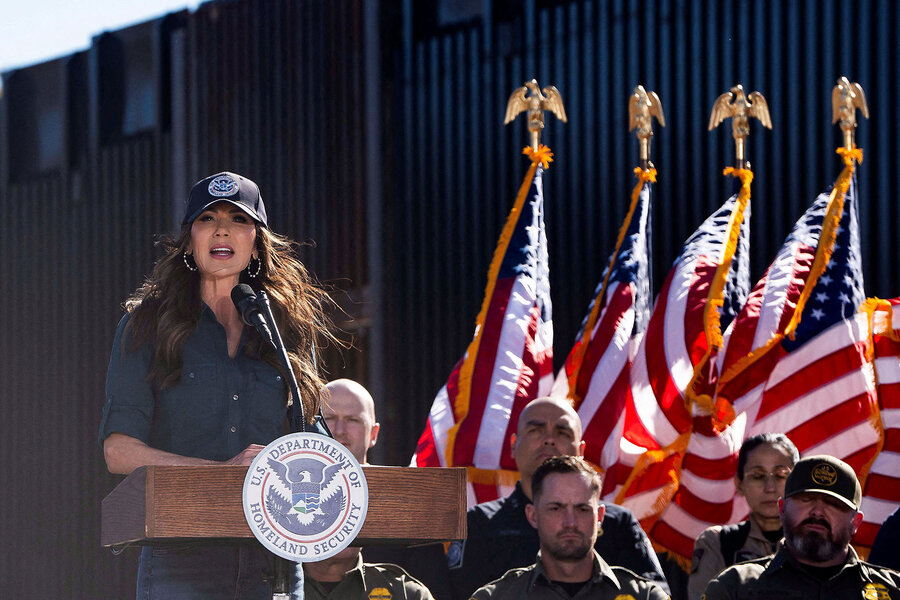
Donning flak jackets and cowboy hats, Homeland Security Secretary Kristi Noem appeared in several videos over the past year defending agents and urging unauthorized immigrants to leave. Among other controversies, that self-promotion appears to have factored into President Donald Trump’s loss of confidence in her.
Ms. Noem’s demotion to become a “special envoy” for a new security initiative is the first Cabinet-level shakeup of Mr. Trump’s second term. The former South Dakota governor had drawn sharp criticism from Republicans in Congress over her leadership as well as her stewardship of taxpayer funding. Her ouster leaves the sprawling Department of Homeland Security in a leadership flux as it enters the fourth week of a funding shutdown – and stands alert for threats as the U.S. continues bombarding Iran.
Why We Wrote This
Kristi Noem’s firing as Secretary of Homeland Security is President Donald Trump’s first Cabinet shakeup of his second term. The challenges she faced leading a critical agency at a time of public polarization remain for her successor to navigate.
The leadership shift also arrives at a moment when members of Congress and the American public are engaged in vigorous debates over the role and future of DHS, following its rollout of an aggressive immigration enforcement campaign that resulted in federal agents killing two U.S. citizens in Minneapolis in January. Democratic leadership in the Senate is withholding funding to demand agency changes. Public polling shows disapproval among a majority of U.S. adults in Immigration and Customs Enforcement, a DHS agency.
At the department’s headquarters, “The biggest problem it faces right now is legitimacy among the American public,” says Henry Brady, professor at the Goldman School of Public Policy at the University of California, Berkeley. Beyond a perceived lapse in ethics, he says, many Americans “don’t think the culture that’s been created in places like Minneapolis is a good culture for any agency.”
The president has tapped GOP Sen. Markwayne Mullin of Oklahoma as his next choice to be DHS secretary, with an expected March 31 start. The role requires Senate confirmation, which appears likely.
The next secretary will wade into the same challenges Ms. Noem faced over how to lead an agency overseeing immigration enforcement, disaster relief, border enforcement, and airline security, at a time of public polarization.
A secretary’s rise and missteps
After Ms. Noem’s stints as a state and federal lawmaker, South Dakotans elected her as their first female governor in 2018. During the Biden administration, she dispatched her state’s National Guard to the southern border to help fend off what she called a national security crisis stemming from high rates of illegal crossings.
Since her early days as DHS secretary, she featured prominently in the Trump administration’s social media videos and ads – from urging unauthorized immigrants to “self-deport” to standing before detainees in a Salvadoran prison.
Though illegal migration had already begun to fall during President Joe Biden’s final months in office, Ms. Noem and other Trump officials touted their own successes along the border early on. Border Patrol encounters, a proxy for illegal crossings, fell from thousands per day under the past administration to thousands a month now.

Under Ms. Noem’s leadership, “we saw mass deportations, record drops in border crossings, and the true end of catch and release,” the National Border Patrol Council said in a post noting her departure.
But she could not overcome scrutiny of DHS’ immigration enforcement tactics and her own public profile.
Ms. Noem had “obviously become a problem for the administration. So politically, [her firing] was overdue,” says Mark Krikorian, executive director at the Center for Immigration Studies. After reports of infighting between Ms. Noem and other DHS top brass, Mr. Krikorian says, the question is whether the incoming secretary will let border czar Tom Homan and “the other career professionals do their job.”
As Ms. Noem leaves, Democrats in Congress don’t expect much to change.
“Changing the name on the door will not change the policies, the abuses, or the Trump administration’s rejection of congressional oversight,” Democratic Rep. Raja Krishnamoorthi of Illinois said in a statement. “The American people deserve a Department of Homeland Security that respects the rule of law and answers to the public. We must abolish Trump’s ICE.”
In a way, surges in interior enforcement and deportations have overshadowed the administration’s achievements at the border, says Doris Meissner, director of the Migration Policy Institute’s U.S. immigration policy program.
The exporting of aggressive arrest tactics to city streets further north – such as Los Angeles, Chicago, and Minneapolis – “turned the tables in ways that ultimately [have] led to Kristi Noem being fired,” she says.
Pushback mounts
Beginning late last year, roughly 3,000 federal law enforcement agents surged to the Twin Cities area of Minnesota, where two Americans were fatally shot in January. DHS officials immediately claimed the acts were self-defense.
Ms. Noem took heat – including from some Republicans – for likening the slain citizens’ actions to domestic terrorism. Since mid-February, Democratic lawmakers have demanded reforms to immigration enforcement before voting to fund DHS. Critics of the holdup say the funds are especially vital to national security now, given a heightened threat environment amid the war in Iran.
The funding debate continued over testy exchanges with Ms. Noem in Congress this past week. Lawmakers, including Republicans, scrutinized reports of potential conflicts of interest and lack of transparency. They probed some of the department’s contracts, including for the “self-deportation” ad campaign. Republican Sen. John Kennedy of Louisiana challenged the secretary on the ads’ origins.
“You’re testifying that President Trump approved this ahead of time? Is that my understanding?” asked the senator.
“We had conversations about making sure that we were telling people –”
“No ma’am,” the senator cut her off. “I’m asking ya, sorry to interrupt – but the president approved ahead of time you spending $220 million running TV ads across the country in which you are featured prominently?”
Ms. Noem affirmed again and noted “how effective” the ads had been.
“Well, they were effective in your name recognition,” said the senator. “To me, it puts the president in a terribly awkward spot.”
Mr. Trump has denied the secretary’s account of the ads, which reportedly angered him. “I never knew anything about it,” he told Reuters.
Democratic Sen. Richard Blumenthal of Connecticut has called for a perjury investigation into whether Ms. Noem lied under oath to Congress about contracts for advertising campaigns.
Separate accusations had been piling up for weeks, including internal frustrations with the secretary’s leadership and her alleged affair with a DHS adviser (Ms. Noem has called the rumor “tabloid garbage”). Then, in a March 2 letter to Congress, the DHS Inspector General Joseph Cuffari claimed that the department had “systematically obstructed the work” of his office over the past several months.
Mr. Cuffari alleged several instances in which DHS agencies denied the watchdog access to data. DHS did not immediately respond to a request for comment on the inspector general’s claims.
“There are oversight mechanisms. They’ve not been properly utilized,” says Daniel Altman, the former head of investigations at the Office of Professional Responsibility at Customs and Border Protection, which falls under DHS.
Since he left the administration last year, Mr. Altman has raised transparency concerns around his former agency’s handling of the death of Alex Pretti in Minneapolis at the hands of CBP personnel.
DHS officials need to rely on oversight protocols established by Congress and promote transparency, he says. “That will win back people’s confidence.”
“Trying to manage the whole”
Leadership shakeups aren’t new at DHS, which spans border and airport security, disaster funding, and the Secret Service.
During the Biden administration, the House impeached Secretary Alejandro Mayorkas for his handling of the southern border. (The Senate dismissed the charges.) During his first term, Mr. Trump rotated through several secretaries in the post. Observers say DHS is an especially challenging Cabinet-level department to run.
“It’s an aggregation of disparate pieces that were put together in sort of a forced marriage after 9/11,” says Professor Brady, who is also a past president of the American Political Science Association. “Each successive secretary has struggled with trying to manage the whole.”
Restructuring the department is an option – but unrealistic, given the difficulties of such an enormous undertaking, says Ms. Meissner, a former head of the Immigration and Naturalization Service, which predated DHS.
Despite the secretary’s range of responsibilities, she says, “Leadership tone does matter.” Ms. Noem “made some very serious mistakes and misjudgments.”

Nathan Howard/Reuters/File
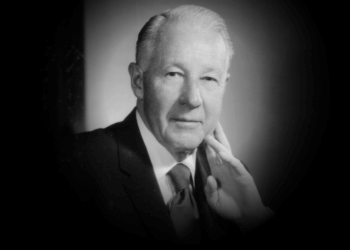
Mr. Mullin, the Oklahoma senator, on Thursday expressed a mix of surprise and gratitude for Mr. Trump’s nomination for the job. A plumbing business owner, he also has a ranching background, like the outgoing secretary. During the Jan. 6, 2021, attack on the U.S. Capitol, he helped barricade a door in the House chamber against rioters seeking entry.
Senator Mullin has defended the administration’s immigration crackdown. Yet if confirmed, he will inherit DHS at a time when the public has soured on interior immigration enforcement, polling shows.
Mr. Mullin’s home state, where every county voted for Mr. Trump in 2024, has shown similar fissures in support. While Oklahoma has touted close collaboration with ICE, Republican Gov. Kevin Stitt has questioned the “endgame” of interior raids and mass deportation. The mayor of Oklahoma City, also a Republican, commended property owners who he said walked away from a potential deal with DHS to use their sites as an ICE facility.
While the administration might be concerned about optics, it doesn’t appear open to changing mass deportation policy, says Ms. Meissner.
She would advise Mr. Mullin to recognize that deporting the “worst of the worst” criminals from the country “can only be carried out effectively by a much more targeted enforcement effort,” she says.
Staff writer Caitlin Babcock contributed reporting from Washington.