On Thursday, with little evident concern in the White House, the last surviving nuclear arms agreement between the United States and Russia is due to expire.
President Donald Trump, who said recently he was relaxed about the pact’s ending, could yet shift direction and agree to Russian leader Vladimir Putin’s proposal to extend the 2010 New START treaty for another year.
That would avoid a likely new drive by both countries, which together hold nearly all the world’s nuclear weapons, to deploy additional warheads.
Why We Wrote This
As a key nuclear arms agreement is set to expire, the world ponders what kind of arms-control architecture needs to be built to address the geopolitical challenges of the 21st century.
But if that’s the most obvious risk, it might not be the most important.
That’s because New START represents the last thread in a fabric of nuclear diplomacy woven over the past half-century: the mutual recognition by Washington and Moscow that it was in their interest – and the world’s – to engage in arms control; to hold hundreds of hours of tough, detailed talks; to build up a modicum of confidence and trust.
All with the aim of minimizing the danger that a misunderstanding or miscalculation by either side could ignite nuclear war.
The stakes in abandoning that shared approach have been getting ever higher.
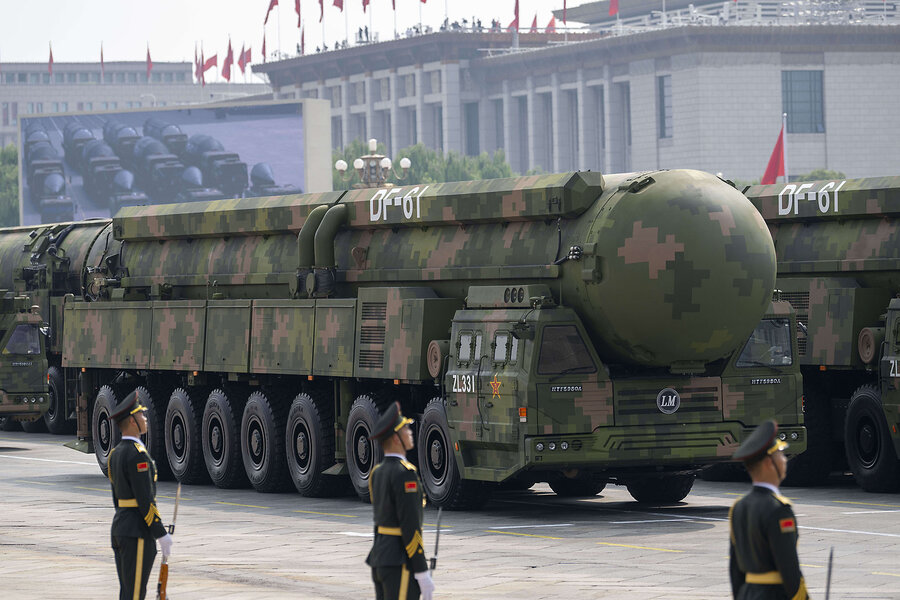
China still lags far behind Russia and the U.S. in its number of warheads, but is on an accelerating drive to expand its nuclear arsenal and close the gap.
Mr. Putin has breached a decades-old international consensus on the need to avoid using nuclear arms by hinting at deploying tactical nuclear weapons in the war in Ukraine. Some of these “low yield” weapons can still carry a payload more powerful than the American bombs that devastated the Japanese cities of Hiroshima and Nagasaki at the end of World War II.

And the advent of new technologies – including hypersonic aircraft and missiles, space-based weaponry, and artificial intelligence – has added a daunting new dimension to the miscalculation risks that decades of U.S.-Russia arms talks have worked to defuse.
Mr. Trump has not abandoned the idea of arms treaties altogether. But he has suggested that he would prefer pursuing a wider nuclear deal that includes America’s main great-power rival, China.
China has insisted, however, that its arsenal remains small. It argues that the U.S. and Russia – with 90% of the world’s more than 12,000 nuclear warheads – must reduce their forces first.
Mr. Trump has also sent mixed signals on wider U.S. nuclear policy, emphasizing his commitment to modernizing America’s nuclear arsenal, and raising the possibility of lifting its three-decade moratorium on nuclear weapons tests.
And the president is championing a new “Golden Dome” air-defense shield. If it’s deployed, one outcome might well be to underscore Russia’s worries about the effectiveness of its missiles in the event of a conflict – reinforcing an urge in Moscow, and in Beijing, to develop new weapons systems capable of frustrating it.
That scenario is an illustration of why the political fabric of decades of nuclear diplomacy, with New START its last surviving thread, matters so much.
That treaty was built on a series of U.S.-Soviet arms accords during the Cold War that were only partly about limits on weapons or warhead numbers.

They were also about building mutual confidence and avoiding catastrophic miscalculation through agreed avenues of communication, data sharing, verification, and an understanding of each rival leadership’s intentions.
Starting in the 1970s, Washington and Moscow agreed to limit their antiballistic missiles, then their intercontinental missiles and nuclear tests.
In the 1980s, they settled a bitter dispute over the deployment of intermediate-range Soviet missiles threatening Europe, and a counterdeployment of similar U.S. missiles, by agreeing to remove all of them, with unprecedentedly extensive verification wired into the accord.
In the waning years of the Soviet Union, the two countries moved from merely limiting strategic weapons to reducing their numbers, and also dismantling large numbers of tactical weapons.
Yet, New START turned out to be the final major negotiating success.
It capped warhead and missile numbers. It also built on the wider fabric of earlier agreements: introducing enhanced exchanges of data and an inspection regime to build confidence in the accord.
Amid steadily worsening U.S.-Russian ties, that fabric has been fraying for some time.
During his first term, President Trump withdrew from the 1987 intermediate-range missile treaty in response to Russia’s deployment of a new mid-range cruise missile. He also questioned the value of a treaty that did not cover what Washington viewed as a rising threat in Asia: similar deployments by China.
While the warhead limits under New START have appeared to hold, the provisions for data sharing and inspections have stalled, first as a result of the coronavirus pandemic and then in the wake of Mr. Putin’s 2022 full-scale invasion of Ukraine.
The result is that, whatever the fate of New START, replicating the broader arms-control architecture of the past five decades will now require a rebuild from the ground up.
Whether that happens is the wider question hanging over future nuclear diplomacy.
The stakes were perhaps best highlighted on Wednesday in an appeal from another prominent American: Chicago-born Pope Leo XIV.
Exhorting the U.S. and Russia to avert a new arms race, he said: “It is more urgent than ever to replace the logic rooted in fear and mistrust with a shared ethic … toward the common good.”