
It was Day Two of the Greatest Peace Deal of The Last Three Thousand Years™, and Keir Starmer had come to update the House of Commons. The previous day, at the Israeli parliament, the agreement had seen Donald Trump, in all seriousness, compared to Cyrus the Great. In London, it was fair to say, the response was a little more cautious. No one even compared the president to Cyrus the Average.
The news was set out for us by Keir the OK. He followed the middle path, welcoming the release of Israeli hostages and deploring the deaths in Gaza over the past two years. These were barely mentioned in the Knesset on Monday, unless you count the bit where Trump talked about all the terrific weapons the US had given Israel. “Almost all” Gazans, the prime minister said, “will have lost family members, husbands, wives, brothers, sisters and of course, worst of all, sons and daughters. Over 20,000 children killed.”
We got an insight into the diplomacy behind the deal. After praising Trump, whose big contribution — alongside “the best weapons in the world” — was getting Israel to the table, Starmer turned to the UK’s decision, alongside other countries, to recognise the state of Palestine. “This move,” he said, “helped lead to the historic New York Declaration, where for the first time, the entire Arab League condemned the atrocities of October 7, urged Hamas to disarm and crucially, demanded that they end their rule in Gaza.”
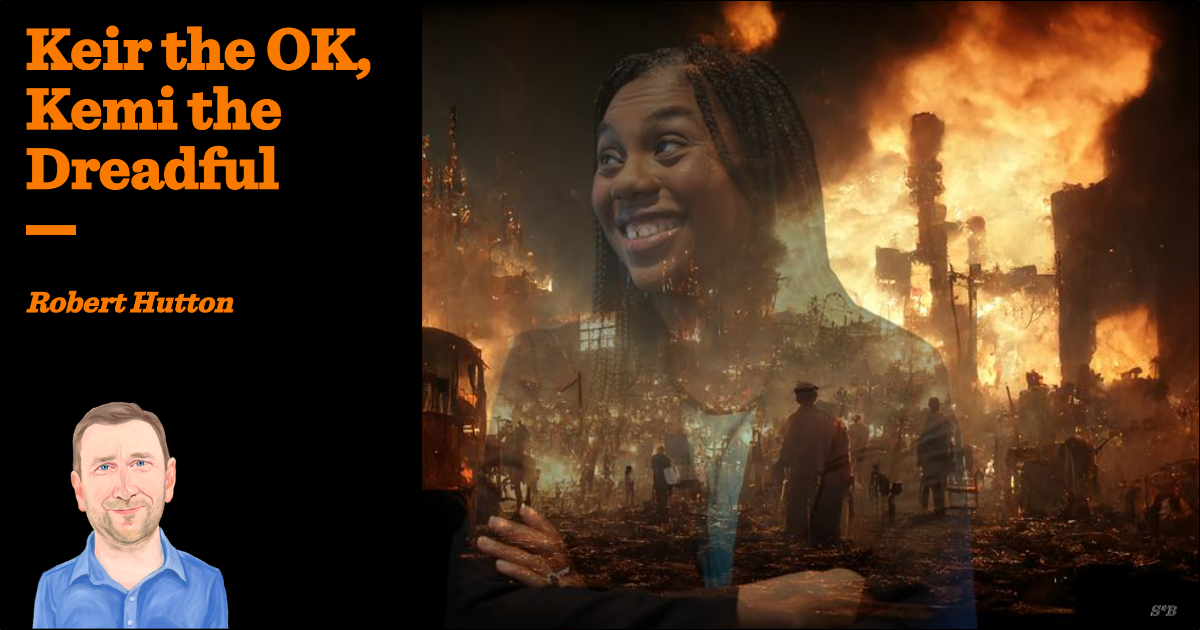
Responding on behalf of the Conservatives was Kemi the Dreadful. Were you under the impression that the situation in the Middle East was complicated, an endless cycle of cruelty and revenge? You’re wrong. It turns out to be very simple: Israel, and more specifically Benjamin Netanyahu, is right about everything. “It is quite clear,” Badenoch said, “that UK relations with Israel have been strained by the actions of this government.” Another way of putting that might be that Israel’s relations with quite a few countries have been strained by the actions of that government.
“Their view, and they have stated publicly,” the Tory leader went on, “is that under pressure from his own backbenches, the prime minister has taken the wrong decisions time and time again, diminishing our influence in the region.”
Some of her own backbenchers shifted uncomfortably. The Israeli government’s most recent comment on British affairs was to invite Tommy Robinson to visit. It’s possible that this might not be the outfit from whom the Conservatives should be taking dictation.
On the Labour benches, the response was more forthright. As ever, Kemi the Mad was delighted to have provoked outrage. “They can shout ‘Shame’ as much as they want to!” she cried. “The truth is, as historic events have unfolded in the Middle East, Britain has been out of step with the US.” Is this true? And even if it is, we have to ask whether “out of step with Donald Trump” is really such a bad thing as all that.
Keir the Mid was, as far as he is capable, damning in his response. Badenoch had been so anxious to get on with attacking the government that she hadn’t even bothered to mention Gaza, “the number of people that have been killed, that are starving, been subjected to denial of aid.” Her statement, he said, “shows yet again, just how far her party has slid from serious statesmanlike approach to diplomacy.”
Worse for Badenoch was the way her own side completely failed to follow her lead. The first Conservative up was Sir Edward Leigh. “I may be naive,” he said, “but cannot both sides the House unite in saying that we are absolutely, completely committed to creating a Palestinian state in the West Bank?” The prime minister welcomed this drive-by of the leader of the opposition. “That sounds like the old Tory party I used to know,” he said warmly.
Sir Andrew Mitchell was next. Monday had been, he said “an historic and much longed for day for which this government and the last one have worked tirelessly.” Starmer thanked him for his own part in that. Then Kit Malthouse praised the decision to recognise Palestine, saying it was “concrete action” that had helped deliver a breakthrough. Not every Labour MP was that effusive.
Indeed, several MPs were more worried that the deal was too kind to Israel, with both Labour and the independents who won on the Gaza ticket last year demanding “justice” for Israelis involved in the assault on Gaza. “This government is committed to international law,” Starmer replied carefully, “and to the accountability that brings.” Which wasn’t really the full-throated call for arrests that they will have wanted to hear. Though also is an answer that they may struggle to condemn.
Layla Moran of the Lib Dems, who has family in Palestine, asked the question so many have been wondering over the last two years: “What on earth was it all for?”
But if you were looking for a measure of how out of step Badenoch was with the chamber, we got the answer when Reform’s Richard Tice spoke. “As we hope that the divisions start to reduce in the Middle East,” he said, “we must also hope that we can reduce the heat and the division of this debate here in the United Kingdom.”
When even Reform sound more reasonable than you, you’re in trouble.