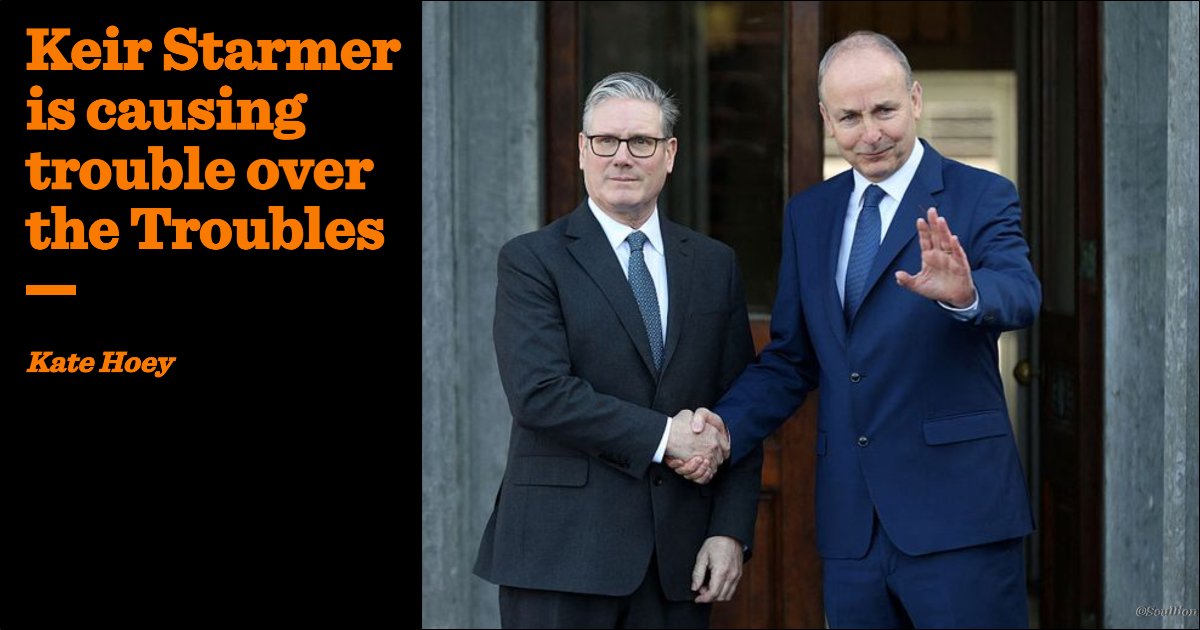
Sir Keir Starmer has just visited Belfast to speak to community and political leaders. He is now in Cork for a two-day “UK-Ireland Summit” with the Dublin government. This is a key part of the “reset” with Ireland of which the Prime Minister is inordinately proud. It replaces the Conservative government’s frosty relationship as it, uniquely, legislated on legacy without Dublin’s agreement much to their annoyance.
These now annual summits are also seen as an important gateway to resetting relationships with the EU of which Ireland is a disproportionately influential member and one the U.K. hopes can smooth paths in the great Reset which I refer to as selling out the 17 million people who voted to Leave the EU.
It was to pacify the Irish government that Boris Johnson was forced to accept that Northern Ireland would become an EU protectorate for trade purposes, while the Belfast judiciary and quangos have ruled that NI must be subject to EU law, not only on legacy but also for equality and immigration purposes. That determination is currently under consideration by the Supreme Court in the NIO’s appeal on the Dillon case. In Cork the Irish will be pushing the PM to stop any further efforts to protect veterans while maintaining its interstate case against the U.K. at the Strasbourg court. Surely our PM will not allow his human rights zealotry to trump support for service men and women.? Is it not time for him to tell the Irish to look into their own disgraceful ignoring of IRA killers who fled across the border after a terrorist act?
Lord Hermer advised days after becoming Attorney General in July 2024 that the core aspect in the Belfast High Court judgment by Mr Justice Colton would not be appealed since the Act had breached Article 2 of the ECHR. Hermer had so advised despite having had Gerry Adams as a client in the current London civil suit. He recused himself thereafter.
The unappealed part of the Colton judgment required new legislation by Hilary Benn, the NI Secretary of State. In the first instance, a Remedial Order was published in December 2024 to remove most of the 2023 Legacy Act including the bar on Gerry Adams getting compensation for his 1970s internment. The Order then sat for over a year despite its purpose being said to be urgent. Only in January 2026 did a new version of the Remedial Order pass the House of Commons, but has yet to surface in the House of Lords. It now avoids mention of Adams’s money being reinstated despite a probable Strasbourg appeal.
The NIO’s Troubles Bill was published and given a 2nd reading in the Commons on 18 November 2025. It has been dormant for four months as army veterans in the country and their supporters in Parliament mounted an ongoing resistance movement. Human rights lawyers only take account of defence forces once in government and so the MoD hastily produced a list of six protections for veterans — not cleared with a peeved Dublin Foreign Minister — but ones it was reluctantly admitted would apply as much to terror suspects as veterans and are insufficient to safeguard from ongoing vexatious prosecutions The Irish government will be pushing the PM for more concessions in order to prevent changes that would favour veterans while at the same time still maintaining their legal challenge in the interstate case at Strasbourg .Surely it is time for our PM to put British interests in front of his zealotry on Human Rights.There are now 45 pages of amendments on the order paper for the Bill’s committee stage with some that would at least put the 6 protections into the Bill. However given the huge Labour majority most will receive short shrift. It is only in the Lords where the real battle will occur — one in which I and a large number of other peers will participate.
One set of amendments will be tabled to add those hurdles against veteran prosecutions that appear in Johnny Mercer’s Overseas Operations Act. They were designed to thwart solicitor Phil Shiner’s Iraq lawfare which the Prime Minister worked for in the Al-Skeini Strasbourg case. As I argued in the Commons this should have extended to Operation Banner service in Northern Ireland but the Government got cold feet.
These amendments however will not bring much succour to veterans as it is the lengthy process from first knowing that you are being investigated that is the real punishment.
It is important to remember how and where Hilary Benn and the Labour Party’s policy on legacy was developed. It was generated in the Lords in opposition to the Tories 2023 Legacy Act and came from a coalition led by Lord Hain, Baroness O’Loan (a former NI Police Ombudsman also appointed to the Finucane public inquiry and to Operation Kenova), and former Metropolitan Police commissioners advised by the current PSNI Chief Constable, Jon Boutcher, also of Kenova (cost £50 million for no Stakeknife prosecutions). These CID police chiefs have an inbuilt antagonism to Special Branch and the Security Services who unlike them do context and politics. Peter Hain had introduced a 2005 Amnesty Bill for Tony Blair which was only scuppered by Sinn Fein when they discovered that it would apply to former soldiers too. Amnesty or drawing a line has been policy on both sides of the border on a number of occasions since the 1920s, but no-one in Government dares to admit it.
The result is an unending series of reinvestigations that will produce neither justice nor the truth, whatever that is, at an enormous cost, the only beneficiaries being legacy practitioners and the rewriting of history. The price of legacy lawfare to date is approaching £2 billion and future costs are estimated,even by Jon Boutcher at another billion.
The Conservatives had already allocated £250 million to its reinvestigation body ICRIR which has in large part been eaten up by the costs of the 200 staff.
The big issues in the Lords where the government is likely to have to make concessions if veteran pressure, not least on the danger to current military morale and recruitment, continues, relate to inquests and civil suits. There are some 50 reopened inquests currently stayed. Given Northern Ireland judicial practice, inquests have effectively become public inquiries and take years to conclude. They require military witnesses to give evidence about events 50 years ago with the coroners likely to rule there is a potential prosecution to be considered, as happened after the Clonoe inquest.
The final reinstatement in Hilary Benn’s Bill is to be civil suits. Given allegations of collusion (not itself a crime) every Troubles death can be judged a collusion death as the state, quite properly, had participating agents in all the terror groups. In a Commons answer to Jim Allister MP on 29 January, the MoD Minister, Al Carns, said 123 claims already lodged would “be unfrozen under the Remedial Order”. Added to the existing number, that made 966 in total. At settlements of £50,000 each time, inclusive of legal fees, the cost would be nearly £50 million, and that is before lawfare cranks up with another thousand claims. How can the United Kingdom afford this when our public finances are under so much pressure and the morale of our Armed Forces is so critical to our security. Why would any young person even consider joining up when they see how those who fought bravely for their country in the fight against terrorists have been treated.
This Troubles Bill is not the answer.