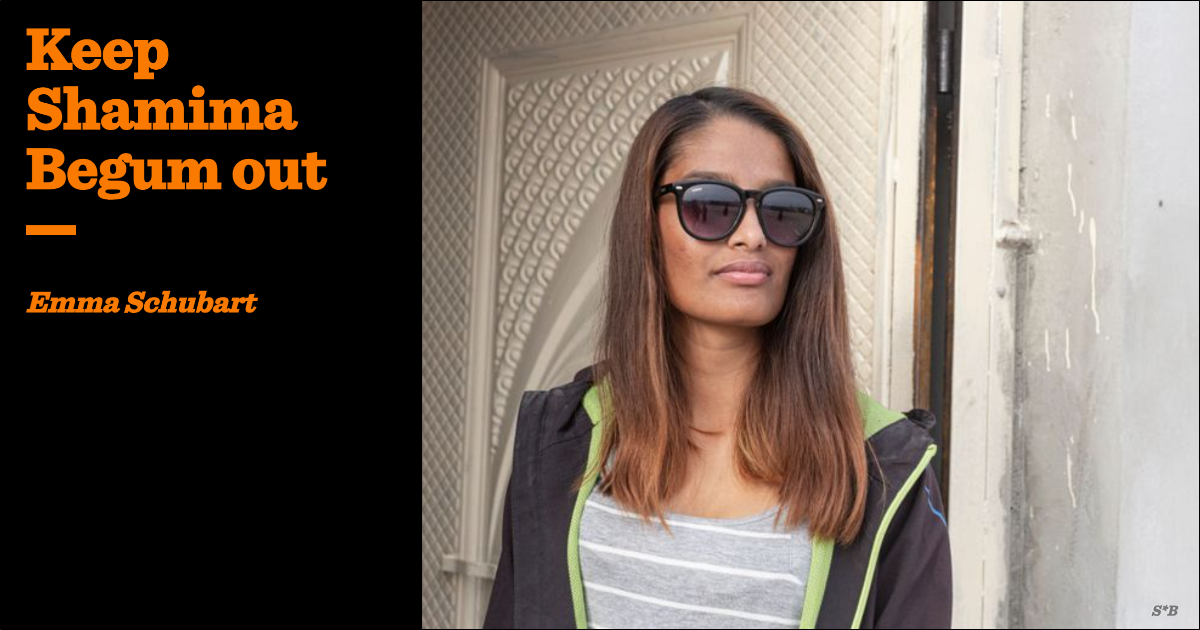
The European Court of Human Rights (ECHR) has once again elbowed its way into a decision that ought to belong to Britain. This time, it’s challenging whether the UK was entitled to strip Shamima Begum of the citizenship she forfeited when she joined the Islamic State (IS). In so doing, the ECHR is reviving the asinine campaign to haul her back to the country she renounced.
Britain owes her due process under British law, and has given her years of it
Begum willingly left London in 2015, aged 15, travelled to IS territory in Syria, and remained there while IS was at the height of its power and barbarism. She emerged in early 2019 in a Syrian detention camp as the so-called “caliphate” collapsed. In response, then Home Secretary Sajid Javid deprived her of British citizenship on national security grounds.
Britain owes her due process under British law, and has given her years of it.
The legal basis for deprivation is straightforward. The Home Secretary’s power to revoke citizenship is permitted where it is “conducive to the public good”, particularly on national security grounds, so long as it does not render the person stateless. And at the time of Javid’s decision, Begum was deemed eligible for Bangladeshi citizenship through her parents (though Bangladesh later said it would refuse her entry). The UK’s move did not leave her stateless under international law.
The deprivation decision has been litigated, re-litigated, and upheld in British courts. When she demanded entry to Britain to prosecute her appeal, the Supreme Court said no in 2021: national security outweighed her preferred form of participation. The Special Immigration Appeals Commission (SIAC) then dismissed Begum’s appeal in February 2023, and the Court of Appeal unanimously upheld that ruling in February 2024. The Supreme Court drew a final line in August 2024 by refusing permission for any further appeal.
This context makes the ECHR’s current posturing especially galling. The ECHR is not correcting a miscarriage of justice. It is demanding another appeal from a foreign bench, re-litigating a national security judgment that Britain’s own courts have already reviewed at the taxpayer’s expense.
The chosen pretext is “trafficking”, questioning whether the UK adequately considered duties under Article 4 of the European Convention (which prohibits slavery and forced labour) before stripping Begum’s citizenship. The implication is that Begum might have been a victim of trafficking, and that Britain failed to account for that.
But British courts did take this argument seriously. In fact, SIAC found “a credible suspicion” that Begum was “recruited, transferred and then harboured for the purpose of sexual exploitation”. But SIAC also made a crucial point that the ECHR seems determined to misunderstand: a “credible suspicion” of trafficking does not, by itself, establish a violation of Article 4, and it does not automatically disable the Home Secretary from concluding that deprivation is conducive to the public good on national security grounds. In other words, even if one accepts that Begum was groomed into going to Syria, that fact alone does not erase the threat she poses or the gravity of her decision to join IS.
Nor does the claim of “trafficking” erase Begum’s personal agency. The Court of Appeal recorded Begum’s own words from her 2019 interviews: “Even though I was only 15 years old … I could make my own decisions back then. I do have the mentality to make my own decisions and I did leave on my own knowing that it was a risk.” In those interviews, she expressed no remorse for joining IS. On the contrary, she casually recounted that seeing a severed head in a bin “didn’t faze me at all” — even musing that the decapitated victim must have deserved it. She also justified the Manchester Arena bombing (which killed 22 and injured over 1,000) as a form of “retaliation.” That is not the language of a victim; it’s the language of a terrorist.
Only later, when life in Syrian camps grew bleak and the reality of her revoked citizenship seemed to set in, did she swap the burqa for a baseball cap in her interviews and pivot to pleas for sympathy. And those who have interacted with Begum suspect that her current victimhood narrative is a façade. Andrew Drury, a journalist-filmmaker who has interviewed Begum several times, has spoken with eyewitnesses in Syria who allege that Begum “quite certainly sewed suicide vests” onto would-be bombers. Witnesses even claim that she served in IS’s Hisbah, the armed all-female “morality police” that patrolled the streets of Raqqa, flogging and brutalizing local women for alleged social transgressions. And as Sir James Eadie QC told the Supreme Court, Begum remained with IS “until the very end, she didn’t regret going and she wanted the caliphate to be victorious”.
The threat Begum poses is not hypothetical. During her appeals, British courts heard MI5 assessments that women and children in IS “regularly carried weapons and received some level of military training” and that returnees could “inspire and encourage” attacks in the UK.
And the broader context makes that risk obvious. IS and its affiliates continue to plot and inspire numerous attacks in the West, including the 2024 Solingen stabbing in Germany that killed three and injured eight, the 2025 New Year’s Day attacker in New Orleans who killed fourteen and injured at least fifty-seven, and foiled plots against Taylor Swift concerts in Vienna. According to the U.S. Department of Homeland Security, ISIS-Khorasan has been active in recruiting for attacks in the West. And in northeastern Syria, where Begum is detained, IS is active.
Evidence-gathering from a collapsed war zone is notoriously difficult, meaning conviction is far from guaranteed
That’s why the “bring her back to stand trail” line is dangerously dishonest. Evidence-gathering from a collapsed war zone is notoriously difficult, meaning conviction is far from guaranteed. And even if a conviction were secured, the risk would not vanish; it would simply be imported–onto British streets, British police, and British taxpayers — for years to come.
Begum has had years of due process under British law. What she does not have is an entitlement to a British passport after volunteering for a death cult in Syria. Britain must stand by the decision it has already made: keep her out.