Julia Bradbury says she has fine tuned her lifestyle to ensure she stays alive ‘for as long as possible’ – five years after being diagnosed with breast cancer.
The Countryfile presenter’s life as a working mother-of-three was turned upside down when, aged 51, doctors confirmed the discovery of a six centimetre tumour on her left breast.
‘I was terrified and sad, it was a very emotionally upsetting time,’ she told The Times. ‘It must have been very, very difficult for my family.
‘I was in the eye of the storm and changed overnight to become the person I needed to be to get through this.’
While arduous chemotherapy treatment wasn’t needed, Bradbury, 55, underwent a mastectomy to remove the affected breast, a move that prompted immediate changes to her diet – among them the decision to give up meat and sugar.
‘I thought, right, I need to get stronger for this,’ she recalled. ‘I knew after the operation I needed to move and walk as quickly as possible in order to heal.

Julia Bradbury says she has fine tuned her lifestyle to ensure she stays alive ‘for as long as possible’ – five years after being diagnosed with breast cancer
‘Getting blood pumping around a wound area is very, very important and your heart health also comes under attack when you have anaesthetics. In the moment it was instinct, but from that proactive period I was on a different path and didn’t come off it.’
Meat has since found its way back into the presenter’s diet, but she insists on healthier, organic options rather than cheaper cuts.
‘I used to live very much on convenience fast food because I was out and about filming all the time, eating at petrol stations, airports,’ she said, recalling how her working diet consisted of cheap sandwiches and bags of sweets.
‘I was having sugar all day in crazy quantities but I’m naturally slim so I didn’t have the warning sign some people have of putting on weight,’ she added.
As well as dietary changes, Bradbury has incorporated regular exercise, outdoor walks and an insistence on consistent sleep patterns into her daily routine in a bid to stay fit and be a constant in the lives of her children, son Zephyr, 14, and twin daughters Xanthe and Zena, 11.
Bradbury, who claims she ‘felt invincible’ when she was younger, admits she would have adopted a more considered approach to her health and diet at an earlier point in her life had she known what she knows now.
The presenter is now also an advocate for making PRS and SNP testing available on the NHS and previously revealed she has taken her own polygenic risk score (PRS) test, which she branded a life-saver to empower women and help them predict breast cancer risks.
She told Instagram followers: ‘When I was diagnosed with breast cancer, it changed my life. But it also made me ask more questions about why it happened—and what I could do to reduce the risk of it coming back.
‘That’s why I took a polygenic risk score (PRS) test under the guidance of Professor Gareth Evans at the Manchester Biomedical Research Centre. He has since retired.
‘It’s a genetic test that looks at small variations (called SNPs) across your DNA to help assess your personal risk of developing breast cancer—or, in my case, a recurrence.’
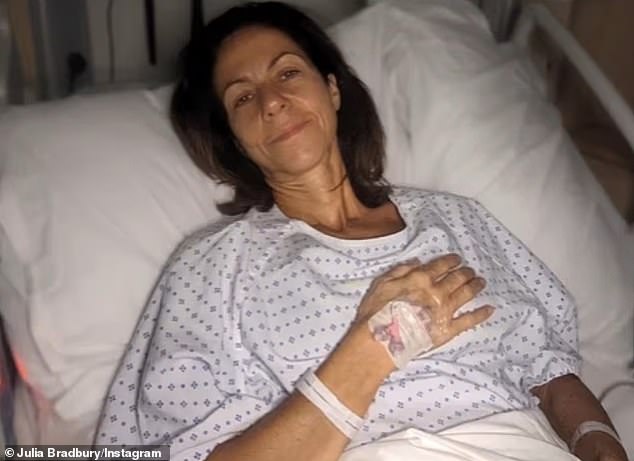
The TV presenter’s life as a working mother-of-three was turned upside down when, aged 51, doctors confirmed the discovery of a six centimetre tumour on her left breast
Breast cancer is one of the most common cancers in the world and affects more than two MILLION women a year
Breast cancer is one of the most common cancers in the world. Each year in the UK there are more than 55,000 new cases, and the disease claims the lives of 11,500 women. In the US, it strikes 266,000 each year and kills 40,000. But what causes it and how can it be treated?
What is breast cancer?
It comes from a cancerous cell which develops in the lining of a duct or lobule in one of the breasts.
When the breast cancer has spread into surrounding tissue it is called ‘invasive’. Some people are diagnosed with ‘carcinoma in situ’, where no cancer cells have grown beyond the duct or lobule.
Most cases develop in those over the age of 50 but younger women are sometimes affected. Breast cancer can develop in men, though this is rare.
Staging indicates how big the cancer is and whether it has spread. Stage 1 is the earliest stage and stage 4 means the cancer has spread to another part of the body.
The cancerous cells are graded from low, which means a slow growth, to high, which is fast-growing. High-grade cancers are more likely to come back after they have first been treated.
What causes breast cancer?
A cancerous tumour starts from one abnormal cell. The exact reason why a cell becomes cancerous is unclear. It is thought that something damages or alters certain genes in the cell. This makes the cell abnormal and multiply ‘out of control’.
Although breast cancer can develop for no apparent reason, there are some risk factors that can increase the chance, such as genetics.
What are the symptoms of breast cancer?
The usual first symptom is a painless lump in the breast, although most are not cancerous and are fluid-filled cysts, which are benign.
The first place that breast cancer usually spreads to is the lymph nodes in the armpit. If this occurs you will develop a swelling or lump in an armpit.
How is breast cancer diagnosed?
- Initial assessment: A doctor examines the breasts and armpits. They may do tests such as a mammogram, a special X-ray of the breast tissue which can indicate the possibility of tumours.
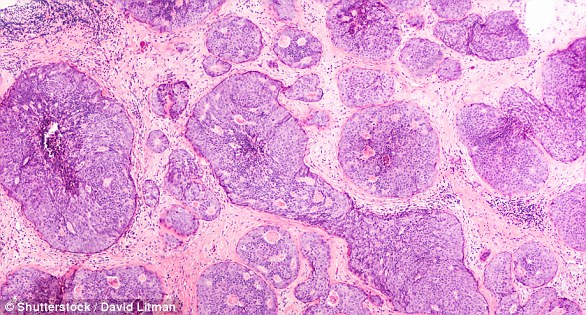
- Biopsy: A biopsy is when a small sample of tissue is removed from a part of the body. The sample is then examined under a microscope to look for abnormal cells. The sample can confirm or rule out cancer.
If you are confirmed to have breast cancer, further tests may be needed to assess if it has spread. For example, blood tests, an ultrasound scan of the liver or a chest X-ray.
How is breast cancer treated?
Treatment options which may be considered include surgery, chemotherapy, radiotherapy and hormone treatment. Often a combination of two or more of these treatments are used.
- Surgery: Breast-conserving surgery or the removal of the affected breast depending on the size of the tumour.
- Radiotherapy: A treatment which uses high energy beams of radiation focused on cancerous tissue. This kills cancer cells, or stops them from multiplying. It is mainly used in addition to surgery.
- Chemotherapy: A treatment of cancer by using anti-cancer drugs which kill cancer cells, or stop them from multiplying.
- Hormone treatments: Some types of breast cancer are affected by the ‘female’ hormone oestrogen, which can stimulate the cancer cells to divide and multiply. Treatments which reduce the level of these hormones, or prevent them from working, are commonly used in people with breast cancer.
How successful is treatment?
The outlook is best in those who are diagnosed when the cancer is still small, and has not spread. Surgical removal of a tumour in an early stage may then give a good chance of cure.
The routine mammography offered to women between the ages of 50 and 71 means more breast cancers are being diagnosed and treated at an early stage.
For more information visit breastcancernow.org or call its free helpline on 0808 800 6000
She added: ‘My PRS results showed a slightly higher genetic risk for recurrence.
‘Knowing that helped me and my medical team make more informed decisions about treatment, ongoing monitoring, and lifestyle changes. It’s given me peace of mind, and a plan.
‘I truly believe this kind of testing could save lives. It’s not just about diagnosing disease—it’s about predicting risk, preventing cancer, and empowering women (and men!) with personalised information about their own bodies.
‘If I had known I was at a higher risk of breast cancer, perhaps I would have proceeded differently when I first discovered my lump, in my 50’s.
‘I’m an advocate for making PRS and SNP testing more widely available on the NHS. We need to move towards preventative care, not just reactive care.
‘Because the earlier we understand our risk, the earlier we can take action.’