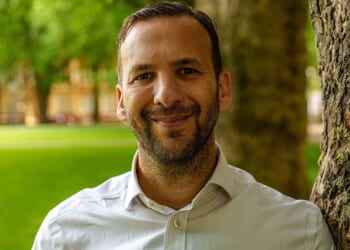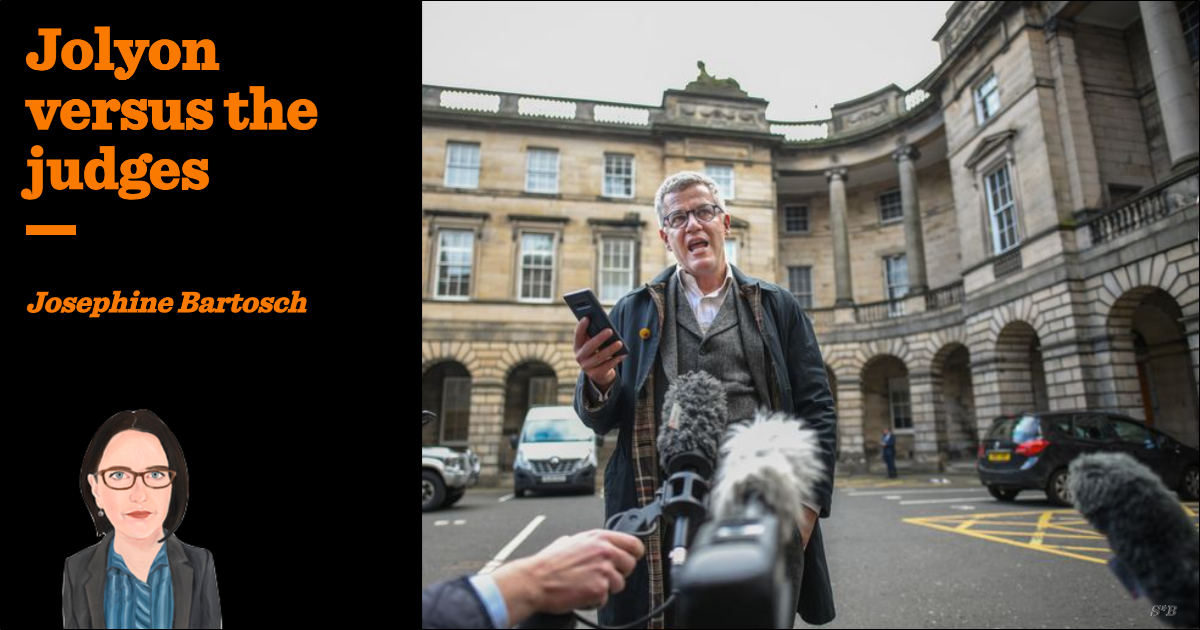

Who could fail to admire the grit of Jolyon Maugham KC — the campaigner who left a career in tax law behind to become a born-again transvangelist? He’s the lovechild of Pollyanna and Pangloss. Where others see a courtroom drubbing, he spies an opportunity to rail against transphobia and sock it to The (non-gendered) Man.
Last week, fresh from the Good Law Project’s unsuccessful challenge to the Equality and Human Rights Commission’s single-sex guidance, he delivered a masterclass in positive thinking. Breaking the news to Good Law Project supporters, he began: “I’m sorry to have to tell you that the High Court has said that we have lost”.
Yet before dispirited donors could slide their credit cards back into their wallets, he added: “the media will tell you that we have lost and we will have to pay most of the costs of £300,000 but none of that is quite true.” The clear implication was that defeat existed only in the dreary, technical sense. In the higher court of virtue, GLP remains undefeated.
Quite true or not, GLP has now launched a fundraising appeal. With characteristic bombast, Maugham pivoted from defeat to denunciation, blaming an unsympathetic judiciary. Ratcheting up the rhetoric, he declared that “trans people and those who love them know that the judiciary can’t always be trusted … this case is a very good example of why.” He added that Judge Swift was “just not interested enough in what the trans people, the claimants before him, were telling him about the reality of their lives,” and had dismissed them in a “world that is increasingly transphobic and increasingly violent.”
The segue from legal setback to funding drive was seamless. Railing against the unfairness of the hefty bill, Maugham explained why donations were needed: “this is how they get you if you’re not backed by some evil billionaire and you don’t have access to the limitless pockets of government.”
Other lawyers with expertise in this area are unimpressed
A bold complaint for an organisation that pays him a £93,000 salary, employs several dozen staff and reports multi million pound turnover. (But then I would say that — I work for The Critic and therefore am a Tufton Street stooge drowning in dark money.)
Following the ruling, the Good Law Project produced a FAQ to the law on single-sex spaces claiming that “it will likely be discriminatory to force trans people to use facilities based on their sex recorded at birth” and that the “equalities minister Bridget Phillipson will likely ask the EHRC to redraft this guidance.”
Other lawyers with expertise in this area are unimpressed. Akua Reindorf KC, who oversaw the guidance during her time as an EHRC commissioner, rejects the claim outright, posting on social media: “GLP lost on standing, and the other Claimants lost on every substantive ground.”
There is a whiff of the swivel-eyed 9/11 truther in Maugham’s telling
Meanwhile, Oxford law professor Michael Foran has systematically dismantled each claim in the GLP’s FAQ. In his analysis he drily observed that sometimes “the claims that individuals or organisations make are so radically detached from any plausible interpretation of the law that it becomes impossible not to wonder whether this is wilful disinformation.”
There is a whiff of the swivel-eyed 9/11 truther in Maugham’s telling — that official accounts cannot be taken at face value, that powerful forces are aligned against The Righteous, that GLP has privileged information about the way things really work.
Such face-saving guff is perhaps predictable — it is much easier on the ego to believe you are a brave truth teller and that they are out to get you. If I’d staked my reputation on the belief that sex can be changed with magic words, I too would prefer that story to the more prosaic reality that I was in the grip of a middle-aged messiah complex. (After all, championing a cause beloved of the young is a tried and tested method of postponing one’s political and personal twilight.)
Despite scepticism from many lawyers, social media silos ensure GLP’s claims still find an audience. Indeed, Kate Osborne MP has already publicly claimed that the ruling “confirmed that the EHRC’s code of practice got the law wrong” and other public figures have repeated these claims.
What transforms Maugham from an amusingly sore loser into something more concerning has been his sly suggestion that the system is rigged. Following the Supreme Court’s landmark judgment on biological sex last year, Maugham proposed that one of the judges “did it to please their dinner party friends.”
To believe there is a cabal out to get you, or to crush a cause you cherish, is immensely flattering. It casts you and your beliefs at the centre of events. Defeats become proof of the forces arrayed against you, of your own influence. Every loss fuels the belief that one is a crusader for truth, albeit in Maugham’s case, a suitably intersectional and decolonised one.
But Maugham is not some lone nutter who insists birds aren’t real on Rumble. He is a high profile lawyer heading a well funded campaign organisation with friends in Parliament and a loyal online following. However much he rages against the machine, he is part of it.
When people in that position imply judges cannot be trusted simply because they lost, or disseminate claims that muddy clear judgments, the damage is not to their pride but to public confidence in the rule of law. That is a high price to pay for saving face.