It’s hard to imagine that Jackie Robinson’s contributions to baseball – and more important, to civil rights – would ever be forgotten. And yet, the contributions of a comparable civil rights giant, Paul Robeson, have largely been removed from our collective consciousness.
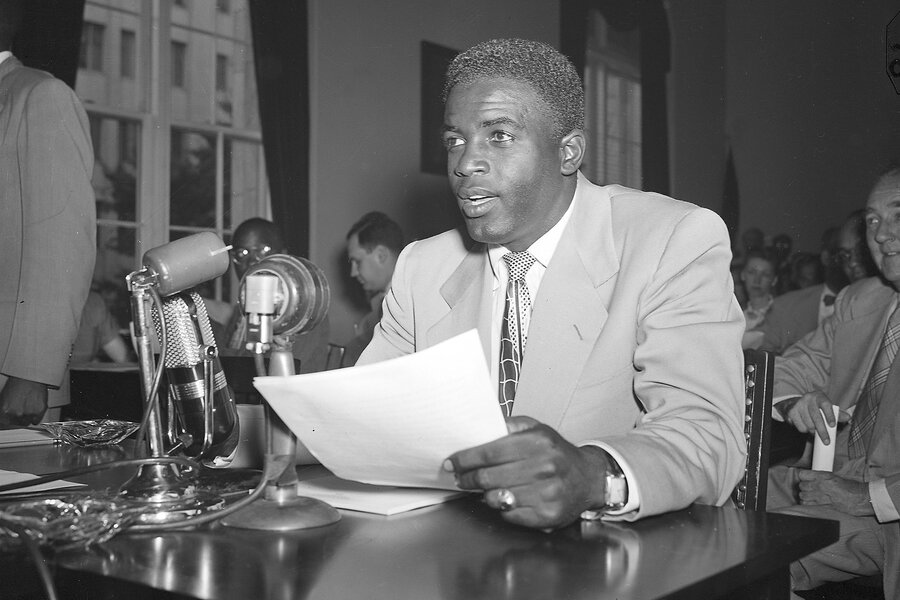
Author Howard Bryant juxtaposes the politics and power of these two men in his latest book, “Kings and Pawns: Jackie Robinson and Paul Robeson in America,” published Jan. 20. Their testimonies before the House Un-American Activities Committee in 1949 are a huge point of reference in the book, along with other flashpoints from their professional and political careers.
“For me, I think that every book, not just my books, but every book, builds on each other,” Mr. Bryant says. “In my case, when I was working on ‘The Heritage,’ the introduction of that book notes Robeson. And I’ve been a huge baseball fan, a huge Jackie Robinson fan before that.
Why We Wrote This
Jackie Robinson and Paul Robeson were titans in their fields. Robeson’s calls for the equitable treatment of Black people were framed as communism. Robinson felt compelled to counter Robeson’s statements, which appeared to call into question Black loyalty to the United States against the former Soviet Union. Both men were pawns in Cold War politics, argues historian Howard Bryant.
“How many times have I read ‘Jackie Robinson testified against Paul Robeson’ and kept on reading,” he added with a laugh. “That’s kind of a big deal.”
The analysis in “Kings and Pawns” doesn’t just challenge how society views sports, politics, and civil rights. It also compares anti-communism and anti-labor sentiments of the Cold War to current events and political administrations.
The Monitor spoke with Mr. Bryant over the phone. The interview has been edited for length and clarity.

Why was it important to draw parallels between the Cold War and the current political landscape?
It’s one of the things we have to do, and it’s our job as writers and authors to do it. We use terms like fascism, authoritarianism, “red scare.” If we’re using these terms, we have to investigate them. While I was working on this book, the parallels became more and more obvious.
When you look at what is taking place, specifically the assault on education, it’s the same playbook that took place between 1945 and 1957. The list of people who were called “un-American.” In 1949, Life Magazine ran a spread of people that they thought were dangerous, and of course, they were all on the political left. It had Langston Hughes and Albert Einstein, and all of these great people were called un-American.
You see the closing of the borders in immigration, especially to countries that are populated by Black and brown people. It’s the same thing as the National Security Act of 1950. It’s the same language that Joseph McCarthy used. “The enemy of the people,” or “the enemy within,” turning American citizens against each other. And today, the same rhetoric turning the government and turning law enforcement against its own people, we saw what happened in Minnesota with Renee Good. So much of that playbook is just being reenacted right now.
How did two Black giants, Robinson and Robeson, end up pitted against one another? And what does it tell us about race-based politics?
One of the things that I wanted to do with this book was to take it away from Black people in the sense that whenever we deal with Black issues, we always separate them from national issues. When we talk about the Cold War and McCarthyism, nobody ever talks about African Americans in general. They just leave civil rights to us. But Black people were directly involved and directly affected by what was happening in the Cold War. And those politics took Jackie Robinson – his name, his celebrity, and his success – to position him against the man who was the most famous Black American in the world at one point, Paul Robeson.

Robeson wasn’t just an athlete or an entertainer. He was known from China to India, to all of the countries in Africa – truly a world-renowned figure. One of the things that I always say is, and it’s contemporary to today, the Black person who is willing to publicly criticize another Black person, will have a job for life. If you have been positioned to be a pit bull against your own people, there will always be a use for you.
What was really important about trying to untangle this project was why Jackie, to that point, was not political. He didn’t get involved in political questions. So why is Jackie Robinson testifying in front of the most notorious government body, or one of the most notorious government bodies, in American history? The answer, of course, is [Brooklyn Dodgers general manager] Branch Rickey. Robinson felt obligated to this man who gave him the opportunity to integrate baseball.
Why has history forgotten about Paul Robeson?
I think back to when I was growing up, and who was considered heroic and who wasn’t. You had Martin Luther King Jr. As a Bostonian, we knew Crispus Attucks. But Malcolm X was a villain. The Black Panthers were villains. Paul Robeson was a villain.
When I went to college in Philadelphia at Temple University in the late ’80s, Robeson had only been dead a decade. His aura was still around.

I talked to Spike Lee about this. I told Spike, “You are the single most important person in the restoration of Malcolm X.” Paul Robeson has been framed by white Cold War politics, and also Black Cold War politics too, because the NAACP didn’t do him any favors, and neither did a lot of the Black establishment. But Robeson deserves to be reclaimed. This is a great man we’re talking about. This is a man who in the 1930s believed in universal health care and predicted the Vietnam War. This is a man who understood that Black liberation was not gonna come through the capitalist system, not because white people weren’t good people, but because the numbers were just so overwhelmingly against Black people.
Now look at what people are talking about. They’re talking about wealth distribution, and then Zohran Mamdani was elected in New York City, the biggest city in the country, because everyone understands. What do we talk about now? We’re talking about affordability. And everyone knows these numbers don’t add up, and if they don’t add up for white people, they certainly are not gonna add up for Black people.
What do you want people to take away from the book?
I mentioned Moses Fleetwood Walker, who predated Robeson and Robinson, at the end of the book to bring everything full circle. It shows that Black people have always had the same questions. What does it take? What do we have to do? Is there anything we can do?
Walker came to the same conclusion that Marcus Garvey did, that W.E.B. Du Bois did. Think about Du Bois, probably the greatest Black intellectual in this country’s history. He was born in 1868 and died in 1963, 95 years old. Look at everybody he overlapped – Muhammad Ali, Malcolm X, Jackie Robinson, Harriet Tubman, Ida B. Wells, Frederick Douglass.
I really wanted to center how different themes inform the work that I do. The work builds on itself, you start connecting all of these dots, and you realize that there are just pockets and pockets that need explanation.