A trip to the toilet used to fill Gagan Papneja with dread.
‘I’d developed a phobia of going because I would regularly see blood, and I was scared I’d got cancer,’ says Gagan, 45, who works in finance.
In fact he had haemorrhoids – or piles. And after ten years of trying all sorts of treatments, the father-of-two from Isleworth, west London, has now developed a tailor-made approach to keeping them at bay (and it could help you, too – but more on this later).
Haemorrhoids occur when blood vessels in the anal cushions – three soft, fleshy pads of tissue inside the anal canal that help control faecal continence – become swollen and like varicose veins, these blood vessels ‘can start to stretch’, explains Professor Sue Clark, a consultant colorectal surgeon at St Mark’s, The National Bowel Hospital in London.
In some cases, the engorged blood vessels remain inside the anal canal – these are internal haemorrhoids.
‘You know if you have an internal haemorrhoid problem because it starts bleeding,’ explains Professor Clark, who’s also a spokesman for the charity Bowel Research UK.
If the blood vessels around the anus swell, forming small lumps, these are external haemorrhoids. The lumps can be the size of small grapes, and may bleed, itch and feel very painful.
‘The more they’re outside the anus, the more they get bashed around, becoming more swollen and sore,’ says Professor Clark.
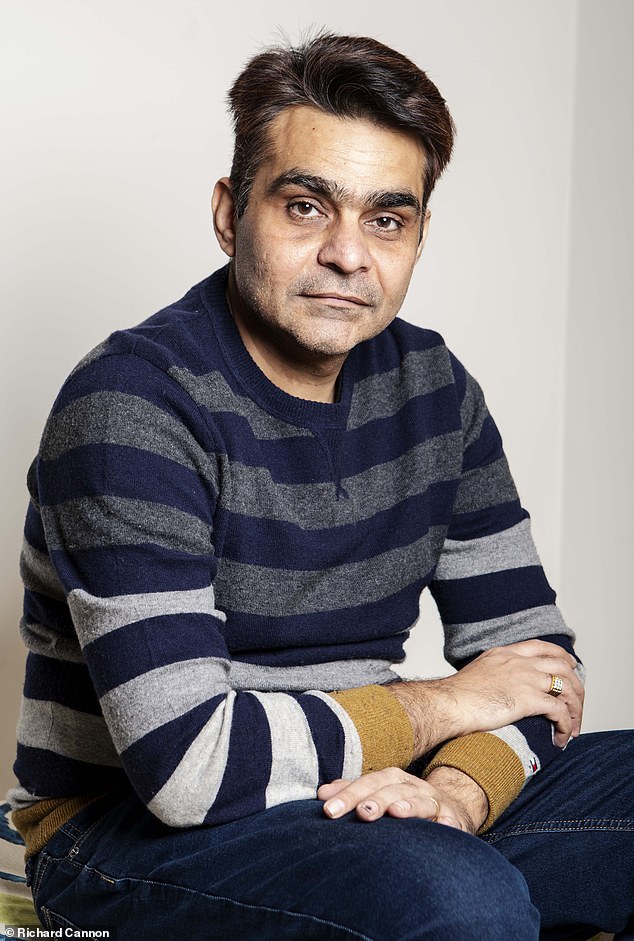
‘I’d developed a phobia of going because I would regularly see blood, and I was scared I’d got cancer,’ says Gagan, 45, who works in finance
Piles are essentially caused by increased pressure in the veins in your bottom – while the exact cause is not clear, risk factors include constipation, pregnancy, chronic coughing and lifting heavy objects.
‘When I was a medical student, we were told that there were two kinds of people in the world: people with haemorrhoids and the people who haven’t got them yet – because they’re really that common,’ says Professor Clark. It’s thought about a third of people in the UK experience haemorrhoids at some time.
A study suggests more younger adults are developing them because they sit for long periods on the loo scrolling on their phone.
The US research, published in the journal PLoS One, involved 125 adults who underwent a colonoscopy (where a camera is inserted via the rectum to check the bowel), as well as answering questions about their lifestyle.
Two thirds of the participants reported using their phone on the loo. Most of those were younger – and spent longer on the loo, with 37 per cent spending more than five minutes per visit compared to 7 per cent who didn’t use their phones on the loo. The phone users had a 46 per cent increased risk of haemorrhoids.
‘Using smartphones on the toilet may contribute to the rising incidence of conditions previously thought to be influenced primarily by dietary and lifestyle factors,’ the researchers wrote.

Professor Sue Clark, a consultant colorectal surgeon at St Mark’s, The National Bowel Hospital in London
How we sit on a loo is key to the findings in this study, says Professor Peter Whorwell, a consultant gastroenterologist at Wythenshawe Hospital in Manchester. ‘When you’re sitting in a chair, your pelvic floor is supported but that’s not the case with a toilet seat.
‘On a loo, the pelvic floor sags and therefore more blood flows into the network of veins around the anus, and pressure increases.
‘In theory, that’s why the anal cushions become engorged and start leaking blood when straining on the loo.
‘In the past, people including my own father read a newspaper in the bathroom. It’s not unique to mobile phones.’
Professor Clark agrees. ‘This is a modern spin on what people have always done while on the loo.
‘But we do need to ask if someone is spending a longer time in the bathroom, maybe something’s not quite right. Possibly they’re constipated and they know they will take ages straining, so take their phone to pass the time.
‘I think saying that if you use your smartphone on the loo you’ll get haemorrhoids is over-simplistic.’
Treatment for piles usually starts with diet and lifestyle changes – a common cause of haemorrhoids is constipation (defined by the NHS as opening the bowels less than three times a week).
‘The main reason why we sit straining and develop haemorrhoids is because few of us have enough fibre in our diets,’ says Professor Clark.
Over-the-counter soothing ointments and creams containing hydrocortisone, which is an anti-inflammatory, along with other active ingredients reduce swelling, itching and pain while helping to shrink smaller piles.
Professor Whorwell also recommends patients rest their feet on a low stool, about six inches high, while sitting on the loo – this changes the angle of the rectum, which has been shown in studies to help piles by easing constipation.
‘Using a stool relaxes the sling-like puborectalis muscle which loops around the rectum. This muscle is tight when we sit to stop us having any accidents, but when we squat, it becomes more relaxed.
‘Basically the position on the footstool straightens things out more and tends to relax the pelvic floor muscles as well.’
It’s believed around 40 per cent of people with chronic constipation have anismus, a miscoordination of the anal canal muscles.
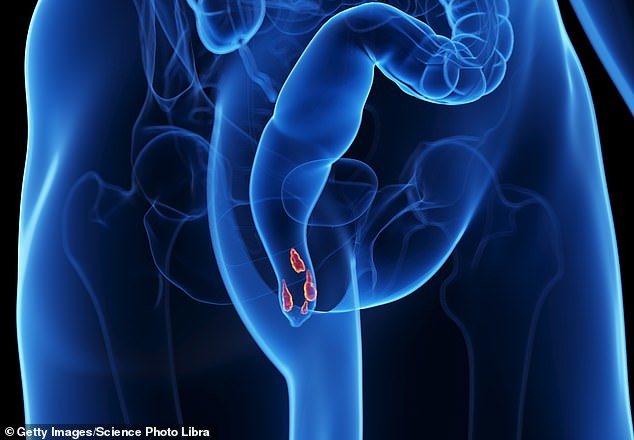
Haemorrhoids occur when blood vessels in the anal cushions – three soft, fleshy pads of tissue inside the anal canal that help control faecal continence – become swollen
‘Instead of relaxing their anal muscles, which makes it easier for the stool to come out, the anal canal is clamping shut,’ says Rhiannon Cannell, a senior clinical scientist who treats patients with anismus at The Functional Gut Clinic in London.
‘So essentially you’re pushing against a closed trap door, which makes pooing very difficult. This puts extra pressure on haemorrhoidal tissue in the anus which can increase the likelihood of haemorrhoids.’
Signs of anismus include having difficulty opening your bowels and straining or discomfort when passing a stool.
Patients can retrain the muscles in their anal canal to relax using biofeedback therapy – this involves a small sensory probe being inserted 5cm into the anus, then the patient visualising their muscle pressure changing while practising pushing down as if they were opening their bowels. On a screen beside colours on a chart change as they engage or relax muscles.
Internal haemorrhoids can be treated with a procedure called banding, where a surgical band is put around them, cutting off the blood supply, causing them to fall off within a week.
Gagan’s haemorrhoids were internal and after numbing ointment didn’t help, he was referred to his local hospital for further investigation.
‘Sitting at my desk most of the day was very uncomfortable – even with a cushion – as by then my haemorrhoids had become external, and were extremely painful,’ says Gagan, who is married with two daughters, aged 20 and 15.
In 2011, he underwent a haemorrhoidectomy, a procedure where the swollen blood vessels are removed surgically.
That failed to stop the bleeding and pain, so the next year he had another operation where the piles were stapled to the rectum wall to reduce their blood supply so they shrink. But this also failed to help.
‘Some nights I would be woken by a stabbing pain in my abdomen as well as my bottom,’ recalls Gagan. ‘The bleeding and pain was always on my mind which stopped me doing things. I missed out doing family activities with our youngest daughter in particular as I stayed at home more.’
Gagan began researching different ways of managing his haemorrhoids – starting with replacing his ‘normal’ meals with homemade yoghurt, rice and lentils for about eight months.
‘I didn’t want anything hard to digest because I felt I wanted to help my gut to treat the haemorrhoids.’ A healthy, balanced gut microbiome – the community of bacteria and other microbes found there – is linked to better bowel function.
Gagan also began taking regular probiotics (good bacteria), prebiotics (supplements that feed the ‘good’ bacteria in the gut) and diluted apple cider vinegar to help balance his gut’s bacteria, along with herbal teas to aid digestion.
After coming across a YouTube video about how squatting – crouching with knees below his hips and bottom a few inches off the ground – could help make it easier to pass a stool he now squats for ten minutes every morning before going to the loo.
Six months after introducing these changes, ‘I saw light at the end of the tunnel’, says Gagan.
‘First the pain stopped and then the bleeding. I returned to more normal food but still eat very healthily. I’ve not had haemorrhoids for more than ten years.’
Professor Whorwell says he normally encourages patients to ‘change one thing at a time and see if that’s making the difference’.
Commenting on Gagan’s DIY approach he adds: ‘I cannot quite see how the squatting works before going to the toilet because as soon as he moves towards it, the muscles would tighten again. But it won’t cause any harm.’
According to the NHS, bleeding from the bottom is very common and will often resolve on its own and in most cases is due to non-cancerous anal conditions such as piles or tears known as fissures. But you should see your GP ‘if you have blood in your poo for three weeks,’ says Professor Clark, adding: ‘Or sooner if you’re in lots of pain around your bottom, you have pain or a lump in your tummy or you have lost weight for no reason.’