Years from now, it‘s possible that we will look back on this as the week that the worldwide panic around autism finally came to an end.
For decades, we‘ve been told by supposed experts that the lifelong developmental disorder – which makes it difficult for people to understand social cues and express themselves – is far more common than originally thought.
This is, in large part, because the definition of autism has markedly changed over the years.
What was once considered a severe and rare condition that affects a small number of children, the majority of whom are boys, has slowly morphed into a mild, easy-to-miss disorder that affects both sexes.
Autism, many doctors today claim, exists on a ‘spectrum‘ – meaning that it is possible for a non-verbal child who needs full-time care to have the same disorder as a married working woman in her thirties who finds social situations a bit intimidating.
As a result, the number of those diagnosed with autism has surged by almost 800 per cent over the past 20 years, according to research published in the Journal of Child Psychology and Psychiatry.
Anyone with common sense could see that these figures were entirely suspect. How was it possible that hundreds of thousands of children and adults could have a mental disorder that doctors failed to spot until now?
But the Government and the NHS never questioned this farcical argument. Instead, millions of pounds was poured into offering all these newly discovered autism patients appointments on the Health Service and special needs care in schools.
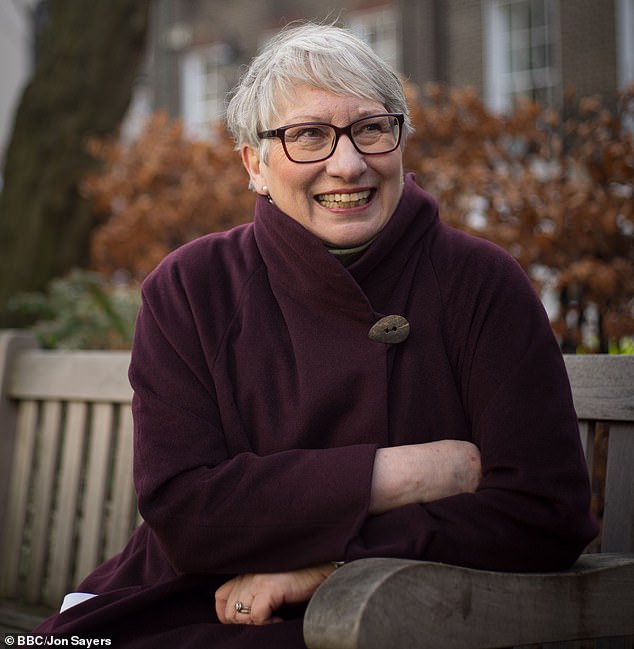
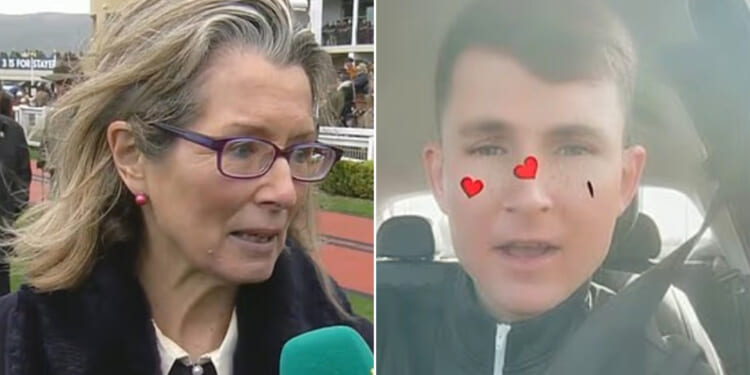
Dame Uta Frith, one of the biggest names in the autism world, argues that the autism spectrum has become ‘so accommodating’ that it is now ‘completely meaningless’
However, last week, the entire argument supporting this modern definition of autism came crashing down after one of the researchers who helped come up with the idea of the spectrum admitted that the term was now meaningless.
Dame Uta Frith is one of the biggest names in the autism world. The 84-year-old developmental psychologist is a medical icon. A titan in her field.
I remember reading her books and research when I was at medical school. Dame Uta was one of the first experts to argue against the orthodoxy of the time, that autism was not caused by a lack of parental love, but by developmental issues that occur during pregnancy.
For decades her work has shaped how clinicians, researchers and the public understand this complex condition. She also played a central role in the idea of autism existing along a spectrum. This is why her remarkable intervention last week was so striking – and so important.
In an interview with the education magazine Tes, Dame Uta argued that the autism spectrum has become ‘so accommodating‘ that it is now ‘completely meaningless‘ as a medical diagnosis.
She added that the concept of the spectrum ‘has come to its collapse‘.
In particular, Dame Uta raised concerns over the number of girls and women with social anxiety who are wrongly told or believe they have autism.
I‘ve followed Dame Uta‘s work throughout my career and I cannot overstate the significance of what she is saying. And I believe her argument has chilling implications for the way that the NHS currently treats young women who are diagnosed with autism.
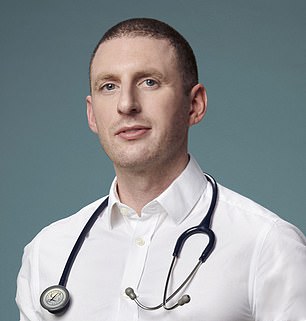
Consultant psychiatrist Dr Max Pemberton
So, what can be done to fix the problem?
First, it‘s important to explain how we got to this point.
When I first started working in the NHS nearly 25 years ago, I could count on one hand the number of autism patients I had seen. Now I see at least one a week.
However, the patients I see today have vastly different symptoms to those I first encountered.
They don‘t have severe, volatile meltdowns or self-harm. They don‘t have profound communication problems. These new patients describe vague feelings of not fitting in, social awkwardness, perfectionism and obsessive traits.
I want to be clear: I do not doubt that these patients are suffering. Their distress is real. But as a clinician, I have a duty to be honest: These patients do not have autism.
This issue all stems from the creation of the autism spectrum. The idea does have a certain logic. There is no test that can diagnose autism. And the condition is complex – no two patients have exactly the same symptoms.
The concept of the spectrum was intended to capture this genuine variation. But in medicine, when anything sits on a spectrum, there is inevitably ‘diagnosis creep‘.
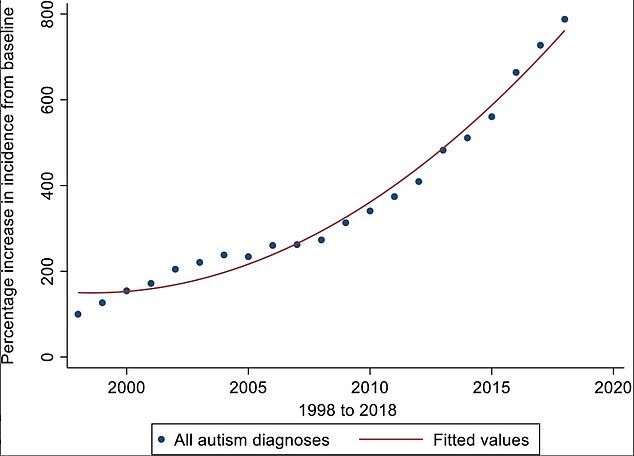
Autism diagnoses have risen by an ‘exponential’ 787 per cent over 20 years, according to recent research
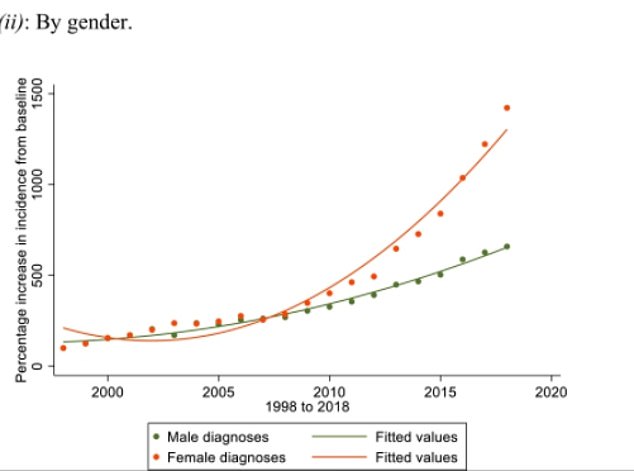
Diagnoses of autism among both men and women have both increased over the 20-year period, but especially among females
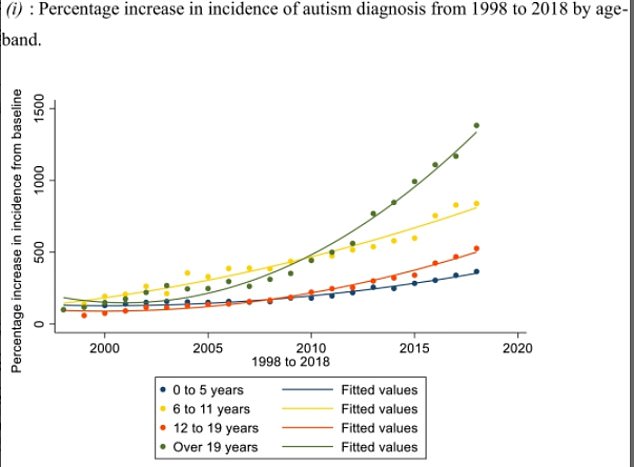
The average of autism diagnoses has generally increased over the period of the data used in the study
This is where the criteria are widened incrementally until the label risks becoming meaningless. A 2018 study from the universities of Montreal and Copenhagen found that the bar for diagnosing autism has been getting progressively lower for 50 years.
Astonishingly the researchers concluded that, if the trend continued, within a decade the entire population would be considered to have autism.
Another issue is the abandonment of the medical term Asperger‘s syndrome. Previously, patients with milder forms of autism were considered to have Asperger‘s. However, in 2013, the condition was done away with – in large part due to the fact that the Austrian paediatrician who it was named after, Hans Asperger, was argued to have been a Nazi.
This has meant that the already broad autism spectrum has become even wider.
Which brings us to what Dame Uta now identifies as the most pressing dimension of the crisis: the dramatic rise in diagnoses among adolescent girls and young women.
These female patients are without intellectual impairment but feel highly anxious in social situations. Often, these are women who make it to adulthood – having gone to university and held down jobs – before they seek out a diagnosis.
Dame Uta argues that the number of young women diagnosed with autism has risen at a ‘frightening rate‘.
Central to this surge has been the concept of ‘masking‘, the notion that women and girls have been historically under-diagnosed because they learn to conceal their autistic traits behind a veneer of social competence.
It is a theory that has spread rapidly and is now received wisdom in many quarters.
Frith, however, is now blunt about this: masking has ‘no scientific basis‘. As she puts it: ‘We could say we are all masking, all the time, trying to adapt to society‘s norms.‘ In other words, a desire to present as outgoing and socially savvy isn‘t a sign of a disorder, it‘s normal human nature.
Then there is the role that parents play in the rise in autism diagnoses. When your child is struggling, whether that‘s socially or in school, it‘s normal to want to find a reason.
This is why many parents push for their child to get an autism diagnosis, as it‘s easier to understand a child‘s difficulties as the product of a neurodevelopmental condition than to sit with the more uncomfortable possibility that their child simply might be an average pupil or a bit socially awkward.
A diagnosis offers parents a clean narrative. It absolves them of guilt.
This is understandable and I do not say this to condemn parents – I get the impulse entirely.
The problem is that, with a diagnosis comes accommodation, adjustments and financial support.
A report published last year by the think-tank Policy Exchange and backed by Jeremy Hunt, the former health secretary, concluded that the widening definitions of childhood development disorders such as autism and attention deficit hyperactivity disorder (ADHD) have cost the taxpayer an extra £16billion every year.
This is due to the growing costs of special education support in schools and NHS mental health services.
Worse still, the creation of the spectrum has hurt those who need our help the most – patients with severe autism.
A mother whose son has profound non-verbal autism requiring round-the-clock care with an uncertain adult future put the problem to me more strikingly than I ever could.
Imagine, she said, if everyone who had slightly imperfect vision, who squinted at signs or needed reading glasses or simply suspected they didn‘t see as well as they might, suddenly started calling themselves blind.
Imagine if they demanded support from services set up for blind people.
How would those who are actually blind feel? How would that change the way society understood and responded to their very real, very profound disability?
She was not being unkind about people with milder difficulties. She was asking us to consider what happens when a label is stretched beyond recognition, and who pays the price when it is.
The answer, I am afraid, is always the same. It is those at the most severe end who suffer the most. So what should we actually be doing to fix this problem?
Dame Uta is clear that we should not dismiss or ignore these anxious young women. ‘I would definitely not say they are making it up,‘ she said in the Tes interview. ‘But I would say that these are problems that can perhaps be treated much better than under the label of autism.‘
Many of these women likely have anxiety – or a form of the mental health condition called social hypersensitivity. Others may have depression. These are not minor issues.
Anxiety and depression blight the lives of millions – has far-reaching health consequences that shorten lives, and even leads some to suicide.
But the key difference to autism is that these conditions can be effectively treated. Research shows that talking therapy and, when necessary, antidepressants can be lifesavers for anxiety and depression patients.
These young, anxious women are not hopeless cases. With the right help, they can get better.
This is why labelling them as autistic is so dangerous. We are telling thousands of young, still-developing women that their problems are permanent and untreatable.
In doing so, we remove their agency and also any hope that their lives will improve. For many, an autism diagnosis is not a blessing but a curse. And it can cause real harm.