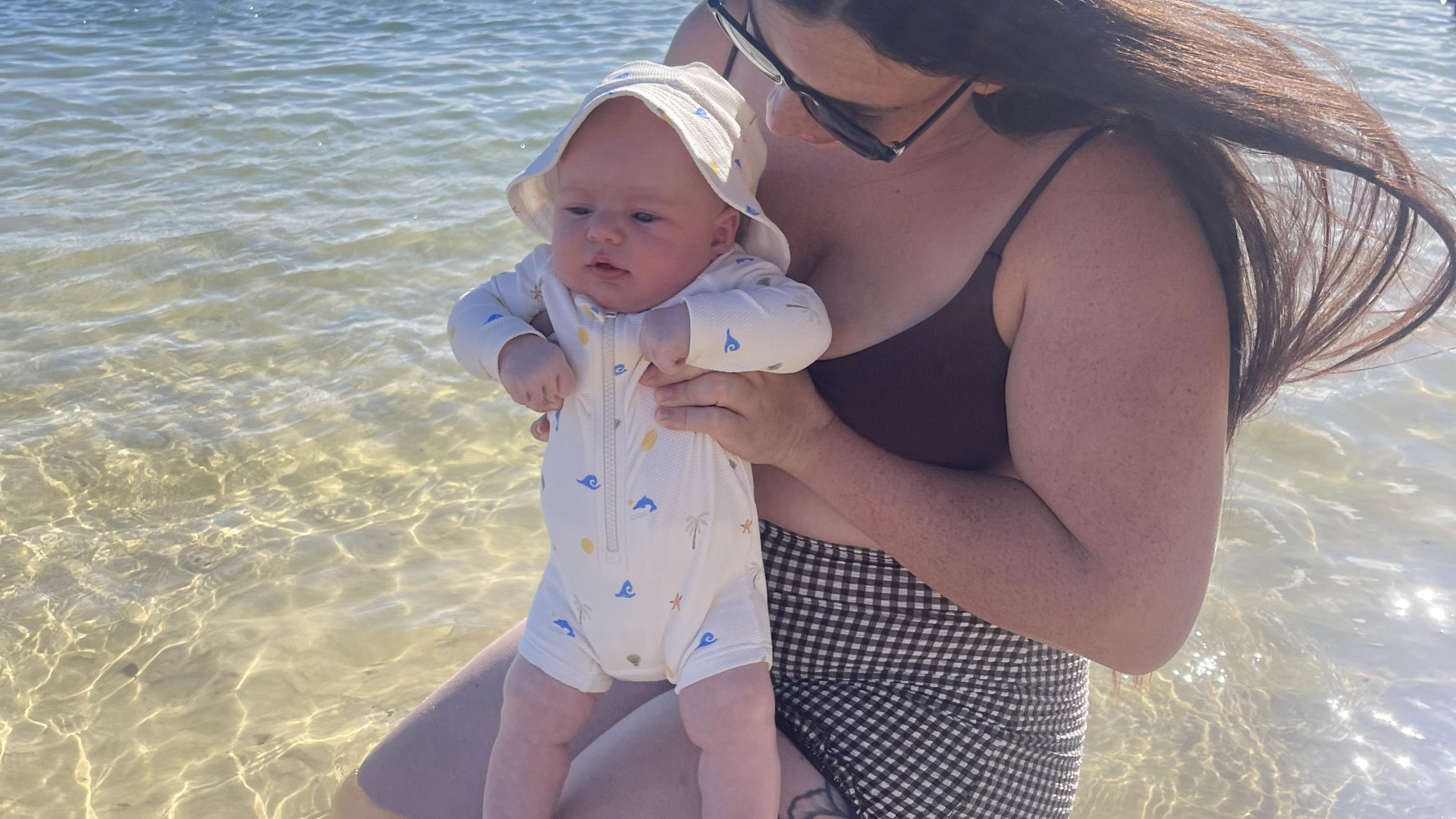
WE ALL have different ways of parenting, but one mum has come under fire after “abandoning” her baby to go for a swim.
A mum, who says she is “constantly risk assessing”, made an innocent video of her beach trip, participating in a trend where people ask their viewers to “keep an eye” on someone.


Despite raking in over four million views on TikTok, she did not get the reaction she expected.
Renee, 28, walked across the sand towards the sea, while her son laid on a towel resting in the shade.
She and her partner enjoyed a dip in the water, before heading back to their baby boy.
The mum felt safe leaving her son for a short while, after spending time on the same beach the previous day and connecting with another parent and their family – and Renee had felt safe leaving her child in their care for a moment.


Renee, who is from Brisbane in Australia, said: “As a mum, I am constantly risk assessing and taking in our surroundings, especially now with two kids.
“I felt very comfortable leaving him there with not only [the other mum] watching him, but also me and my partner watching from the water.”
Speaking about the video clip, the registered nurse added: “In the video, we may look far away, however, it was only about 10 metres.
“He only stayed asleep for four minutes before waking up.”
But many were left baffled by the decision. One person said: “This has to be a joke right?”
“That’s horrible,” said another viewer. “Do not ever do this again,” demanded one other.
Someone else commented: “With the way the world is going with current events, just how human nature is now, I would’ve never let my child there.”
One person commented: “I won’t even leave my phone, WTF, a baby? Are you serious?”
“I would never,” someone else agreed.
Renee said that while it is not evident in the footage, there was always someone watching her 10-month old.
The mum pointed out that there “was never any risk that anyone would kidnap” him.
On why she shared the clip, the mum said: “I had seen a trend where people would sit their babies in front of their phone and then leave the room, asking the internet to watch their baby, so I decided to set my phone up to do that.
“There was very minimal thought into it – I posted the video as a bit of light-hearted fun and did not intend to upset anyone.”
She added: “Some people lack critical thinking; they watch a 20-second video and comment quite horrible things with no context, which is very strange to me.”
Different parenting styles explained
There are four recognised styles of parenting explained below:
Authoritarian Parenting
What some might describe as “regimental” or “strict” parenting.
Parents with this style focus on strict rules, obedience, and discipline.
Authoritarian parents take over the decision-making power, rarely giving children any input in the matter.
When it comes to rules, you believe it’s “my way or the highway”.
Permissive Parenting
Often referred to as “soft parenting” or “yes mums/dads”.
Permissive parents are lenient, only stepping in when there’s a serious problem.
They’re quite forgiving and they adopt an attitude of “kids will be kids”.
Oftentimes they act more like friends than authoritative figures.
Authoritative Parenting
Authoritative parents provide their children with rules and boundaries, but they also give them the freedom to make decisions.
With an authoritative parenting style, parents validate their children’s feelings while also making it clear that the adults are ultimately in charge.
They use positive reinforcement techniques, like praise and reward systems, as opposed to harsh punishments.
Neglectful or Uninvolved Parenting
Essentially, neglectful parents ignore their children, who receive little guidance, nurturing, and parental attention.
They don’t set rules or expectations, and they tend to have minimal knowledge about what their children are doing.
Uninvolved parents expect children to raise themselves. They don’t devote much time or energy to meeting children’s basic needs.
Uninvolved parents may be neglectful but it’s not always intentional.
A parent with mental health issues or substance abuse problems, for example, may not be able to care for a child’s physical or emotional needs consistently.