When it comes to pushing back against the endless tide of woke dogma, one can never be complacent. Just when you think things have returned to some semblance of sanity, along comes something to remind us that the fanatics are still very much in charge, or at least they would like to be.
Last week, the NHS announced a wide-scale trial of puberty blockers among under-16s – in some cases children as young as ten – as part of a move to determine their efficacy in treating gender-questioning youngsters.
To be clear, these are not mere sweeties. They are drugs that pause or halt the onset of puberty, powerful hormonal treatments which can alter not only a person’s outward appearance but also their mental and physical state.
In females, they can induce menopausal symptoms, such as hot flushes, brain fog and anxiety; in males they halt the development of the sex organs, and if used long-term will very likely affect fertility.
In all cases they can result in mood swings, anxiety, depression, reduced bone density (especially in males, whose bones develop significantly during puberty), and potentially stunt growth.
In the past, these treatments were only ever used in rare cases of early onset puberty – and to chemically castrate sex offenders.
And yet the NHS now wants to inflict them on hundreds of under-16s (they are aiming to recruit at least 250) as part of this trial, in a £10.7million research programme. In other words, the NHS is going to run hormone experiments on underage children, at the taxpayer’s expense.
In any normal world, this would be considered a form of child abuse and treated accordingly. But in the trans fantasy world of pink unicorns and rainbows, it makes perfect sense.

Last week, the NHS announced a wide-scale trial of puberty blockers among under-16s – in some cases children as young as ten – as part of a move to determine their efficacy in treating gender-questioning youngsters (posed by model)
Why? Well, the excuse is the Cass report, which last year concluded that there was insufficient clinical evidence to show that the use of these drugs in gender-questioning children was a valid treatment path. The report suggested that more evidence was needed. Cue the announcement of this trial.
Participants will be randomised into two different groups: those who start the blockers immediately versus those who are given them after a delay of one year – and the trial will continue for two years, at which point the findings will be assessed and ongoing care needs examined.
That the findings of the Cass report – damning in all aspects of these kinds of treatments on young children – should be interpreted as requiring such action tells us everything we need to know about how the NHS has been captured by gender ideology.
No sane person reading that report could conclude that the next steps in providing responsible care and treatment for vulnerable children would be to turn them into human guinea pigs.
Especially when that is, in effect, what already happened at the now thoroughly discredited Gender Identity Development Service (GIDS) at the Tavistock and Portman NHS Foundation Trust.
If the NHS wants to gather evidence and data on the effects of these drugs on under-16s, they need look no further than the treatment records of the patients who went through their doors – which far exceed the numbers proposed for this trial – around 9,000 in total.
One of those was, of course, Keira Bell, a young woman who started her transition process at the Tavistock via puberty blockers and cross-sex hormones but later regretted the process, saying that she had not been capable of informed consent at the time – and that the gender dysphoria for which she was treated was in fact misdiagnosed depression.

Keira Bell was a teenager when she started her transition process at the Tavistock via puberty blockers and cross-sex hormones. She later regretted the process, saying that she had not been capable of informed consent at the time
She successfully challenged the use of puberty blockers on minors via the High Court, which ruled in her favour, concluding that it was highly unlikely a child aged 13 or under could give informed consent for puberty blockers; and it was doubtful for many aged 14 to 15.
Although the High Court ruling was later overturned by the Court of Appeal on a point of law, Bell’s case and Bell herself were instrumental in spotlighting the culture and practices at GIDS, and the way young people were being sent down irreversible medical pathways without a proper understanding of the long-term psychological and physical implications.
Bell more than anyone understands the harsh realities of these drugs. As she herself posted on X this week, ‘[The treatment] sent me into a menopause-like state: hot flushes, brain fog, worsened depression, anxiety and my bone density drastically decreased.
‘It did not provide a “pause” to think and reflect like these doctors claim.’
‘In fact,’ she adds, ‘I became more desperate to start cross-sex hormones [testosterone] and escape the compounded hell I was experiencing, which I did a year later. I also went ahead with a double-mastectomy at age 20.
‘I am included in the statistic of 98 per cent of children who proceed further down the pathway once they are initiated on puberty blockers.’
In other words, these drugs are not being used to ‘press pause’ on puberty, more as a precursor to permanent transitioning.
As Bell says, the treatment ‘is rightly described as a conveyor belt that will undoubtedly lead to infertility and lack of sexual function, to name only a couple.
‘A child cannot fully understand these effects, let alone those that are unknown.’
Those last words are so true. As any parent knows, you can explain stuff to your children until you are blue in the face but there are some things their brains simply cannot comprehend until they are older.
This is partly to do with the fact that some things just need to be experienced first-hand to be properly grasped but also to do with the fact that the part of the human brain responsible for complex decision-making, emotional regulation and risk-assessment – the prefrontal cortex – simply doesn’t fully develop until our mid-20s.
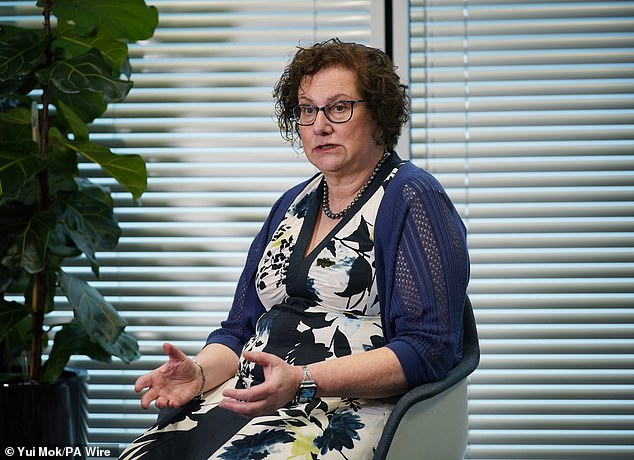
The Cass report, led by Dr Hilary Cass (pictured), concluded that there was insufficient clinical evidence to show that the use of puberty blockers in gender-questioning children was a valid treatment path, and suggested that more evidence was needed
It follows that when it comes to serious questions, such as whether to permanently alter gender, along with all the lifelong consequences that entails (including being permanently dependent on medication, potential infertility and sexual dysfunction), it is quite simply physiologically impossible for a child to make an informed decision – and also thoroughly irresponsible for any adult to expect them to do so.
This is why, quite rightly, we don’t allow people under the age of 18 (arguably it should be 21) to take part in certain actions or decision-making processes. They simply don’t have full capacity. In the context of the gender debate, that has nothing to do with transphobia. It’s just common sense.
If the NHS really wants to help improve outcomes for gender-questioning young people, the best thing it could do is track down each and every one of the people treated via GIDS since it was first established in 1989 – and find out how they are doing. That is almost 40 years of useful data, right there.
Information about these individuals’ levels of happiness, health, sexual satisfaction and other important factors in the wake of their treatment programmes would provide valuable data on how successful or otherwise these sorts of interventions are in helping people with gender dysphoria live functional, fulfilling lives.
There is no need to inflict these drugs on a whole new cohort of young people to determine their effects: there are plenty of existing test cases who are already living with the consequences of these decisions. The responsible thing to do is start there.