Following weeks of nervous expectation of a conflict with Iran, Israelis awoke Saturday just after 8 a.m. local time to blaring warning alerts on their cellphones.
The Israel Defense Forces (IDF) was instructing them to know where their nearest shelter is and to avoid unnecessary travel.
News soon spread: Israel had just launched a preemptive attack on Iran. The country was in a state of national emergency.
Why We Wrote This
Israeli civilians have been accustomed to hearing air-raid sirens and running to shelters. But after weeks of building anticipation of some new conflict with Iran, they awoke Saturday to messaging from their leaders that the stakes in this war would be far higher.
For Israelis, no strangers to conflict and in a constant state of war readiness since Hamas attacked from Gaza on Oct. 7, 2023, this was still new ground: an unprecedented joint attack launched with the United States against their archfoe, Iran.
Unlike the 12-day war Israel launched against Iran last June that the U.S. then joined, this highly coordinated war appears to have much broader aims. Beyond halting Iran’s nuclear program or ballistic missile production, its stated goal includes regime change in the Islamic Republic.
“Our joint operation will create the conditions for the brave Iranian people to take their fate into their own hands,” Prime Minister Benjamin Netanyahu told Israelis in a video address. The attack had been planned out for months by the Israeli and U.S. militaries, he said, vowing that this historic strike would “remove the existential threat posed by the terror regime in Iran.”
A message to the public from the Israel Defense Forces chief of staff, Lt. Gen. Eyal Zamir, implored civilians to follow the Home Front Command’s safety advisories and suggested they need to be ready for the long haul.
“We now face a significant, decisive, and unprecedented operation … to secure our existence and our future here, in the land of our forefathers, for generations to come.”
The first air-raid sirens sounded about five minutes after the initial warning.
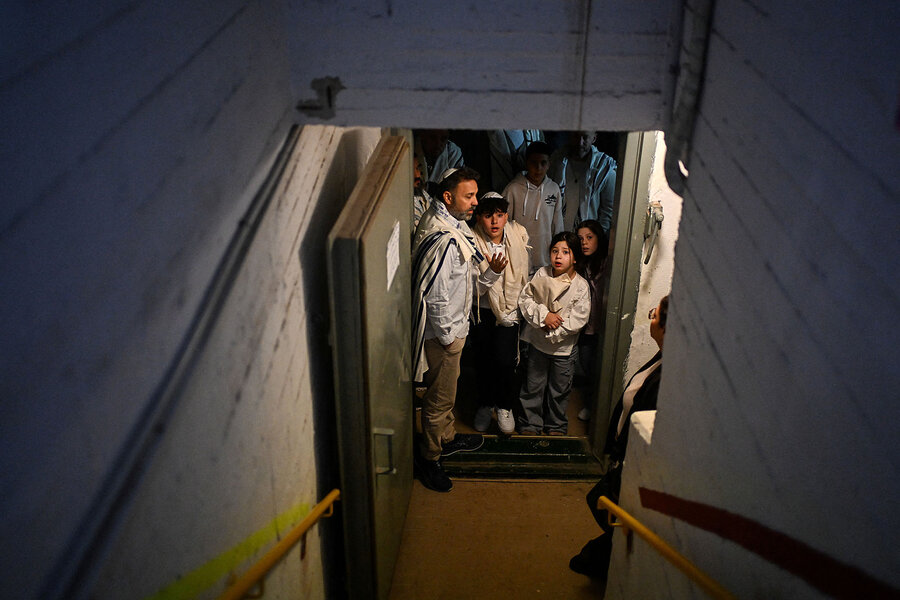
Sleepy-eyed neighbors, still digesting the news – some carrying down young children, others reining in barking dogs – congregated in the basement bomb shelters of their apartment buildings.
Others quickly made their way to large public shelters in underground parking lots or underground light-rail train stations. Campers in the Galilee found shelter in a concrete dugout.
For most of the day Saturday, air-raid sirens have been wailing across the country, rushing people back into shelters, often just minutes after they had emerged.
The country had been on edge for weeks, waiting out a mounting war of words and warnings between the sides. A recent poll conducted for Israel’s Channel 12 said 59% of Israelis favored joining a U.S. attack on Iran if the Americans failed in their stated goal of reaching a nuclear deal with the Islamic Republic.
One of the main military objectives in the war, now dubbed by Israel as Operation Roaring Lion, is to destroy as much as possible Iran’s sophisticated and extensive ballistic missile arsenal.
“In addition, Israel appears to have used the element of surprise to ‘decapitate’ senior Iranian political and military leaders,” Amos Yadlin, a retired major general and former deputy commander of the Israeli air force, posted on the social platform X. “In the coming days, the IDF’s focus will be on establishing a threat-free aerial ‘corridor’ and achieving air superiority for its aircraft over Iranian skies.”
In a briefing with journalists, Major General Yadlin said the attack was both a tactical and operational surprise, guided by what he described as Israel’s precise, real-time intelligence to target Iran’s political and military leaders.
He also said it’s likely Israel hit the leadership, as by law, the U.S. cannot strike foreign leaders. He described the joint attack on Iran as highly planned and choreographed.
“Israel knew that there will be an Iranian retaliation, and Israel has a multilayer system to stop the Iranians’ attack,” he told reporters. “The first and most important is attacking [missile] launchers in Iran, and this was done from the morning.”
According to an Israeli military source, Israel has mobilized some 70,000 reservists for aerial defense and border security. He said Iran has spent between $700 million and $900 million on bolstering its regional allies, primarily Hezbollah in Lebanon.
In the days before this attack on Iran, Israel conducted a wave of airstrikes against Hezbollah targets across Lebanon, including in the south.
The Israeli military source would not comment on reports in Israel that Iran’s supreme leader, Ayatollah Ali Khamenei, may have been killed in an airstrike on his compound. He said the focus of the airstrikes was military targets, but that much of the Iranian leadership “is involved in promoting attacks against Israel and promoting the destruction-of-Israel plan. And people who are involved in the plan to destroy Israel can be targets.”