Even as Israel and Iran recover from the short but damaging June war between them, the arch foes wrapped up the old year and began the new with a flurry of warnings and threats about a potential renewed conflagration.
Yet analysts caution that both governments are beset by mounting domestic challenges – increasingly violent street protests in Iran and election year politics in post-Oct. 7 Israel – and there’s a wide gap between the governments’ rhetorical needs and the countries’ strategic interests.
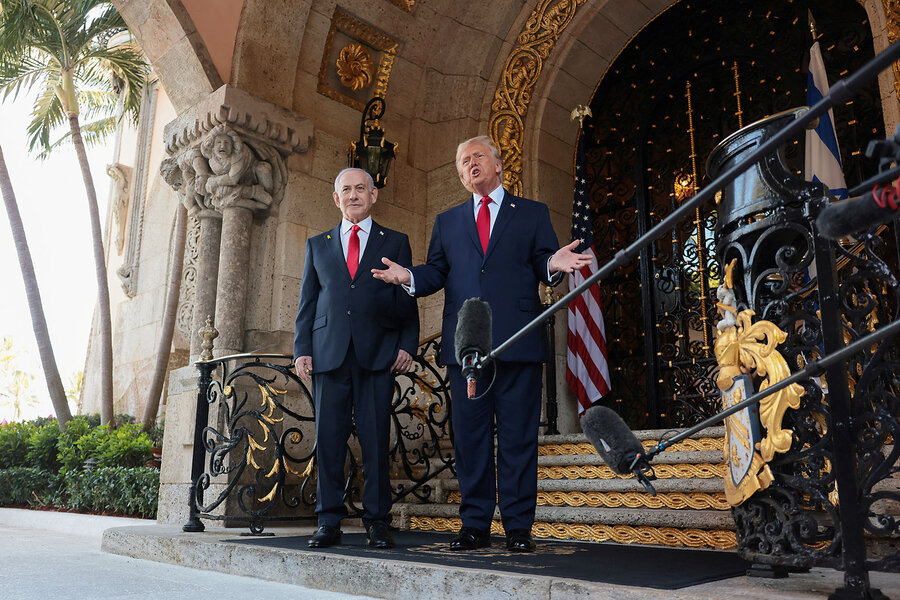
Meeting Dec. 29 at President Donald Trump’s Mar-a-Lago Club in Palm Beach, Florida, Israeli Prime Minister Benjamin Netanyahu warned that Iran’s reported efforts to rebuild its ballistic missile arsenal and nuclear enrichment sites are cause for alarm, not just for Israeli interests, but for American as well.
Why We Wrote This
Israel’s and Iran’s defenses are vulnerable and rebuilding after the June war – and not yet ready for another round – so why is the leaders’ rhetoric so bellicose? Both governments have an interest in deflecting dissent, but the rationale for renewed hostilities still exists.
Mr. Trump said the United States would back Israel and consider another major strike on Iranian military targets, as it did when it joined forces with Israel in June, and “knock the hell out” of it, if Tehran rebuilds its ballistic missile or nuclear weapons programs.
Iranian President Masoud Pezeshkian replied by threatening a harsh response to any attack, heightening talk of war in both nations. On Thursday, banners were hung in Tehran threatening further attacks on Israeli and American military sites.
But analysts in Israel and Washington see the saber-rattling as attempts to deflect from intense dissent both governments face, especially in Iran where widening anti-regime mobilizations have the country on edge. And a resumption of fighting, they note, not only would upend any vestige of regional stability that Mr. Trump says he seeks, but would find neither nation in a good position to defend its respective population.
More than 1,100 Iranians, among them senior security officials and scientists, were killed in the intense June war, as were 28 Israelis.

Both Iran and Israel need to rebuild their respective anti-ballistic missile defenses, which were depleted and damaged in June. A new war could stretch thin Israel, which, more than two years after Hamas’ Oct. 7, 2023, attack, faces unresolved conflicts from all directions. And the cost could be devastating to Iran, with its economy already reeling from sanctions and an increasingly worthless currency that is plunging Iranians into poverty.
Another war now would lead to “significant damage” to both sides, says Raz Zimmt, director of Iran and the Shiite Axis research program at The Institute for National Security Studies (INSS), a think tank in Tel Aviv.
Sense of urgency in Israel
Nevertheless, concerns remain.
“Iran’s leadership knows it needs to rebuild its crippled proxy armies, including Hamas and Hezbollah, and even expand operations into East Africa to create new logistics systems to replace capability lost in Syria, before it can put Israel in the vulnerable position it seeks,” explains Norman Roule, a former senior American intelligence official.
“Restoring proxy capability against Israel and other potential targets enhances Tehran’s overall security by requiring that adversaries dissipate intelligence, military, and diplomatic capability throughout the region and not concentrate them against Iran alone.”
Still, Mr. Roule, a senior adviser at the Center for Strategic and International Studies in Washington, cautions that while Iran is not prepared for conflict now, its long-term plans will be seen as an intolerable threat by Israel.
“Iran built the region’s largest missile force, but the size of the force failed to provide Iran with strategic advantage during the June war,” he says. “Iran’s goal may be to build a program so large and widely dispersed that neither Israel nor the U.S. could neutralize its threat in a lightning attack before Iran could launch a devastating retaliation.”

Majid Asgaripour/WANA/Reuters
If Tehran were to realize this goal, he argues, it “may believe that such a security umbrella would allow it to rebuild a nuclear weapons program or undertake aggressive proxy attacks on Israel without consequences.” For this reason, Israel is unlikely to “stand by while Iran builds an impenetrable missile system, and U.S. policymakers will share these concerns.”
In Israel there is already a sense of urgency. “We need to reconstitute our [defensive] capabilities, and the pace that we do this unfortunately might not be the pace that Iran is able to produce its missiles,” Eyal Hulata, a former head of Israel’s National Security Council, said in a Dec. 29 media briefing.
Defending Israel from daily ballistic missile barrages in June was extremely resource intensive, a “heavy burden,” he added. Israel relies in part on American missile interceptors. Its stockpiles were largely depleted by the fighting, and it is expected it would take time to replenish them.
Assessing the costs to both sides from a resumption of fighting, the INSS’ Dr. Zimmt says this time, Israel could target not just Iran’s ballistic missiles, nuclear facilities, and aerial defense systems, but also infrastructure and symbols of the Iranian regime in a bid to destabilize it. Iran, meanwhile, has learned important lessons about its missile accuracy and Israel’s defenses from the June war and will seek to inflict “as much damage as it can,” he says.
Citing Iran’s depleted air defenses, he says Tehran “is very unlikely, at least for now, to make a decision to strike Israel,” though he cautions against miscalculations by either side and the risk of Iran building up too many missiles for Israel not to respond.
Domestic discontent
With the Israeli and Iranian governments both confronting daunting domestic political environments, some observers say the urge to suppress dissent is fueling the hostile rhetoric.
It’s an election year in Israel, and Mr. Netanyahu is facing both a deepening backlash over accusations that two of his close aides accepted money from Qatar, and added pressure for a state commission of inquiry into the military and intelligence failures surrounding Oct. 7.

The Iranian threat and the still open fronts with Gaza, Lebanon, and Syria, “serve Netanyahu politically,” says Zvi Bar’el, Middle East affairs analyst for the Haaretz newspaper.
“As long as we can talk about a possible war with Iran,” the subtext is that Israelis should not engage in anti-government protests, “because they will be construed as a betrayal of Israeli security,” he says.
That said, if Mr. Netanyahu wants to have a war just to boost his ratings, “he would first have to convince President Trump,” says Meir Javedanfar, a lecturer at Reichman University in Israel. “He would have to present intelligence which President Trump will then have to corroborate with the CIA, showing that we must attack, and we must attack now.”
A similar dynamic may apply to Iran as it deals with protesters blocking roads and chanting anti-government slogans. Israeli officials reportedly are concerned that Iran could launch a surprise war on Israel as a distraction.
“Some people in the Iranian regime may want a war as an excuse to go and carry out a massive wave of arrests,” portraying the protesters as pro-Israel supporters, Mr. Javedanfar says.
President Trump, meanwhile, issued his own related warning to Iran in a post early Friday on Truth Social. If Iran “violently kills peaceful protesters, which is their custom, the United States of America will come to their rescue,” he wrote. “We are locked and loaded and ready to go.”