Ceramic fragments found near a site believed to be the last resting place of Noah’s Ark could prove the biblical boat really did exist.
Prof. Dr Faruk Kaya of Agri Ibrahim Cecen University said the pieces were found close to the alleged Ark outline at the Dogubayazit site on Turkey’s Mount Ararat, according to Turkish media.
The fragments were uncovered during road construction near the Durupinar Formation in Agri province, a boat-shaped geological structure that has been at the centre of Noah’s Ark claims for decades.
Academics involved in the research said the ceramic material points to human activity in the region during the Chalcolithic period, roughly between 5500 BC and 3000 BC, a timeframe that some scholars and believers associate with the era traditionally linked to the Biblical figure of Noah.
Prof Dr Kaya said: ‘The ceramic fragments show that there was human activity in this region during the Chalcolithic period, between 5500 and 3000 BC.’
The fresh revelations have also prompted renewed calls for the site to be formally protected, amid concerns that visitors are removing stones and fragments as souvenirs.
Prof Dr Kaya said: ‘This formation and its surroundings must be protected, and the removal of stones, rocks or similar material from the site must be prevented.’
He warned that tourists had been taking material from the area, including stones bearing markings, potentially damaging what researchers believe is an important archaeological and religious heritage site.
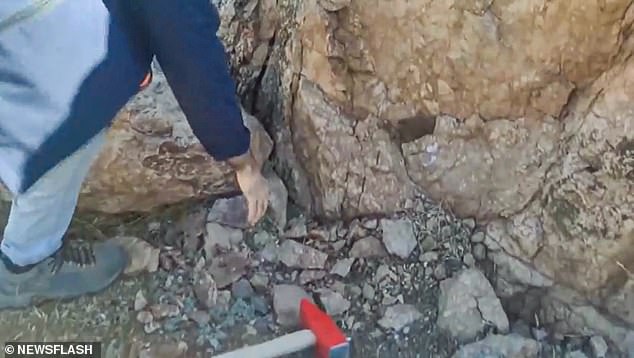
Ceramic fragments found near a site believed to be the last resting place of Noah’s Ark could prove the region was settled by humans at the time of the Great Flood
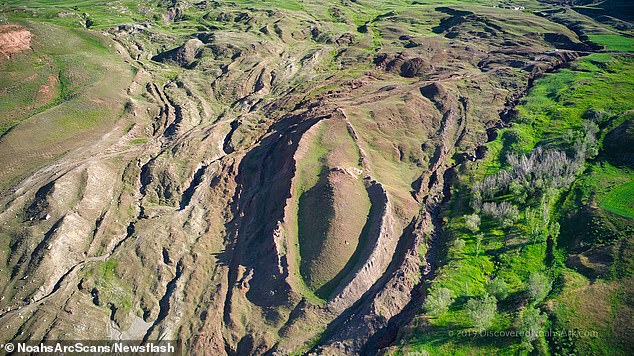
The fragments were uncovered near the Durupinar Formation in Agri province, a boat-shaped geological structure that has been at the centre of Noah’s Ark claims for decades
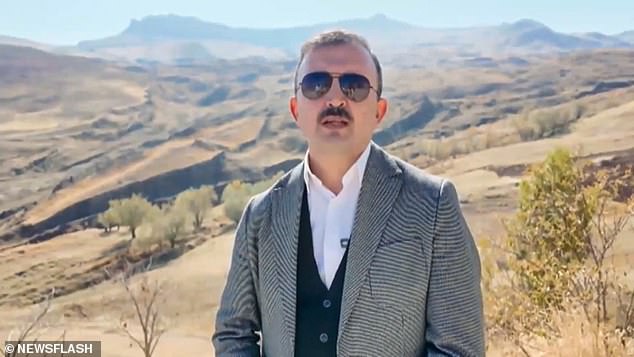
Prof Dr Faruk Kaya (pictured), of Agri Ibrahim Cecen University, said the pieces were found close to the alleged Ark outline at the Dogubayazit site on Turkey’s Mount Ararat, according to Turkish media
The Durupinar Formation was first identified on 11th September 1959, by Captain Ilhan Durupinar, a Turkish surveying engineer who spotted the structure while mapping eastern Anatolia from an aircraft operated by the Turkish Armed Forces.
Heavy rain and earthquakes later eroded surrounding earth, exposing more of the formation’s outline.
The structure has long drawn attention because of its boat-like shape and its proximity to Mount Ararat, Turkey’s highest peak, which has been associated with the Ark in Christian tradition for centuries.
The Bible’s Book of Genesis states that Noah’s Ark came to rest on the ‘mountains of Ararat’ after a flood that submerged the Earth for 150 days.
Biblical measurements describe the Ark as 300 cubits long, 50 cubits wide and 30 cubits high, dimensions that some researchers argue broadly correspond to the scale of the Durupinar site.
Prof Dr Kaya said the dating of the pottery broadly aligned with traditional estimates of Noah’s lifetime.
He said: ‘This period roughly coincides with the time in which Prophet Noah is believed to have lived.’
Scientific interest in the area has intensified in recent years.
The Mount Ararat and Noah’s Ark Research Team was formally established in 2022 through a collaboration between Agri Ibrahim Cecen University and Istanbul Technical University, bringing together experts in geophysics, chemistry and geoarchaeology.
Rock and soil samples collected from the formation were analysed in laboratories at Istanbul Technical University.
Researchers said the results indicated that sustained human life in the region was possible from the Chalcolithic period onwards, adding further basis to the claim that it could be the real-life Biblical site.
The pottery fragments discovered during the recent roadworks are being viewed as a notable development, as ceramics are widely regarded by archaeologists as one of the clearest indicators of human settlement.
Prof Dr Kaya said: ‘There is no other structure like this identified anywhere else in the world,’ describing the formation as unique in both scale and shape.
He also raised concerns about natural threats to the site, warning that landslides – particularly during spring rains – were eroding both sides of the formation and accelerating damage.
As part of wider preservation efforts, Prof Dr Kaya suggested that a dedicated Noah’s Ark museum or research centre should be established near Mount Ararat, arguing that similar themed attractions already exist in countries such as the United States, the Netherlands and Hong Kong.