Even some of the supporters of the anti-UPF fad have backed away from its most dramatic claims

Remember Joe Wicks, the chirpy gym bunny whose YouTube channel got children exercising during lockdown? He was quite famous in the spring of 2020 but was rather less famous five years later. In 2021, at the peak of its success, Joe Wicks Ltd. had £2,181,299 in the bank. By 2024, it had just £78,758.
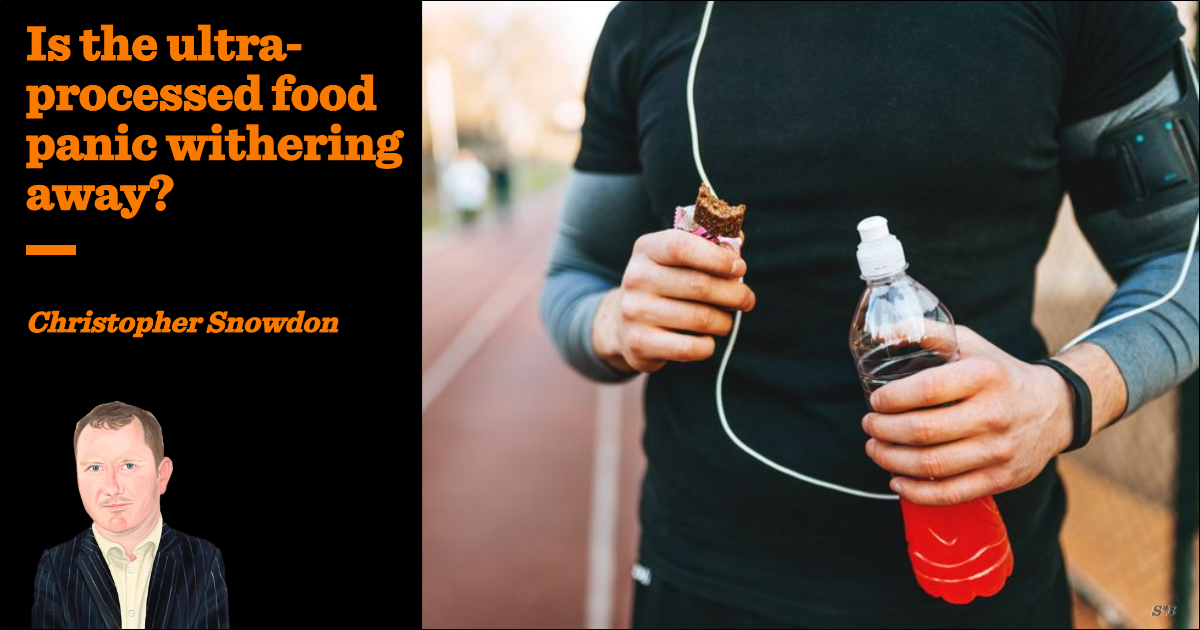
Whether the fading fame and fortune of Mr Wicks had anything to do with his decision to get onboard the bandwagon against ultra-processed food (UPF), we may never know, but it has certainly got him back on prime time TV. He has been on the breakfast sofa with Ed Balls and Susanna Reid, and viewers were treated to a whole hour of him on Channel 4 this week (Joe Wicks: Licensed to Kill). His promotional device is the “Killer” protein bar which he has created and is portraying as “the most dangerous health bar” ever. It supposedly causes cancer, stroke and heart disease — and yet it is legal! Why won’t the government do something?!
Inevitably, the documentary involves Wicks going on a poorly scripted “journey” to discover the truth about what is really going on in our food environment, blah, blah, blah. Equally inevitably, his tutelage leans heavily on the opinions of Chris van Tulleken who has recently been made a professor and is beginning to look as crazy as he sounds. For cinematic reasons, van Tulleken is portrayed as living in a dimly lit, underground laboratory surrounded by bottles of dangerous chemicals. The vibe is that of a strange but brilliant scientist who has accidentally unleashed the zombie apocalypse and is humanity’s only hope of ending it. Once Wicks gets to work manufacturing his unhealthy snack, van Tulleken occasionally surfaces with an intense stare, urging his youngish protégé to see it through to the end.
The “Killer” bar is terribly dangerous because it is “ultra-processed”, of course. Wicks and van Tulleken think such products should have health warnings on them, but what exactly should people be warned about? Van Tulleken mentions three ingredients that particularly concern him.
The first is aspartame, an artificial sweetener that he tells Wicks has classified as a Group 2B carcinogen by the World Health Organisation. That sound scary unless you understand that the WHO’s International Agency for Research on Cancer (IARC) rates cancer risk by the strength of the evidence, not the size of the risk. Group 1 carcinogens include things like tobacco and radiation for which there is “sufficient evidence of carcinogenicity in humans”. Group 2A includes things like red meat and frying food for which there is evidence of cancer risk from animal studies but “limited evidence of carcinogenicity in humans”. Group 2B is the same as 2A except that it includes substances for which there is “little or no information about whether it causes cancer in humans”. Aspartame is in that category alongside aloe vera, pickled vegetables and being a carpenter.
IARC is notoriously reluctant to say that something doesn’t cause cancer. It has classified more than a thousand substances and activities since 1971 but has only ever put one in the lowest category of “probably not carcinogenic” (caprolactam). Even that is now in Group 3 (“carcinogenicity not classifiable”) because IARC abolished Group 4 in 2019. Since IARC never gives anything a clean bill of health, we must look elsewhere and consider that aspartame has been approved as safe for human consumption by every major food regulator in the world and, according to Cancer Research UK, sweeteners such as aspartame are “unlikely to cause cancer. The best studies of people do not show a link between artificial sweeteners and cancer.”
The second ingredient is polyols, or sugar alcohols, which occur naturally in many fruits but which are also used in some processed foods, notably chewing gum. Van Tulleken claims they can cause diarrhoea. In large enough doses, this is true. That is why food products which contain more than 10 per cent polyol must be labelled with the warning: “Excessive consumption may produce laxative effects”. Very few products do.
The third ingredient is glycerol which is sometimes used as a sweetener and humectant in food. Van Tulleken says that glycerol consumption has led to more than 20 children collapsing in Britain in recent years. This is also true. You may recall reports earlier this year about kids passing out after drinking ice drinks such as Slush Puppies. But this was a direct consequence of the sugar tax and the government’s desire for “reformulation”. Without sugar to raise the freezing point of water, glycerol was needed to stop the drinks turning into solid ice. In doing so, a harmless treat was turned into a mild health risk, albeit only for young children. The Food Standards Agency says that children aged under seven should not consume drinks that contain glycerol.
It is notable that all three of the additives specifically mentioned by van Tulleken are substitutes for sugar and are only used in food and drinks so the manufacturers can market them as having “no added sugar”. Insofar as they pose a risk to health, it is an unintended consequence of the anti-sugar hysteria which directly preceded the anti-UPF hysteria.
The science behind the anti-UPF fad serves only to make the rest of nutritional epidemiology look respectable
It is not clear whether any of these ingredients are in the “Killer” bar, but it scarcely matters because the bar is ultra-processed and therefore inherently dangerous according to van Tulleken. Presumably referring to survey-based epidemiological studies, he claims that there is “good evidence” that dementia, anxiety, depression, diabetes, cancer and obesity are all caused by an ultra-processed diet. He adds that ultra-processed food often contains emulsifiers which could harm health by “damaging the microbiome, possibly leading to cancer”.
The science behind the anti-UPF fad serves only to make the rest of nutritional epidemiology look respectable (a study published this week found an association between ultra-processed food and suicide attempts). Lumping together all “ultra-processed food” from gummy bears to sliced bread has never made any sense. Although van Tulleken insists that it is not the fat, salt and sugar but some mysterious process in capitalist food production that is the problem, he recently co-authored a study which showed that people lose weight on an ultra-processed diet so long as the diet is nutritionally balanced.
The penny is starting to drop and the ultra-processed panic is wearing thin. The Joe Wicks documentary may prove to be its high watermark. By demonising protein bars, which are an unquestionably healthier substitute for chocolate bars, Wicks may have planted the seeds of the fad’s destruction. Criticism of him has come from some unexpected quarters in recent days. Tim Spector, author of numerous diet books and creator of the ZOE app, has written two scathing op-eds and ZOE’s head nutritionist, Federica Amati, has written another.
Until recently, Spector was a fully paid up member of the anti-UPF cult. He said last year that he has “been banging the drum about the dangers of our quite frankly out-of-control ultra-processed food (UPF) consumption in the UK for years”. Indeed he has. His anti-UPF rhetoric has been identical to van Tulleken’s. He has had van Tulleken on his podcast several times and agrees with him about the alleged hazards of mass produced bread. In 2023, he echoed van Tulleken’s line about UPFs being “an industrially produced edible substance” by calling them “edible food-like substances” and “fake foods”. Like van Tulleken, he wanted health warnings on them and claimed that people should simply “avoid ultra-processed foods”.
Maybe it’s a case of sour grapes after the Advertising Standards Authority ruled that one of his food supplements was ultra-processed or maybe the evidence has changed, but Spector now says that ultra-processed foods “exist on a spectrum. The risks depend on what’s in them, how often we eat them and what the rest of our diet looks like. Lumping all the many thousands of ultra-processed foods into one bucket is just bad science.” In an article titled “Joe Wicks is scaremongering — not all ultra-processed foods are bad”, he claims that only 20 per cent of processed foods are unhealthy. His head nutritionist echoes this, saying: “Our research shows only around 20 per cent of foods fall into the truly high-risk category — not 60 per cent, as the programme implied.”
Spector is now promoting “the ZOE processed food risk scale”, an app that “tells you how risky a product is simply by snapping a photo.” Readers who are familiar with Professor Spector will not be surprised that this comes at a price (£9.99 a month with an optional “gut health test” for an additional £149). Those who are concerned about ultra-processed food can now find out which ultra-processed foods they should be concerned about. It seems that the science is not settled. Where would the market for diet gurus be if it was?