Western leaders have spent the last year attempting to will a dangerous fantasy into existence: that Syria’s new government is a credible partner. US President Donald Trump hosted the new Syrian President at the White House; UK Foreign Secretary David Lammy pledged hundreds of millions of pounds of British taxpayers’ money to the new regime, and Germany reopened its embassy in Syria. These leaders decided that decades of hard-won counterterrorism lessons could be replaced with wishful thinking. But the horrific footage coming out of northeastern Syria over the past week should finally put an end to that self-deception.
Since the fall of Bashar al-Assad in late 2024, Syria has been governed by the Sunni Islamist militant group Hayat Tahrir al-Sham (HTS). HTS, formerly Jabhat al-Nusra, was al-Qaeda’s Syrian affiliate until it rebranded in 2017 under Abu Mohammad al-Jolani, who is now styling himself President of Syria. Al-Jolani is a veteran jihadist who was held in U.S. detention in Iraq for years. The US Department of State even had a $10 million bounty on his head until December 2024. And when Trump met al-Jolani in Riyadh in 2025, the Syrian leader was still on the State Department’s list of Specially Designated Global Terrorists.
A costume change is apparently all it takes to fool the West
For obvious reasons, al-Jolani has since attempted a slick rebrand — displaying an unexpected talent for marketing — which is why he now likes to use a different name with Western media: Ahmad al-Sharaa. It’s also why he switched out the fatigues for a tailored suit and trimmed his bin Laden-esque beard. A costume change is apparently all it takes to fool the West.
At their meeting in Riyadh, President Trump set clear conditions for lifting U.S. sanctions on Syria: sign the Abraham Accords, expel Palestinian terrorists and foreign jihadists (many of whom are still part of al-Qaeda’s global network), take responsibility for managing detention centers holding Islamic State prisoners, and help prevent the Islamic State’s resurgence. Al-Jolani committed to none of these. Nevertheless, Trump lifted sanctions.
What followed should surprise no one. HTS forces have since carried out widespread atrocities against Syria’s non-Islamist minorities – Alawites, Druze, Christians, and now the Kurds. The latest and most consequential violence is unfolding in northeastern Syria, in the Kurdish-administered region known as Rojava.
Since 2012, the Kurds have maintained a de facto autonomous zone in northeastern Syria. Its military backbone, the Syrian Democratic Forces (SDF), became the West’s principal on-the-ground partner against the Islamic State, ultimately dismantling ISIS’s territorial caliphate in 2019. In the aftermath, the Kurds were left managing one of the most dangerous legacies of that war: thousands of captured ISIS fighters and tens of thousands of radicalised ISIS family members.
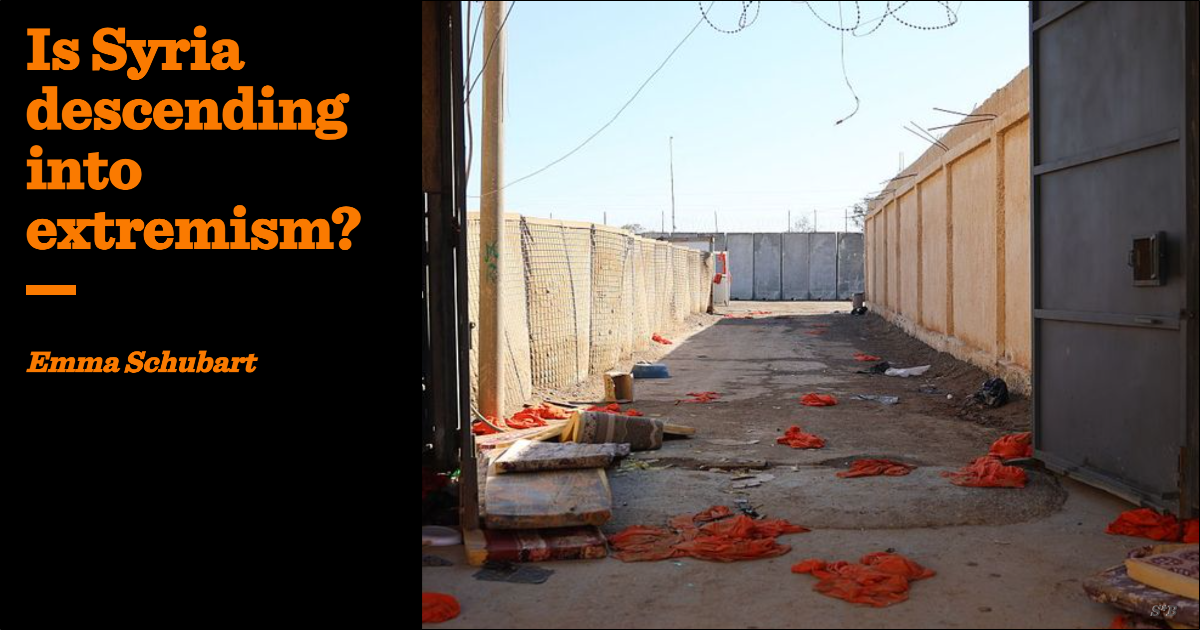
Since 2019, Kurdish authorities in Rojava have guarded a network of prisons and detention camps holding approximately 9,000 male ISIS combatants and more than 43,000 ISIS-linked women and children (including Shamima Begum). That system is now collapsing.
Beginning on 13 January, HTS-backed forces, supported by Turkey and jihadist militias from across the region, launched a coordinated assault on Kurdish areas. These forces have been shelling Kurdish neighbourhoods and carrying out ISIS-style atrocities: torturing and mutilating children, enslaving women and girls, burning civilians alive, beheading, slitting throats, and desecrating corpses.
The Syrian government claims these attacks are the result of Kurdish refusal to “integrate” into Syria. In reality, the Kurds signed an integration agreement in March 2025, under intense international pressure. But after watching Syrian forces massacre Alawite, Christian and Druze communities later that year, surrendering their weapons and autonomy look less like compromise and more like suicide. Supposedly in response to their resistance, President al-Jolani launched this offensive against Kurdish areas across the country.
So why is HTS really attacking the Kurds? According to former CIA targeter Sarah Adams, as far as the Syrian government is concerned, minority groups — whether it’s the Alawites, Druze, Christians, or Kurds — ”are going to get in the way of the [Syrian] government’s ultimate goal of finally declaring an Islamic caliphate again in Syria. That is the goal, no matter who tells you otherwise. That’s the goal of the Turkish government as well, which is why they support this regime.”
And this is why HTS forces appear to have deliberately targeted Kurdish-run ISIS detention centres, freeing thousands of detainees over recent days. The Syrian government denies the releases, and any kind of genocidal violence, claiming that only 120 ISIS detainees “escaped”, but that most have been recaptured.
That strains credulity. Just look at what appears to be a video of Syrian soldiers escorting male ISIS terrorists out of prison, or the footage of former ISIS prisoners openly confirming that they were freed by HTS. Or the videos of armed militants storming detention facilities while chanting “Allahu Akbar”. Or the photograph of freed high-value ISIS fighters posing on a couch. Or the videos of the mass breaches at Al Hol ISIS detention camp (which held around 25,000), sending thousands of ISIS affiliates back into the wild. Or the footage of visibly terrified Kurdish girls who have been captured by HTS and other Islamist thugs. Or the video of HTS terrorists desecrating the graves of Kurdish fighters who died fighting ISIS.
There is already evidence that HTS is absorbing released ISIS fighters into its ranks. In televised coverage, the ISIS emblem can be spotted on the uniforms of gunmen participating in HTS operations.
This is the threat picture delivered to us by Western leaders who chose convenience over realism. HTS appear to have slaughtered our Kurdish allies, displaced survivors, and freed thousands of the most dangerous terrorists on the planet. Now the black flag of ISIS is once again flying in Raqqa, the former “capital” of the caliphate.