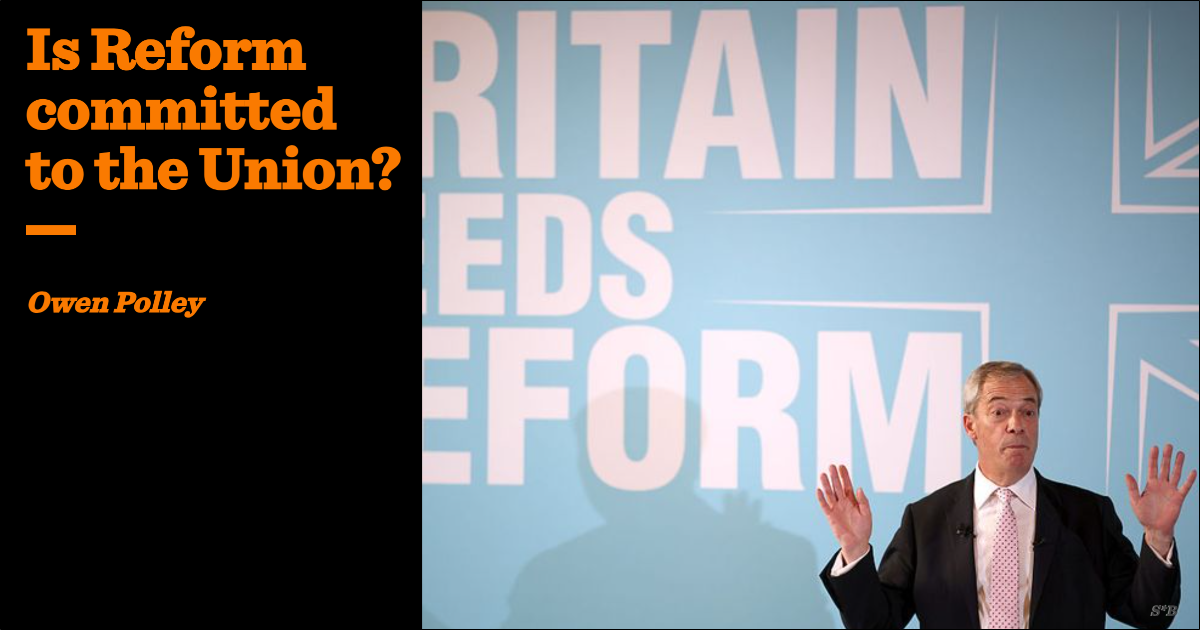
During the EU referendum debate, critics of Brexit often alleged that it was an “English nationalist” project, which they regarded as a damning indictment. The same slur is now frequently directed at Nigel Farage and Reform UK, by their opponents in the devolved regions. It was a claim that had become increasingly difficult to justify, as the party’s election performances and opinion poll results improved across the country, while defectors provided it with more political representation.
Last week, though, Reform’s leader in Scotland, Lord Offord of Garvel, suggested that Scottish separatists should vote for his party at Holyrood elections in May, as a staging post to independence. A Reform government in Edinburgh, he argued, would cut Scotland’s deficit, and leave it in a stronger position to leave the Union. According to The Times, he ruled out a referendum on independence for the next ten years. But claimed that a decision could be made later on the basis of “strength, not just emotion.”
Reform is the bookmakers’ favourite to win the next general election and still holds a significant lead in opinion polls, so this raises fresh questions about its attitude to the United Kingdom. Can the party be described as unionist and can it be trusted to keep the nation together, if it forms the next British government? These were things that some pro-Union politicians in Scotland, Northern Ireland and Wales were already asking, in the light of some of Farage’s previous comments.
It is certainly inaccurate to describe the Reform leader as an “English nationalist”. That phrase implies that he wants to dissolve the UK in favour of an independent England, which he has never said. When he was the leader of UKIP, though, Farage did suggest that the House of Commons should become a de facto English assembly, with the House of Lords acting as “the Union parliament” for a federal UK. This was an eye-catching plan to revamp the constitution, even if it was foolhardy, but he was never likely to have been able to actually implement it.
It was also mooted during the era of coalition government when the so-called “West Lothian question” was taken very seriously. Many commentators felt that it was unfair for Northern Irish and Scottish MPs to vote on policies that applied only to England, when English MPs could not vote on issues that were decided by the devolved administrations. Indeed, the problem exercised many Conservatives in government. It would eventually result in David Cameron’s short-lived English Votes for English Laws mechanism, which was dropped in 2021 because it had been used so infrequently.
The “nationalist” label may be a slur rather than a serious point, but there is more substance to the idea that Farage does not think much about the Union or the devolved regions of the UK. The Reform leader has appeared particularly confused, at times, about Northern Ireland. While apparently supporting its British status, Farage also claimed that the province’s annexation by the Republic was “inevitable” and praised the Sinn Fein president, Mary-Lou McDonald. He even recorded himself unwittingly repeating the IRA slogan, “up the ‘Ra”, in a birthday message on an online video platform.
When Farage became Reform’s leader, just before the general election, the party had an electoral pact with the Traditional Unionist Voice (TUV) in Ulster, based on a slate of shared policies. Farage promptly disregarded this arrangement, backing two rival DUP candidates, including Ian Paisley in North Antrim, who eventually lost his House of Commons’ seat to the TUV’s leader, Jim Allister.
Then, after announcing last year that his party would deport up to 600,000 immigrants and leave the ECHR, the Reform leader appeared to claim that this proposal would breach the Belfast (Good Friday) Agreement. He implied that a solution that included Northern Ireland could take “years and years” to develop, before admitting that the province was not in any case at the forefront of his mind. It was difficult to imagine any other pro-Union party leader referring to an integral part of the UK so dismissively and, according to Policy Exchange among others, his assertion that the agreement needed to be renegotiated was also just plain wrong.
Farage’s sympathisers maintain that, while he is sometimes poorly briefed on devolved matters, he is a strong unionist. This may be true, but he often gives the impression of improvising on issues he knows little about. In Scotland last year, he suggested that the Barnett Formula, which determines the funding for devolved regions, should be replaced or changed, without providing any details of an alternative. The Scottish Conservatives, who describe the formula as the “Union dividend”, claimed his intervention would delight the SNP. It is not that Farage’s ad-lib was necessarily wrong, but it was an odd thing to raise at an event designed to boost Reform’s chances of winning votes in Scotland.
The party, of course, is no longer just about its leader. Reform has attracted several high-profile Conservative defectors, some of whom have serious unionist credentials. Danny Kruger, who is leading Reform’s preparations for government, has described the Windsor Framework as “selling the birthright of Northern Ireland” to play a full role in the UK. He has also written about the need to rule out another independence referendum for Scotland for the foreseeable future. Andrew Rosindell, the former shadow foreign minister who joined Reform last month, described the Irish Sea border as a “shameful betrayal of Northern Ireland.”
Many unionists still doubt whether Reform thinks much at all about keeping the UK together
That has not prevented critics, like the new Ulster Unionist leader, Jon Burrows, from suggesting that Farage as PM would be a “disaster for the UK”. The Conservative leader, Kemi Badenoch, told the Scottish Tory conference last year that he was a “threat to the Union”.
In Ulster, Scotland and Wales, though, many voters are just as fed up with the traditional parties as their counterparts in England. They are equally as worried about immigration, high taxes, the cost of net zero, failing public services and other themes that have driven Reform’s success. In Scotland and Wales, the party is already second in opinion polls, behind the SNP and Plaid Cymru, while half of unionists in Northern Ireland say they would consider giving it a vote, if it were to stand in elections there. From almost nothing in the devolved regions, this is a remarkable achievement. Yet many unionists still doubt whether Reform thinks much at all about keeping the UK together or whether it’s committed enough to the Union to avoid doing it serious damage while in government. The decision to portray itself as a potential route to a separatist Scotland will do nothing to reassure those doubters.