I have zero musical ability. (I like to joke that I am a triangle virtuoso.) And yet, my 2026 New Year’s resolution is to write a Top 40 hit. How? I’m going to utilize an artificial intelligence app. AI now allows ordinary people like me to create professional-sounding songs via text-based prompts. I may even rope in Taylor Swift to sing my chart-topping masterpieces. She’s on the roster of Universal Music Group, which is reportedly going to allow the music app Udio to mimic its artists. Just don’t ask me how I’m going to perform my AI hit song when “Saturday Night Live” invites me to be the special musical guest.
But enough of my delusions of grandeur. I’ll stick to writing about culture. As part of my beat, I have been tracking the impact of AI in the arts. You may have seen some of the headlines. Breaking Rust, a computer-generated artist with 2.4 million monthly listeners on Spotify, recently scored a No. 1 hit on the download charts with the song “Walk My Walk.” Meanwhile, in Hollywood, AI actor Tilly Norwood generated a volume of press normally reserved for the likes of Sydney Sweeney. AI is also impacting publishing. Bestselling but controversial writer James Frey utilized AI in the composition of his latest novel, “Next to Heaven.”
Some creative types are embracing these new tools, excited about the expansive and liberating possibilities they offer. Others are cautious. Here’s what I think most worries many people: What if we can’t tell the difference between artistic works generated by a machine and those created by a human? We think of ourselves, humans, as special. The arts have always been a soulful expression that reflect our deepest values. Yet if we embrace AI-generated songs, movies, artwork, and books that pass a sort of artistic Turing test, some fear it comes at the expense of our humanity. That we lose something of ourselves, our essence, by outsourcing art to machines. As I have grappled with these questions, I’ve found it helpful to observe industry trends and how creative types are thinking about them.
Why We Wrote This
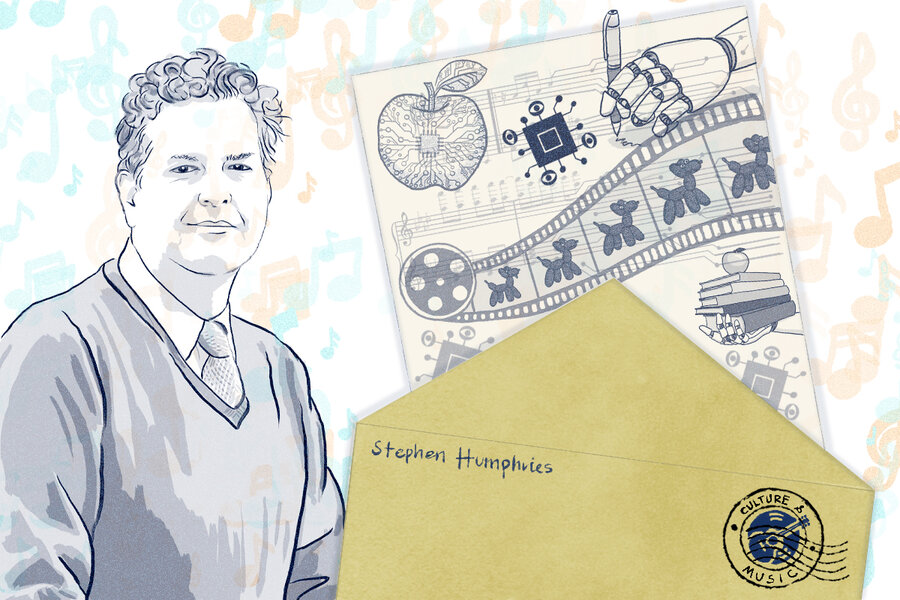
New technology can lead to new art forms. Proponents say artificial intelligence can democratize music or art, making it possible for anyone to become a songwriter or published author. Critics argue that devalues the time it takes to master an instrument or a craft. And it ignores the heart and life experience people pour into creative expression. If art is easy, is it still art? Culture writer Stephen Humphries thinks it’s a different question that most worries people: What if we can’t tell the difference between artistic works generated by a machine and those created by a human? We think of ourselves, humans, as special. The arts have always been a soulful expression that reflect our deepest values.
For starters, let’s look at The Walt Disney Co. Last month, its Pixar Animation unit released the trailer for “Toy Story 5.” It depicts Woody and Buzz Lightyear shrinking in terror as a child unwraps a new plaything, a tablet with interactive speech. The 2026 movie’s tagline: “The age of toys is over.” It suggests a meta theme about the impact of artificial intelligence on humans. The world we are accustomed to will be swept away by this burgeoning technology. (That’s ironic coming from Pixar, which pioneered the computer animation that made swaths of hand-drawn animators redundant.)
Meanwhile, an imminent Disney initiative would turn Woody and Buzz into the playthings of people outside Pixar. Disney CEO Bob Iger announced that AI will allow users of Disney+ to “create user-generated content and to consume user generated content – mostly short-form – from others.”
It’s a startling shift. Disney has long lobbied Congress to extend copyrights to keep its characters out of the public domain. Except now there are financial incentives to essentially lease everything from Mickey Mouse to Moana.
Is this a good idea? Actor Zachary Levi (“Chuck” and “Shazam!”) believes that empowering AI to allow anyone to create anything they can dream of sounds great in theory. But he argues that, just because creativity flows through each of us, it doesn’t mean we’re all artists. That requires spending time learning and honing a skill or talent. “If AI is doing all the heavy lifting, then you are not the artist, the AI is,” he posted on X.
A friend of mine, Lukas, is enthusiastic about AI doing some of that heavy lifting. He’s a businessman by day, a music hobbyist by night. After a recent dinner, he pulled out his phone and showed me some of the AI songs he’s created. Lukas is proficient on piano and guitar. He uploads recordings of his riffs and progressions into an AI platform called Suno. It can replicate guitar parts that, if Lukas were to attempt to play them on a fretboard, would tie his fingers in knots.
He told me that Suno democratizes music-making. (Whether that’s a good thing I’ll let you, the reader, decide.) Thanks to AI tech, he doesn’t have to hire session musicians or rent a recording studio. It frees him up to develop his compositions. As a result of numerous iterations, Lukas’ modern pop songs sound as polished as anything on the radio. The machine singers sound more like Rihanna than R2-D2.
The important thing, Lukas told me, is to put enough of yourself into the composition. Because if you don’t, you’ll end up with something ordinary and predictable. In the world of tech, some thinkers have proposed that AI users should adopt a “30/70 AI rule.” At least 70% of any product should be human-made, with only 30% AI input. Yet the temptation for many users may be to invert that ratio to 70/30. Mr. Levi, the actor, worries that AI democratization could create “a market flooded by ubiquitous content, which inherently makes all of it un-special.”
There’s already a term for that: AI slop. I experience it all the time on Instagram and TikTok. I recently saw a clip of a man affectionately rubbing a great white shark on the nose as if it were a dog. This pet’s bite would definitely be worse than its bark. Perusing the comments, many viewers thought the footage was real.
Lukas believes that, just as supermarkets label whether food items are organic or locally sourced, it won’t be long before artistic mediums stipulate how much AI went into them. That’s already happening.
The credits of Apple TV’s “Pluribus” state “this show was made by humans.”
Vince Gilligan, the creator of that series, is worried that reliance on AI will snuff out our creative spark. But he acknowledges that artificial intelligence hasn’t reached a state of consciousness.
“It knows as much about what it’s creating for us – writing, drawing – as my toaster oven knows about the toast it’s currently heating up for me,” Mr. Gilligan told Deadline. “It doesn’t know anything.”
Which brings us back to Tilly Norwood. When the digital actor was unveiled, dozens of famous actors – including Emily Blunt, Sophie Turner, and Toni Collette – expressed displeasure.
But to date, Tilly has only appeared in a brief promotional video released by parent company, Particle6. AI actors can seem realistic at first glance, but not after a prolonged stare. Moreover, what makes for compelling performances is the ability of actors to channel and embody aspects of humanity that resonate with viewers. It requires a contextual understanding of what it feels like to go through a tragedy, or to fall in love, or to feel shame.
When it comes to making music, the challenge for AI-generated fare is to attain the element of surprise. Sting says that’s the key element to great songwriting.
“Play eight measures of Bach, and you’re surprised. Every time,” the onetime leader of The Police told an interviewer. “Composition is really about surprise.”
By contrast, the output of AI artists such as Breaking Rust and The Velvet Sundown is generic. They rely on easily reproducible tropes. Then again, so does a lot of Top 40 pop music and country produced by Nashville songwriter factories. The use of auto-tune is so ubiquitous that younger singers now mimic its pitch in their natural singing voices. In other words, technology is already so prevalent in today’s music-making that it’s not a stretch for AI to copy those styles. But can it create melodies that would raise Sting’s eyebrow?
Pop star Imogen Heap is so bullish about this technology that she once judged an AI music contest. But she also believes we haven’t yet seen what AI can really do.
“I’m not excited about AI making stuff that sounds like something a human could do,” Ms. Heap told an interviewer last year. “I want to hear things that humans have never imagined.”
A futurist who has pioneered blockchain technology so musicians can manage the rights to their work, Ms. Heap has created an alter ego. She’s named her “digital twin” ai.Mogen. Partly a personal assistant, it also sings on collaborations that Ms. Heap doesn’t have time for. Yet, for all of Mogen’s anthropomorphic traits, it remains for now a tool – one that’s advanced enough to offer creative suggestions.
“Every single scrap of unused or used audio that I ever create goes into a folder,” Ms. Heap explained. “In the future, I can come into my studio and Mogen will say, ‘May I suggest this thing that you created in 1998 and as good a place to start?’”
New technologies tend to open up new artistic vistas. In the 20th century, for example, celluloid cinema leapt forward with the introduction of sound and color, allowing filmmakers to expand the grammar and vocabulary in the language of visual storytelling.
AI could potentially unleash unexpected art forms. Perhaps it will be Ms. Heap who forges something wholly unique. The next Martin Scorsese may be currently experimenting with AI filmmaking on his phone. I’m keeping an open mind. As a consumer, I’m mindful that I can make choices about what sort of AI-assisted works I read, watch, or listen to. We each get to signal what sort of art we find meaningful. It’s a way to regulate AI by retaining our humanity and our values. There’s power in that.
It’s difficult to know what, exactly, the future of AI in the arts will look like in 2026, let alone a decade from now. But, dear reader, here’s one prediction: You’ll be mightily relieved to know that I’m not actually planning to create a hit song in the style of Taylor Swift.