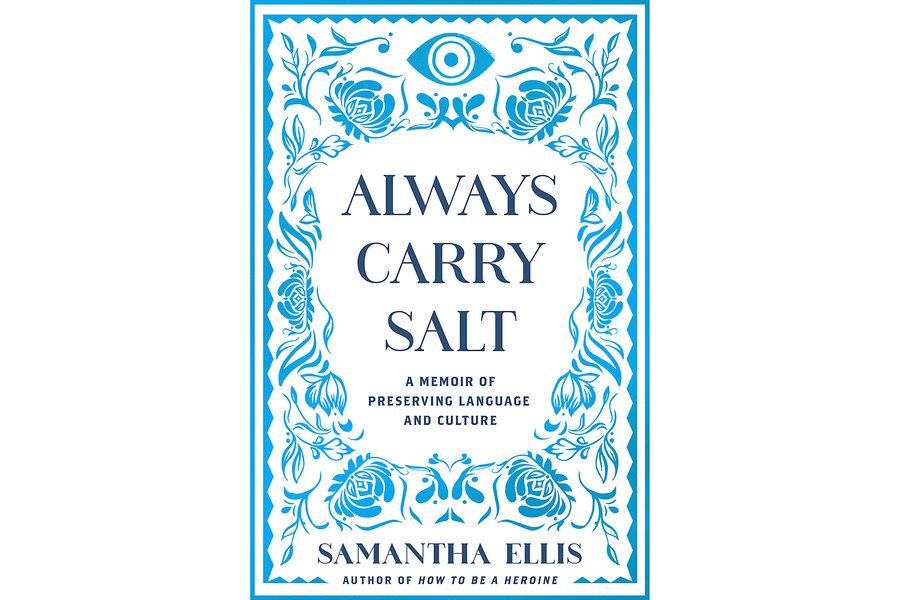
In her new memoir “Always Carry Salt,” London-based writer Samantha Ellis explores the complexity of reacquainting with – and passing along – her vanishing ancestral tongue. Judeo-Iraqi Arabic filled Ellis’ childhood. Spoken by her Iraqi Jewish parents – refugees who eventually settled in the United Kingdom – its consonants and verve resonated throughout the house. So, how could it now appear on UNESCO’s list of endangered languages? In her quest to uncover the story of Judeo-Iraqi Arabic and its role in her world, Ms. Ellis confronts grim histories and archaeological blunders, sure, but also gathers anecdotes, expands community, and discovers joy. The Monitor caught up with Ms. Ellis via video call. The interview has been edited for length and clarity.
Q: You refer to your ancestral language as Judeo-Iraqi Arabic, but acknowledge that it’s not a universal term. What makes it hard to define?
It was mainly an oral language and it was always, I think, seen as quite secondary. In my family, we used to refer to the Arabic spoken mainly by Muslims in Iraq as “real Arabic,” so ours was “not real.” It always gave me that impression. It hasn’t been as studied as it could have been. I’ve gone with the UNESCO name for it. I just wanted something that felt accurate and that people would get.
Why We Wrote This
In the memoir “Always Carry Salt,” Samantha Ellis explores how her family’s Iraqi Jewish heritage was shaped by hardship and language. She also writes about the pleasures of reclaiming her heritage through sharing meals and “leaving room for joy.”
Despite suffering terrible violence in the early 1940s, Baghdad’s Jewish community was robust during your father’s childhood. What changed, and why did he and his family leave Iraq?
There were push-and-pull factors. Some Jews in Iraq genuinely did want to go to Israel once they found out there was a possibility of a Jewish country to go to. And they did remember the Farhud of 1941, which was this sort of pogrom that happened in Baghdad and was horrific. So, some families genuinely thought, “Well, let’s go somewhere and we’ll be safer.”
My dad’s family was quite Zionist, I’d say. My mother’s family was not and they ended up staying. My grandmother – my mother’s mother – lived through [the Farhud] at 11, and all her stories were of being helped by Muslim families: neighbors, the neighbors of her aunt, all these people. Her feeling was, she didn’t want to go.
Instead of describing languages as “dying” or “extinct,” you favor “sleeping.” When did you first consider the distinction?
I love it. It’s from Wesley Leonard, who’s a speaker of Myaaamia. He’s really a keeper and a speaker of that language. He talks about the paradox of speaking in an extinct language. And he coined the idea of sleeping languages, and I found this so powerful.
Languages do come back to life, or some kind of life. I came across this amazing story about these children on the Isle of Man, who were at a private school teaching entirely in Manx. They wrote to UNESCO saying, “If our language is extinct, what are we writing to you in?” I loved that! It’s kind of an obvious question, but it needed to be asked. A lot of people do speak languages that are supposedly extinct or endangered.
The core of your memoir involves a metaphor – “building an ark” for your son. How do you describe this project?
I’ve always loved that story [of Noah’s ark]. It definitely felt like an Iraqi story, as well as a Jewish story. I was interested by this idea that the world that [Noah] knows is ending and you put what you can on a boat – in his case, it’s the animals two by two. There are many accounts: In one, they take one of each craftsperson to not lose the knowledge – I think that’s a Mesopotamian account. And there are imaginings where people are taking seeds. One of the things Noah first does when he gets out on the other end is plant. There is something so powerful in that. You get to a new place and one of the first things you do is you take root. You root yourself.
When did you decide to include recipes and what did you hope to invoke?
I didn’t want to include recipes at first. I’m not a cookbook writer. I found it quite hard to do the recipes since these are all things I do by eye. Also, I’m quite often on the phone with my mom – “I’m trying to make kechri. Do I put this much rice in? And how do we do the onions again?” To actually have to pin it down was quite scary. I’m very happy that I’ve done it because, now, I have a blueprint, which is lovely because many of these recipes don’t exist in many – or any – places.
The passing on of recipes felt so important. And one of the things that people, not just me, can do is to get your relatives’ recipes, record them, and then make them again. Then you are tasting the tastes your ancestors tasted. And you are doing with your hands the things that they were doing.
Why is joy necessary in your work?
[Being Iraqi Jewish] is quite a heavy inheritance. We can’t go back to Iraq. Yet, I kept thinking: This can’t be all of it, because I have a lot of fun being Iraqi Jewish. I enjoy it! Part of the book came out of having a child and wanting to pass [Iraqi Jewish culture] on to him. And having a huge amount of comfort and conciliation from sharing meals with my non-Iraqi friends, saying, “Here. Try this, you might like this. It’s something from my family.” So, sharing was a huge part of it – and I wanted things that would be nice to share.
I was also very interested by the idea that, while we all pass on generational trauma, I think we also pass on strategies for survival and resilience. And part of that is joy.