The Islamic Republic of Iran, enduring waves of U.S. and Israeli military strikes, is seeking to project confidence, continuity, and defiance as it navigates its own survival through the most dangerous threat to its existence in its 47-year history.
That confidence is not bravado, analysts say, but deeply felt.
Politically, Iran’s embattled rulers and commanders moved seamlessly to appoint an interim leadership council, and they’re choosing a new supreme leader to replace Ayatollah Ali Khamenei, who was assassinated Feb. 28 in the first wave of attacks.
Why We Wrote This
The U.S. and Israeli leaders have made it clear they want regime change in Iran. But the Islamic Republic had prepared for this day, with a political succession plan and a battlefield strategy. The result so far is Iranian confidence, despite the existential threat of the war.
On the battlefield, Iran’s top generals also have been killed. Yet its retaliatory missile and drone barrages, while diminished, continue to target Israel, American forces, and Gulf Arab states that host U.S. troops and interests.
U.S. President Donald Trump and Israel’s Prime Minister Benjamin Netanyahu have made it clear they want regime change in Iran, along with the destruction of Iran’s nuclear program and its sizable missile arsenal, as they seek to dismantle Iran’s ability to project power.
“This was never meant to be a fair fight, and it is not a fair fight. We are punching them while they’re down,” Secretary of Defense Pete Hegseth said Wednesday. “We are accelerating, not decelerating. Iran’s capabilities are evaporating by the hour.”

The strike intensity was double that of the U.S. “shock and awe” attack on Iraq in 2003, he said, and seven times that of Israel’s 12-day air campaign against Iran last June.
Through its actions and pronouncements, Iran’s leadership aims to reverse the narrative it has been weakened – and is therefore ripe for collapse – by two years of military blows, as well as by widespread and corrosive popular discontent.
Iran “upping the ante”
“The main target is the calculus in Washington that [Mr. Trump and Israel] can just wage a war and then call a ceasefire, and that things will get back to normal,” says Hassan Ahmadian, an assistant professor of Middle East and North Africa studies at Tehran University, contacted by phone.
Iran’s leaders “aren’t willing to give Washington that, so they are upping the ante,” he says, with retaliatory missile and drone strikes designed to exhaust Israeli and American air defense interceptors, before striking with the sizable Iranian arsenal that remains.
It’s a race against time, with the United States and Israel aggressively hunting Iran’s launchers and hidden missile and drone depots, to prevent just such an outcome.
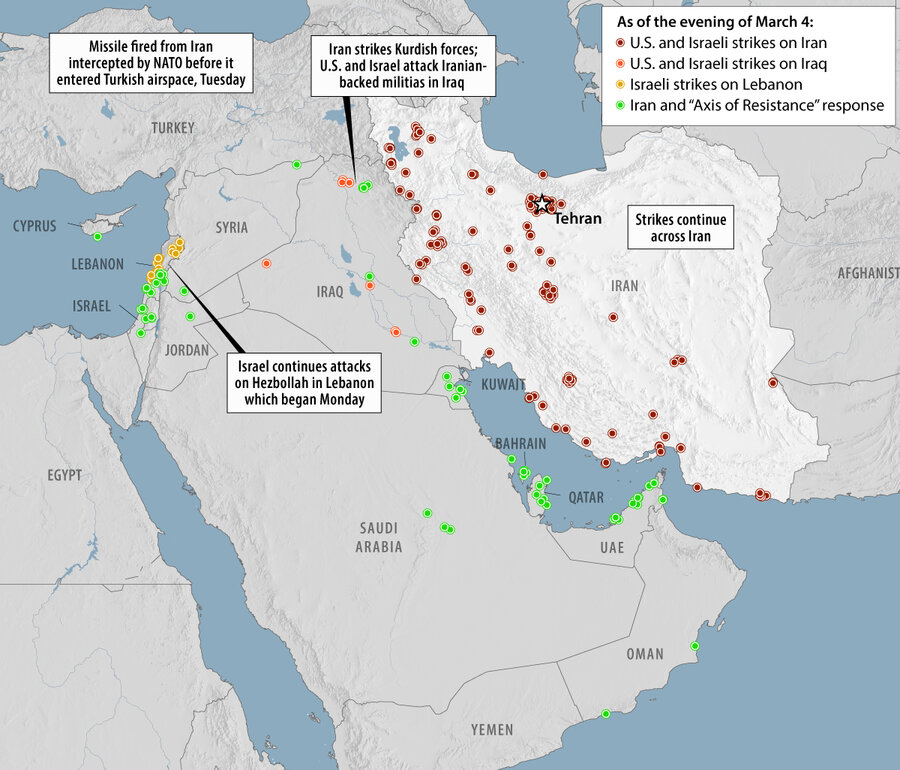
In the first five days, the U.S. struck more than 2,000 targets in Iran, and Israel hit more than 600.
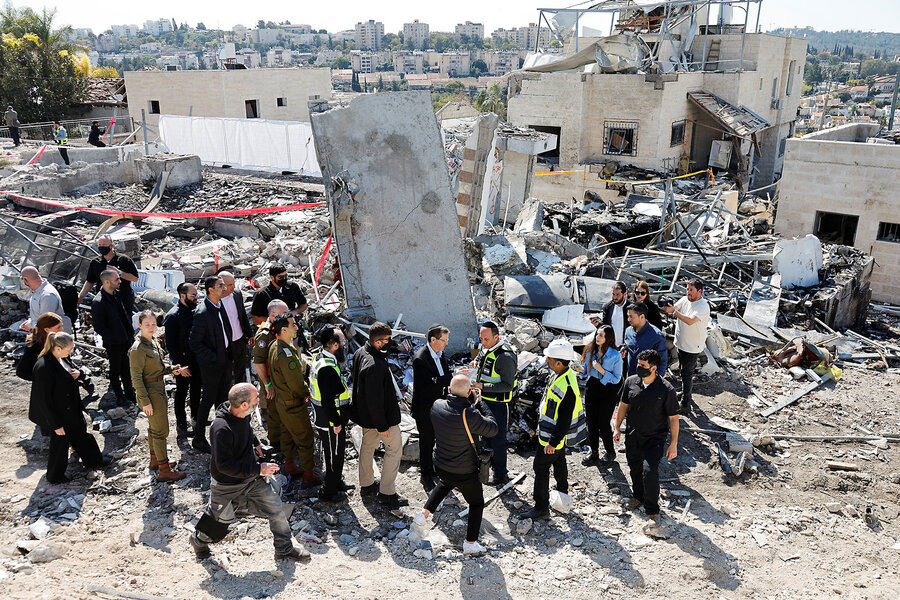
Since Saturday, Israel said Thursday, Iran has launched about 200 missiles and more than 120 drones, resulting in 10 “significant impacts.” Hundreds more have been fired at Gulf countries, though often of shorter range.

The Pentagon said late Thursday that Iran’s ballistic missile firings had dropped 90% from the first days of fighting, and drone launches dropped 83%.
Much of Iran’s missile arsenal remains, even if Israel says it destroyed 200 of Iran’s estimated 400 launchers last June. Less than 20% of the 3,000 missiles that Israel estimated that Iran then possessed were used against Israel in the June war.
The June conflict, which followed nearly two years of fighting between Israel and Iran’s regional allies, started with a surprise Israeli attack that assassinated a swath of Iran’s commanders and nuclear scientists. It was joined by bunker-buster U.S. strikes against Iran’s nuclear program.
“After that, the Iranians built and built, and got ready,” says Dr. Ahmadian. “The [ruling] system is projecting power, in terms of its institutions. [And] with its leader and commanders gone, it is standing up and fighting hard against the aggression.”
Institute for the Study of War and AEI’s Critical Threats Project
|
Jacob Turcotte/Staff
The late Mr. Khamenei prepared Iran’s current response based on lessons of the June war. Israel had begun running short of missile interceptors, and Iran’s later strikes, though fewer, were more destructive.
The supreme leader named several successor candidates, in case he was killed. He also ordered senior commanders to appoint officers three layers deep to step up if they, too, were assassinated.
The Iranian playbook
“In their heads, it’s an existential fight. The mindset is, we resist, or we get martyred while trying,” says an Iran analyst with close access to policy circles in Iran, who asked not to be further identified.
“What we are seeing now is the playbook, developed if all-out war broke out. … A very detailed contingency plan,” he says. “Keeping the military command operational was the key goal here. [In case] certain parts of this chain were disrupted – because of communications being cut, or undermined, or compromised – the different elements could work autonomously.”
“I think they are pretty confident they can handle this [leadership] transition, on one hand, but also the military campaign, on the other,” says the analyst.

“Whether or not the calculus is up to the realities of Donald Trump, and Donald Trump’s presidency, is a big question,” he adds. “And what if the dynamic of the situation changes? Can the preplanned military campaign and response be held back? Or is it on autopilot in a way that it cannot be stopped?”
Iran’s Foreign Minister Abbas Araghchi said this week that Iranian military units had begun a decentralized “mosaic defense,” and had become “independent” and “isolated” as they carried out general orders issued in advance.
On Tuesday, two buildings were destroyed in Tehran and the holy Shiite city of Qom, where the 88-member Assembly of Experts would usually meet to choose a new supreme leader. Israel says any new leader will be targeted.
“Obviously, the key will be how far the elimination operations of the Israelis go,” says the analyst. “We got a clear answer … that they will try to eliminate all of them.”
Iran’s broadcast narrative
Despite frequent airstrikes, the narrative broadcast from Tehran is rich with bombast.
“They [U.S. forces] will be fully uprooted from the region,” predicted Mohammad-Hassan Ghadiri-Abyaneh, a former Iranian ambassador.
“They are within our crosshairs. … They will be begging us for a ceasefire,” he told state-run TV. “Luckily, people are standing firm and opposing a ceasefire. People are saying, ‘Just hit them.’”
Iranian TV is awash with patriotic songs, religious recitations, and anthems celebrating the Islamic Revolutionary Guard Corps, with a split screen showing Iranian missile impacts on regional targets. Highlighted is the “constant fear” felt in Israel by Iran’s weapons prowess.

Majid Asgaripour/WANA/Reuters
“Iran will defeat the United States. Time will tell,” Mohammad Marandi, a professor at the University of Tehran with close ties to the regime, told Britain’s Channel 4.
“Our drones that are being fired are very old drones. Our missiles … are very old missiles. They’re very inexpensive. And Americans are using up very expensive air defense systems,” said Dr. Marandi.
“The Iranians know exactly what they’re doing,” he added. “We haven’t even begun using our latest technology, and most of Iran’s underground bases haven’t even been used yet.”
Aftermath of protests
Part of the U.S. calculation of regime vulnerability stems from the lethal crackdown on nationwide street protests in January, which resulted in more than 7,000 confirmed deaths in just two days. In the aftermath, some Iranians say they welcome foreign intervention.
“Of course, there are many who are unhappy with the [ruling] system,” says Tehran University’s Dr. Ahmadian. “But the other part of it is there are millions, also, who are backing the system. They are willing to fight for it, and they don’t want to see their country invaded.”
One wild card is emerging along the border of western Iran, an ethnically Kurdish region where U.S. and Israeli airstrikes have been concentrated against Iran’s security forces and border posts.
The strikes are an apparent bid to pave the way for an armed incursion by Iranian Kurdish rebel fighters based in Iraqi Kurdistan. Some groups – which for years have waged a marginal insurgency from Iraq – have in recent months reportedly received fresh arms and training from the CIA.
The Islamic Revolutionary Guard Corps and Iran’s Ministry of Intelligence issued a warning to leaders of Iraq’s Kurdistan Regional Government that they would deliver a “decisive, extremely severe, regret-inducing” response if any “terrorist groups” crossed the border into Iran.
“The rally around the flag – at least of people who are very much supportive of the [ruling] system – is happening,” says Dr. Ahmadian. “And those who the Americans and Israelis believe will back the invasion, they are either standing against the aggression, or stepping aside and waiting to see what happens.”
An Iranian researcher contributed to this report.