Iran’s national identity is now up for grabs as a result of the aerial bombardment of the Islamic regime by Israel and the United States. Even Iran’s historical territorial cohesion, despite its ethnic and religious diversity, might be in doubt. That’s why a phone call by President Donald Trump on March 1 hints at the country’s possible future – one that might bring an inclusive democracy in which every citizen is treated equally.
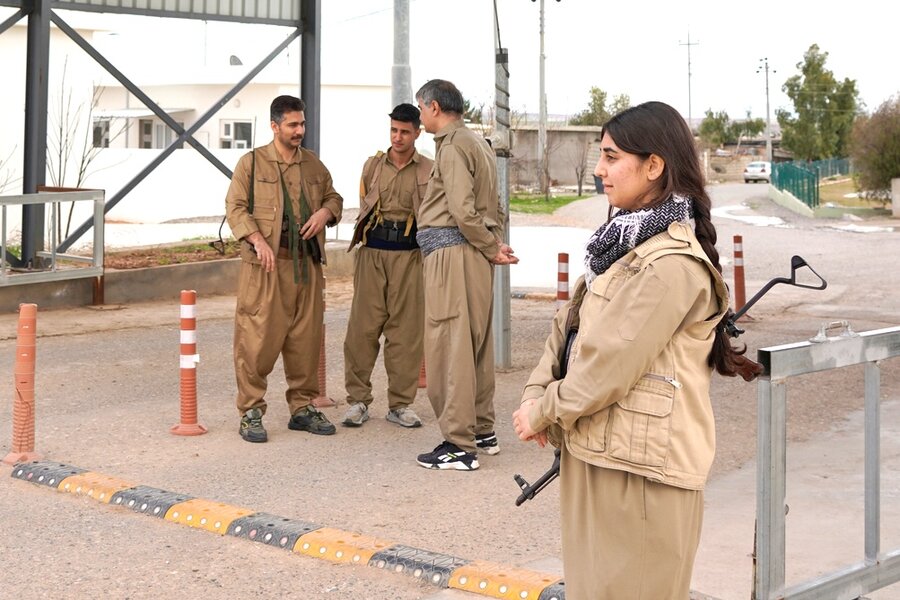
As reported by CNN, Mr. Trump spoke with the president of the Democratic Party of Iranian Kurdistan, Mustafa Hijri, head of what is considered the country’s most powerful organized opposition. He also called two powerful Kurdish leaders in neighboring Iraq. Might Iran’s Kurds provide the foot soldiers to secure Iran if the regime collapses – and then also work with other minority groups to ensure a free, pluralistic country? Or will they use this moment to claim independence?
Mr. Trump’s phone call is also significant because, just days before the war began Feb. 28, five of Iran’s Kurdish political groups announced greater coordination to end the Islamic Republic. In addition, Israel has struck hard at the regime’s structures in Iran’s Kurdish areas while Iranian missiles and drones have hit at Kurdish areas in Iraq.
Whether Kurdish forces can bring down the regime would be an open question. In the Middle East, the total Kurdish population of 30 million to 40 million straddles Turkey, Iraq, Iran, and Syria. It is considered the world’s largest ethnic group without a country. Yet Kurds are divided over whether to seek autonomy as a single nation or to struggle for guaranteed rights and freedoms in their respective countries.
In Iran, about 60% of people are Persian. On March 3, Reza Pahlavi, the son of the country’s former monarch, pleaded to Iran’s minorities not to seek separatism. “You are the backbone of historical and cultural Iran, which has always guarded the territorial integrity of the country and the dignity and pride of the nation,” he stated. “I am certain you will remain steadfast in this covenant.”
Many countries in the Middle East struggle over their national identity. Now, Iran faces a moment to reject the 47-year rule by Islamic authoritarians. But what might take their place, that is, if the regime collapses? In recent years, thousands of Iranians from different ethnic groups and religions have been killed for demanding an inclusive and egalitarian society. As the regime appears to be struggling for its survival, Iranians can end their struggle in defining their country – perhaps with help from its most marginalized groups.