The wife of Iran‘s Supreme Leader died today after succumbing to injuries sustained in the same US-Israeli airstrike that killed her husband.
Iranian TV presenters solemnly announced the passing of 79-year-old Mansoureh Khojasteh Bagherzadeh just two days after her husband, Ayatollah Ali Khamenei, was killed in his compound in Tehran.
Iranian state media reported on Sunday that Khamenei’s daughter, grandchild, daughter-in-law and son-in-law were killed in the strike as well.
Footage taken in a Tehran subway appeared to show a massive crowd of women mourning.
They were heard chanting and hitting their chests on both sides of a train platform.
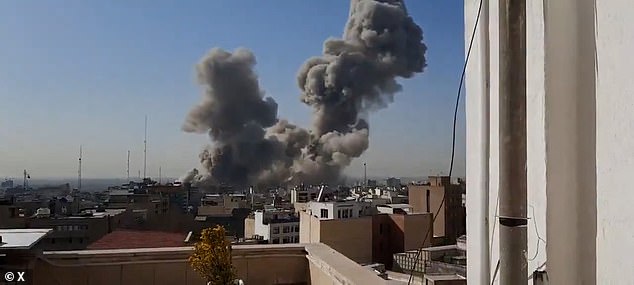
Footage of the aftermath of the Israeli airstrike on Saturday showed a huge tower of smoke rising from the House of Leadership, where Khamenei ran his regime for nearly 40 years.
In one clip filmed by a woman breathlessly speaking in Persian, dark plumes of smoke were seen rising from the compound, billowing upwards and moving with the wind.
She could be heard speaking to another woman and laughing in apparent joy at the death of the Ayatollah.
Another clip, from a different angle, showed the smoke rising over Tehran’s streets as cars and pedestrians passed by.
A third clip showed motorcyclists riding towards the plume of smoke rising up in the distance.
Bagherzadeh married Khamenei in 1965, and had four sons and two daughters with him during their marriage.

Iranian TV presenters solemnly announced the passing of 79-year-old Mansoureh Khojasteh Bagherzadeh just two days after her husband, Ayatollah Ali Khamenei, was killed in his compound in Tehran
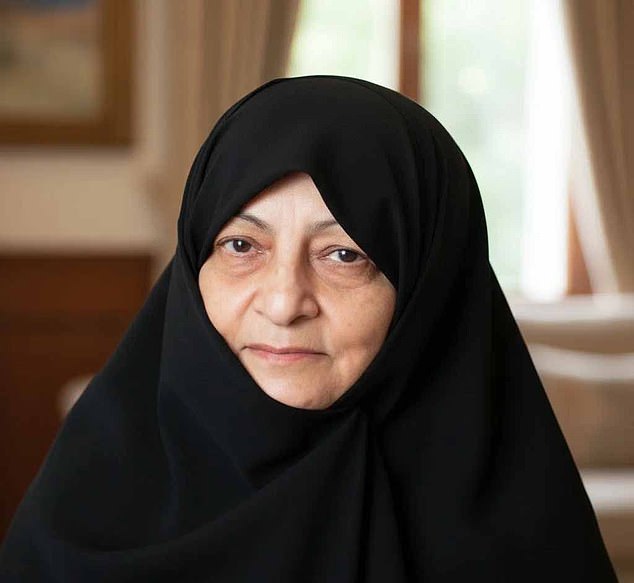
Al Jazeera reported that Mansoureh Khojasteh Bagherzadeh (pictured) died two days after her husband, Ayatollah Ali Khamenei, was killed in his compound in Tehran
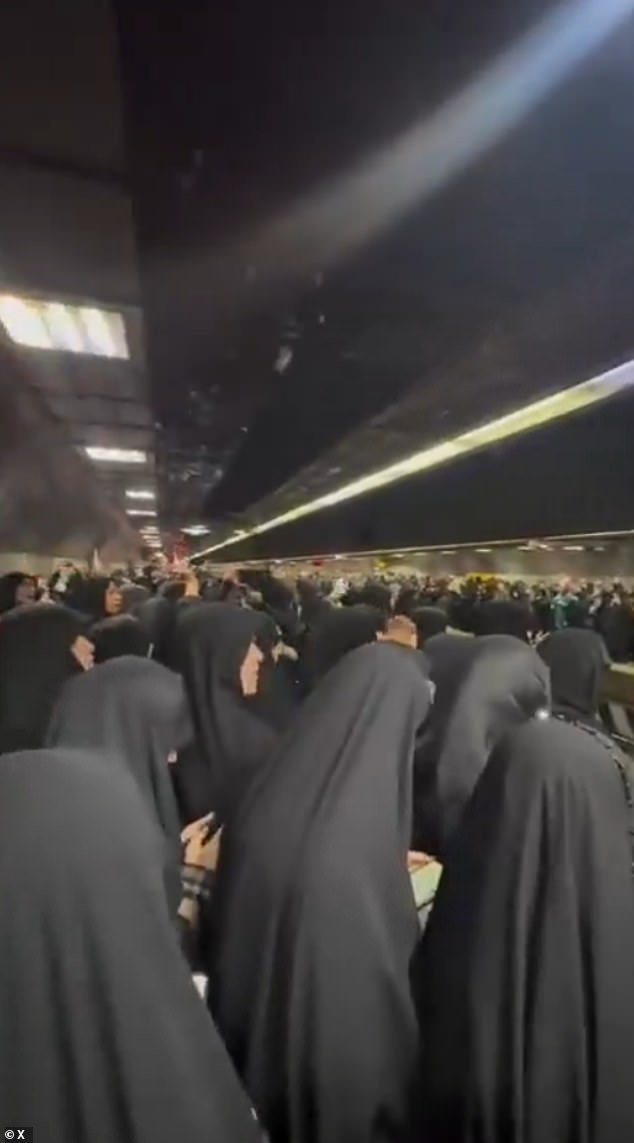
Footage taken from a Tehran subway appeared to show a massive crowd of women mourning
Throughout the decades of turbulence caused by Khamenei’s harsh rule over Iran, Bagherzadeh is said to have quietly supported him.
She did not assume any public responsibilities or play any formal role in the leadership of the nation, instead shying away from cameras and public life.
When asked in a rare interview with state media in 2011 about her role in Khamenei’s fight against the Shah, the previous ruler of Iran before the 1979 revolution, she said: ‘I think my biggest role was to preserve a calm atmosphere in our home so that he could do his work in peace.
‘I would sometimes visit him in prison without telling him about our problems. In response to his questions about us, I would only give him good news.
‘Of course I was also active in distributing pamphlets, carrying messages and hiding documents, but I think [these actions] are not worth mentioning.’
When asked whether her husband helped her in the home, Bagherzadeh said: ‘He neither currently has time [to help] nor do I expect him to do so.
‘One admirable trait he has which could be as an example for others, is that even, though he often comes home tired from work, he does his best to keep work-related problems away from home.’
On Saturday, an Iranian news anchor broke down in tears as he announced the death of Supreme Leader Ayatollah Ali Khamenei.
The anchor read aloud the statement that described Khamenei as a revered religious Islamic figure whose ‘long dream of martyrdom became true’.
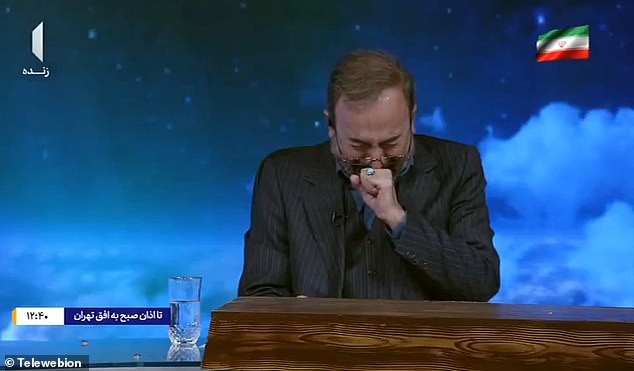
An Iranian news anchor broke down in tears as he announced the official passing of Iran’s Supreme Leader Ayatollah Ali Khamenei
It was also noted that Khamenei was killed during the holy month of Ramadan.
As he read from the paper in front of him, he began to get choked up before sobbing into his hand and holding his head as he composed himself on air.
From behind the camera, others were heard to be seemingly crying along with the anchor, the clip showed.
According to the statement, Iranians were said to be mourning the leader’s death but enemies of the country should note that ‘martyrdom will spark a massive uprising in the fight against oppressors,’ the outlet reported.
The anchor tearfully made his way through the broadcast before breaking down in tears a second time.
The broadcast announced the official 40-day mourning period, as well as a seven-day national holiday in the wake of Khamenei’s death.
Despite the death of its leader and his wife, Iran doesn’t appear to be going down without a fight, with its military and proxies firing missiles at Israel and Arab states, apparently hitting the American embassy compound in Kuwait, while Israel and the United States pounded targets in Iran as the war in the Middle East expanded.
At least 555 people have been killed in Iran so far by the US-Israeli campaign, the Iranian Red Crescent Society said, and more than 130 cities across the country have come under attack.
Eleven people have been killed in Israel and 31 in Lebanon, according to authorities there.
Fire and smoke rose from inside the embassy compound in Kuwait City after the Iranian attack, which came not long after the US issued a warning to Americans there to take cover and for others to stay away. There were no immediate reports of damage or casualties.
Later on Monday, the US military said Kuwait ‘mistakenly shot down’ thee American F-15E Strike Eagles during a combat mission as Iran attacked the country.
The US military’s Central Command said the combat included attacks from Iranian aircraft, ballistic missiles and drones – the first time Iran’s aging combat fleet has been engaged in the war.
Mansoureh Khojasteh Bagherzadeh died two days after her husband, Ayatollah Ali Khamenei, was killed in his compound in Tehran
‘The US Air Force fighter jets were mistakenly shot down by Kuwaiti air defences,’ it said. ‘All six aircrew ejected safely, have been safely recovered, and are in stable condition.
‘Kuwait has acknowledged this incident, and we are grateful for the efforts of the Kuwaiti defence forces and their support in this ongoing operation.’
Meanwhile, Iran’s ambassador to the UN nuclear agency alleged that the US and Israeli operation has targeted Iran’s Natanz nuclear enrichment site.
Israel and the US have not acknowledged strikes at the site, which America bombed back in the 12-day war between Iran and Israel in June.
Iran’s Ambassador to the International Atomic Energy Agency, Reza Najafi, told journalists he condemned what he called the ‘unlawful, criminal and brutal’ attacks by the US and Israel against Iran.
‘Again they attacked Iran’s peaceful safeguarded nuclear facilities yesterday,’ he said. ‘Their justification that Iran wants to develop nuclear weapons is simply a big lie.’
When asked which site he was referring to, Mr Najafi responded: ‘Natanz.’
Officials in Oman said a bomb-carrying drone boat struck a Marshall Islands-flagged oil tanker in the Gulf of Oman on Monday, killing one mariner on board.
The state-run Oman News Agency reported the attack in the Gulf of Oman off the coast of Muscat, the sultanate’s capital. It identified the vessel as the MKD VYOM. It said the dead crew member was from India.
Iran has been threatening vessels approaching the Strait of Hormuz, the narrow mouth of the Persian Gulf, and is believed to have launched multiple attacks.
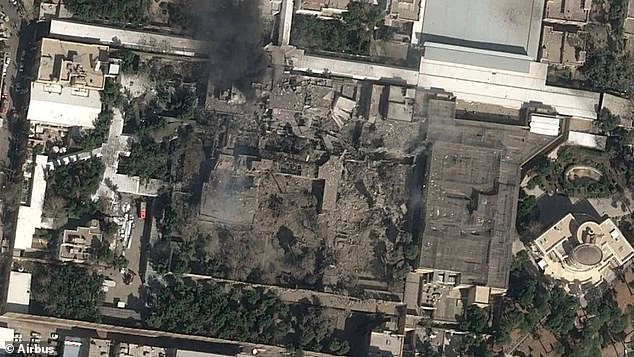
Israeli struck and destroyed the Ayatollah’s compound in the heart of Tehran (pictured) on Saturday
As the American and Israeli air strikes continued, top Iranian security official Ali Larijani vowed on X that ‘we will not negotiate with the United States’.
In Iraq, a pro-Iranian militia claimed responsibility for a drone attack targeting US troops at Baghdad airport, the day after it said it fired at an American base in the city of Irbil in the north.
Cyprus said a drone attack targeted a British base on the Mediterranean island nation.
Meanwhile, Saudi Aramco temporarily shut down its Ras Tanura oil refinery near Dammam after it was targeted by Iranian drones.
Online videos from the site appeared to show thick black smoke rising after the attack. Even successfully intercepted drones cause debris that can spark fires and injure those on the ground.
Saudi state television reported the decision, citing what it described as an ‘official source’. It added there were no casualties from the fire and its decision was a precautionary one.
The refinery has a capacity over half a million barrels of crude oil a day.