From his rostrum, Iran’s military spokesman adopted a decidedly mocking tone, ridiculing the American and Israeli enemy as “those who prefer fleeing over standing their ground, those same masters of consecutive defeats, who … see fear in every one of their cells.”
Then, Ebrahim Zolfaghari – wearing a camouflage Revolutionary Guard Corps uniform and sporting a trimmed black beard and slicked-back hair – switched from Farsi to English to bait President Donald Trump.
“Hey, Trump. You’re fired!” the Iranian officer said, using one of the U.S. president’s signature phrases from his reality TV days. “You are familiar with this sentence. Thank you for your attention to this matter!”
Why We Wrote This
The Iranian military’s destructive capacity is far from that of the United States and Israel. Yet its asymmetric strategy, including closing the Strait of Hormuz, has given it the confidence to issue its own demands. What that means for ending the war, and the aftermath.
After nearly four weeks of war, it has not been a balanced fight: The destructive capacity of Iran’s military forces is far from that of the United States and Israel, which have struck more than 15,000 targets during a campaign that has sought to foster regime change in Iran.
But since the U.S. and Israel launched their surprise attack on Feb. 28 – assassinating Iranian Supreme Leader Ali Khamenei in the process – the Islamic Republic has remained firmly in control in Iran, refusing to capitulate. And it continues to fight back, seizing effective control of the Strait of Hormuz, a vital passageway for one-fifth of global energy supplies.

Iran’s asymmetric strategy has rained missiles down on Israel – including multiple waves on Tuesday – and expanded the conflict by retaliating across Arab states in the Gulf region. Those strikes focused on nations that host U.S. bases, as well as those countries’ civilian infrastructure and shipping.
Growing confidence
“This war will not end, and there will be no ceasefire, until sanctions are lifted, compensation is paid, and legally binding international guarantees are provided to prevent any repeat of aggression against Iran,” Mohsen Rezaei, the recently named senior military adviser to Iran’s new supreme leader, Ayatollah Mojtaba Khamenei, told state-run TV on Monday.
Both the U.S. and Iran have vowed to end the conflict on their own terms. But now, Iran’s strategic endgame is increasingly coming into focus – and its confidence has grown in dictating some of those terms – as energy prices have soared, and the White House appears ready to find an off-ramp.
“Now, in the process of fighting back, Iran built a new source of leverage that is very effective, and that is the Strait of Hormuz,” says Hassan Ahmadian, an associate professor of Middle East and North Africa studies at Tehran University. He notes that Iran has “been successful” in driving up oil prices, controlling the strait, and widening the war “in a way that forced the U.S. to back down from its maximum demands.”

“It is no longer about regime change – as it was initially – no longer about internal uprising in Iran, no longer about electing a new supreme leader for Iran, or wiping out Iran’s missiles and drones,” says Dr. Ahmadian. “The Iranians took the issue from a maximum desire, I would say – not even a goal, on the part of the U.S. and Israel – and turned it into something practical that they can benefit from.”
This past weekend, Mr. Trump gave a 48-hour ultimatum to Iran to “open” the Strait of Hormuz, or the U.S. would “obliterate” Iran’s energy infrastructure. But on Monday, he announced a five-day delay, claiming on social media that “very good and productive” talks with Iran were underway for a “total resolution of our hostilities.”
Mr. Trump also suggested on Monday that he might manage the strait himself, or do so jointly with “the ayatollah” – a line met with derision in Tehran.
Iran’s list of conditions
The speaker of Iran’s Parliament, Mohammad Baqer Qalibaf, responded on X that “no negotiations” have been held with the U.S., and that the “fake news” was being used to “manipulate” oil markets and “escape the quagmire in which the U.S. and Israel are trapped.”
“Iranian people demand complete and remorseful punishment of the aggressors,” he wrote. Last week, Mr. Qalibaf posted that the Strait of Hormuz “won’t return to its pre-war status,” and said it was “hilarious” that Mr. Trump “claimed he ‘defeated’ us 9 times in the last two weeks.”

IRINN/via Reuters TV/Reuters
Iran has made a list of six conditions to end what it calls its “defensive war,” including guarantees that hostilities will not restart; that U.S. military bases in the region be closed; and agreement on a “new legal regime” for the Strait of Hormuz.
Iran is also demanding reparations for U.S. and Israeli strikes, which began while the United States and Iran were engaged in negotiations over Tehran’s nuclear program. On the eve of the attack, the lead mediator, Omani Foreign Minister Badr Al Busaidi, had said a deal was “within reach.”
Similarly, Israel’s 12-day air campaign against Iran last June, later joined by the U.S., was launched amid nuclear talks between the White House and Iran.
Iranian officials also now speak about imposing a toll for passage through the strait, which it has never done in the past.
“This war created a new way of dealing with strategic issues, which recalls what the United States did,” says Dr. Ahmadian. “It is not about international law; it is about might making right. That’s what happened with the start of the war on Iran, and I think Iranians, now controlling the strait, are now legalizing it, based on [Iran’s] internal law – as Iran is not a signatory to the U.N. Convention on the Law of the Sea.”
Popular perspectives
For now, it is not clear when the war might end. Two U.S. Marine expeditionary units are en route to the Middle East, and the Pentagon reportedly plans to ask Congress for $200 billion to pay for a war that only about one-third of Americans support.
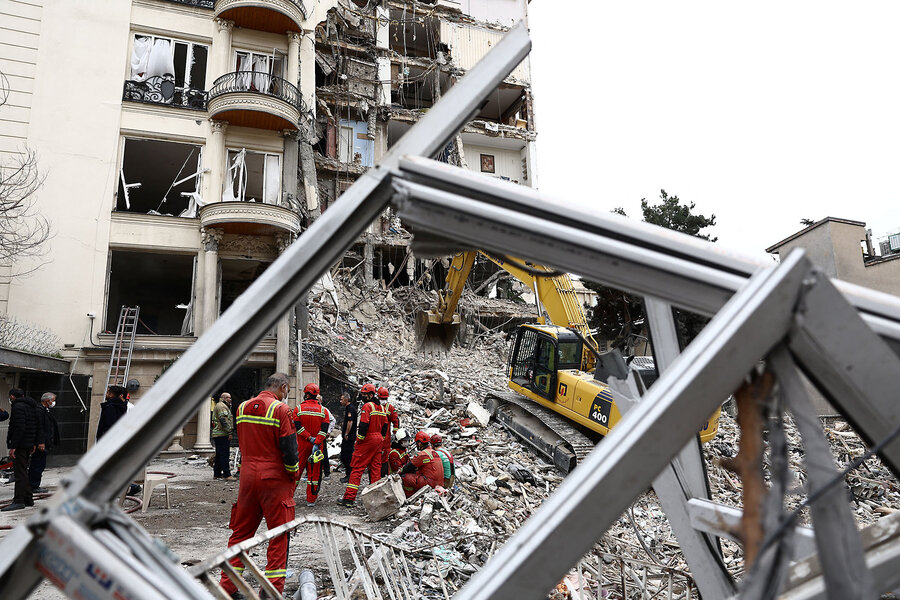
And Iranians, meanwhile, have been caught in the middle of a conflict that health officials there say has left more than 1,500 people dead.
“Everyone was aware of [Mr. Trump’s] 48-hour deadline, and that alone increased social anxiety. People rushed to supermarkets again,” says Elham, an artist and mother in Tehran.
“Telecom services were sending government messages to everyone, saying that they would not fall short in defending the nation, and that energy, fuel, and food supplies would be available for a long time,” she said in a text message, noting that few felt reassured.
“After the deadline was extended, local newspapers interpreted it as Trump backing down,” said Elham. “Although people felt slightly better, they are still worried – because of the constant sounds of explosions or air defense systems, and the rising prices – about the possibility of war and a nationwide blackout.”
Mr. Trump has said repeatedly that “none” of Iran’s military capabilities remain, from its air force and navy to its missile arsenal and nuclear program.
Yet Iran has continued to bombard Israel and strike neighboring Gulf states. And Mr. Trump has been unable to cobble together a coalition to deploy their militaries to keep shipping lanes open.

Majid Asgaripour/WANA/Reuters
Gulf Arab relations
“The Iranians seem to believe that they are in a position where not only does the regime survive, but it imposes enough costs to deter future attacks,” says Ali Vaez, director of the Iran Project for the International Crisis Group.
“But while Tehran has been able to broaden the battlefield and raise economic costs for its adversaries, it runs a major risk of overplaying its hand,” says Dr. Vaez. “Their stated – and rather optimistic – terms are based on the hope of a strategic landscape altered in its favor.”
And, Dr. Ahmadian adds, it will take years for Iran to repair relations with the Gulf Arab nations, whose energy installations have been targeted by Iran and which depend on exporting their oil through the Strait of Hormuz. The grievances run both ways, he says, including Iran’s, over the U.S. use of bases in Gulf Arab states.
“To the extent neither side has been able to land a knockout blow, each has a say in how long it continues,” says Dr. Vaez. He notes that after limited Israeli strikes on Iranian military targets in October 2024 and again last June, there were “bullish estimates as to the extent of the setbacks.”
“But in each case, Iran moved to rehabilitate its missile capability, which has proven, along with drones, its most significant tool.”
“The damage this time is no doubt more significant,” he adds, “but unlikely to be terminal.”
An Iranian researcher contributed to this report.