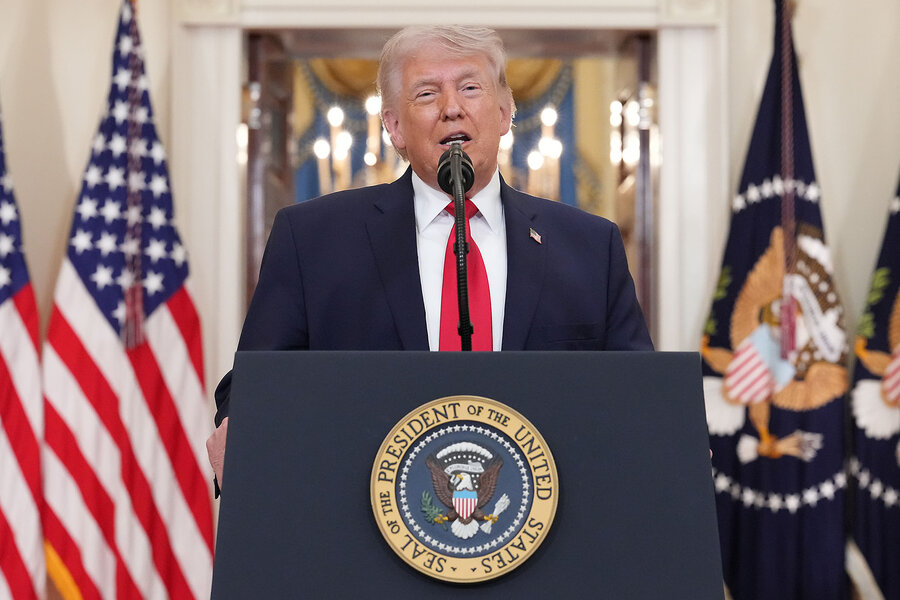
“Two to three weeks” was President Donald Trump’s timetable, delivered from the White House Wednesday night, for ending the war in Iran. And America’s allies, in the Middle East and worldwide, will be fervently hoping he proves right.
But a specific threat in his 19-minute address – initially made two weeks ago and promptly matched by Iran – is alarming longtime partners, especially member states of the increasingly strained transatlantic NATO alliance.
It’s not just the tone of the tit-for-tat threats, but their declared target: energy and desalination plants across Iran and in U.S.-allied Arab states in the Gulf.
Why We Wrote This
The Iran war is the latest conflict that has seen blows to the bedrock principles of international law, the rules of war, and the protections for civilian populations put in place after World War II. Could this “age of impunity” be allowed to become a new normal?
The prospect of attacking facilities on which tens of millions of people rely has spotlighted an issue that they feel has implications beyond the Iran conflict, no matter how and when it ends.
It’s best captured by the official rubric of the Fourth Geneva Convention of 1950, a key part of the international rules of warfare agreed upon after World War II: “The protection of civilian persons in time of war.”
The threats to critical civilian infrastructure have deepened concerns that the Iran war is dealing a major new blow to long-accepted norms governing how and when nations should be able to wage war.
Actions proscribed include attacks on civilians, or civilian infrastructure, without a demonstrable military justification.
That legal framework has been eroding for more than a decade: Syrian dictator Bashar al-Assad’s targeting of rebel-held areas with chemical weapons and barrel bombs during the country’s civil war prompted warnings at the time of an “era of impunity” for attacks on civilians.

Russian President Vladimir Putin has since shrugged off the need for “protection of civilian persons” in Ukraine. Russia has fired thousands of missiles and drones at energy facilities, apparently hoping to cow the civilian population into submission.
The scale of destruction in Gaza from the Israelis’ retaliation for Hamas’ October 2023 kidnappings and killings has also provoked accusations they’ve violated international law.
Yet the Iran war is being viewed as a challenge of a different order – because America was not only a supporter, but a prime architect, of the “rules-based” order forged since World War II.
The absence of military support from key U.S. allies has been only partly because they were kept in the dark about the war plans, or due to Mr. Trump’s alternately dismissive and hostile treatment of them since he returned to office.
Nor is it down to sympathy for the regime in Tehran. Allied leaders have stressed that they share Mr. Trump’s view that Iran is repressive at home, violently destabilizing abroad, and should not be allowed to get a nuclear weapon.
Yet a number of allies have questioned his claim to have launched the war because of an “imminent” threat from Iran – the kind of preemptive attack that might pass muster under the U.N. Charter.
Canada’s Prime Minister Mark Carney called the war “inconsistent with international law.” Political leaders in other Western states – including NATO members France, Spain, Norway, and neutral Switzerland – have also voiced that view.
Their hope will be that Mr. Trump’s reference in his White House address to continuing diplomatic contacts means a negotiated off-ramp might yet be found.

United States allies have signaled a readiness to join in policing a reopened Strait of Hormuz – the waterway through which a significant part of the world’s supply of oil, gas, fertilizer, and other materials passes.
But only if that follows an internationally negotiated arrangement to reopen it.
The fear, however, is of a new escalation, and a new challenge to the civilian safeguards in the Fourth Geneva Convention, expanded in 1997, and in a further U.N.-sanctioned statute in 1998.
They have raised that concern in response to a move by America’s Iran war partner, Israel, to reoccupy southern Lebanon, clear border villages of civilians, and possibly destroy homes as part of a campaign to disarm the Iranian-backed Hezbollah militia.
In a statement this week, European foreign ministers held Hezbollah ultimately responsible for having joined the war and fired into Israel.
But they called for protection of the “civilian population, humanitarian personnel, peacekeepers, and civilian infrastructure, including airports, ports, and bridges across the country, in line with international humanitarian law.”
That could prove an even higher hurdle if the United States and Iran act on their threats.
In a March 21 ultimatum, President Trump gave Iran 48 hours to open the Strait of Hormuz, or he would “obliterate” the country’s energy plants. He has since extended the deadline until April 6, and gave no specific time limit in his White House address.
But he did say that if “no deal is made” in the next few weeks, U.S. forces would “hit each and every one of their electric-generating plants very hard and probably simultaneously.”
Iran responded to the initial ultimatum by threatening to attack power and desalination plants in the Arab Gulf states – an especially dire prospect for their populations, which depend on desalination for fresh water far more than the Iranians.
Iran’s reply to Mr. Trump’s latest address was to threaten “more crushing, broader and more destructive actions.”
For Mr. Carney, the Iran war has vindicated a message he’s been delivering for months now: that the world order is dominated by self-interested, great-power “hegemons,” and the old “rules-based order” isn’t returning.
But his call for fellow “middle powers” to wield their collective weight in response could provide a clue to postwar efforts to keep at least some of the rules of war alive.
In a high-profile speech weeks before the Iran war, he urged a mix of pragmatism and “fundamental values.”
Those values, Mr. Carney said, included “sovereignty and territorial integrity, the prohibition of the use of force, except when consistent with the U.N. charter and respect for human rights.”