Donald Trump‘s Middle East war has plunged the world into an even bigger oil crisis than in the 1970s, the International Energy Agency (IEA) has warned.
As the price surged past $100 (£75) a barrel, the intergovernmental body said the war ‘is creating the largest supply disruption in the history of the global oil market’.
The 1970s saw the West punished by Arab nations, furious with America’s support for Israel, with a crippling oil embargo.
A terrifying illustration of the crisis came earlier this week when two tankers near the southern Iraqi port of Basra were set ablaze after being hit by Iranian boats laden with explosives.
At least one crew member was killed. Hours earlier, three other ships in the Gulf were targeted.
The IEA’s warning will stoke fears of a renewed cost of living squeeze in Britain. New figures showed 93 per cent are already being hit with higher food bills.
Earlier this week, the Chancellor hinted at potential short-term bailouts for struggling families.
Questioned by MPs on the Commons Treasury committee on whether the Government will be able to offer support, Rachel Reeves said: ‘We are working on different ways in which to protect people, including more targeted support.’
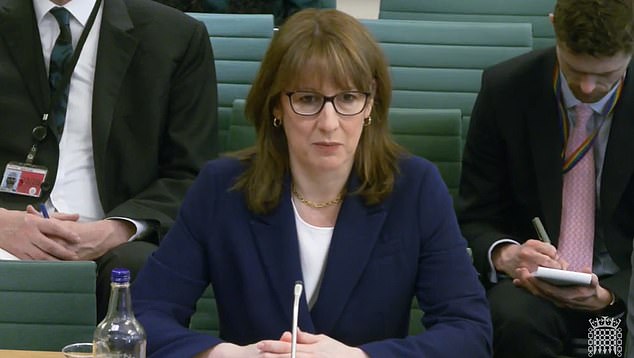
Chancellor Rachel Reeves said the Government is ‘working on different ways’ to support Brits amid fears oil shortages could cause a new cost of living squeeze
It came as analysts at US bank Goldman Sachs predicted that oil prices could hit $150 (£112) a barrel in the event of prolonged disruption – and downgraded UK growth forecasts for the second time since the war began less than two weeks ago.
Such a scenario would result in a major hit to UK growth as inflation surges to 3.5 per cent, it predicts.
The latest comments from US President Donald Trump appearing to brush off the threat of higher oil prices did nothing to soothe markets.
He said: ‘The United States is the largest oil producer in the world, by far, so when oil prices go up, we make a lot of money.’
And Iran’s new leader Mojtaba Khamenei vowed in a statement to keep the strait of Hormuz closed – the chokepoint vital for the shipping of oil and gas across the globe, just 21 miles wide at its narrowest point. A day earlier, the regime warned the world to get ready for oil prices of $200 (£150).
The price of a barrel of Brent crude has spiked at almost $120 (£90) since the war began due to the closure of the strait.
Meanwhile jittery bond markets sent UK Government borrowing costs soaring to a six-month high. That is linked to fears that the Bank of England will no longer be able to cut interest rates this year as the spike in oil and gas prices stokes inflation, as well as the possibility that it may have to foot the cost of energy bill subsidies.
The IEA said flows through the strait of Hormuz had slowed from 20million barrels a day ‘to a trickle’. Oil-producing countries’ storage capacity is filling up, prompting them to reduce pumping by at least 10million barrels.
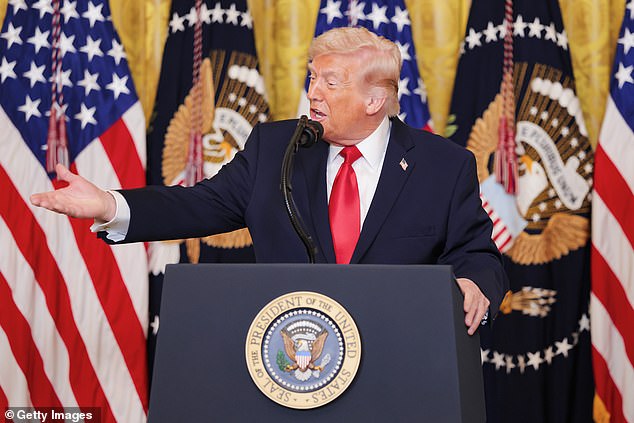
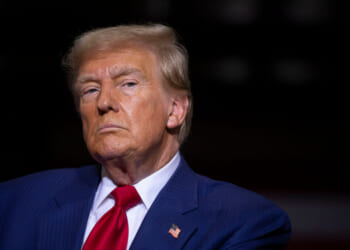
US President Donald Trump appeared to brush off the threat of higher oil prices
An agreement brokered by the IEA this week sought to quell supply fears by releasing 400million barrels of oil held by its member nations, including the UK.
But Ashley Kelty, oil and gas analyst at City broker Panmure Liberum, said the move was seen as ‘inadequate’ by traders and described it as ‘a sticking plaster… only covering lost supplies for around a fortnight’.
Despite fierce bombardment from the US and Israel, there was no sign of the Iranian regime collapsing yesterday as it attacked Iraq, Kuwait, the United Arab Emirates, Bahrain and Oman.
Already, the cost of a litre of petrol has gone up by 7p since the war began to more than 140p and diesel up 16p to 158p, according to the RAC.
Household energy bills are protected by a price cap for now but are likely to spike in July when the cap is reviewed.
The Office for National Statistics showed that last month, 56 per cent of adults reported that their cost of living had increased, rising to 93 per cent when asked about their food shop and 69 per cent for gas and electricity bills.