Iran is rapidly restoring its missile bunkers to working order just hours after they are pounded by US and Israeli strikes, according to fresh intelligence assessments.
The White House has pointed to a drop in Iranian drone and missile launches since the conflict erupted as evidence that Tehran’s strike capabilities are being crippled.
But a newly published US intelligence report cited by The New York Times suggests otherwise, indicating the regime still possesses a substantial arsenal and is swiftly repairing damaged sites.
Some of these massive missile bunkers are buried deep within granite mountains that can withstand crushing pressures far beyond those that conventional construction materials can withstand.
This material puts up the toughest barrier possible for even the most powerful American bunker-busting bomb – the GBU-57 Massive Ordnance Penetrator.
One of these fortresses, the Yazd missile base, is thought to possess an automated rail system that runs through tunnels linking assembly areas, storage depots, and multiple concealed exits cut into different faces of the mountain.
In similar underground missile cities seen in Iranian propaganda videos, launchers are moved around rapidly on lorries, rolled out to fire, and withdrawn back underground behind heavy armoured doors in the blink of an eye.
Despite weeks of relentless US-Israeli strikes on its facilities, Iran is somehow still able to unleash its hidden arsenal of rockets and drones at targets across the Middle East.

Iran showed off a sprawling underground network of tunnels filled with row after row of drones and rockets in a propaganda video at the start of the war
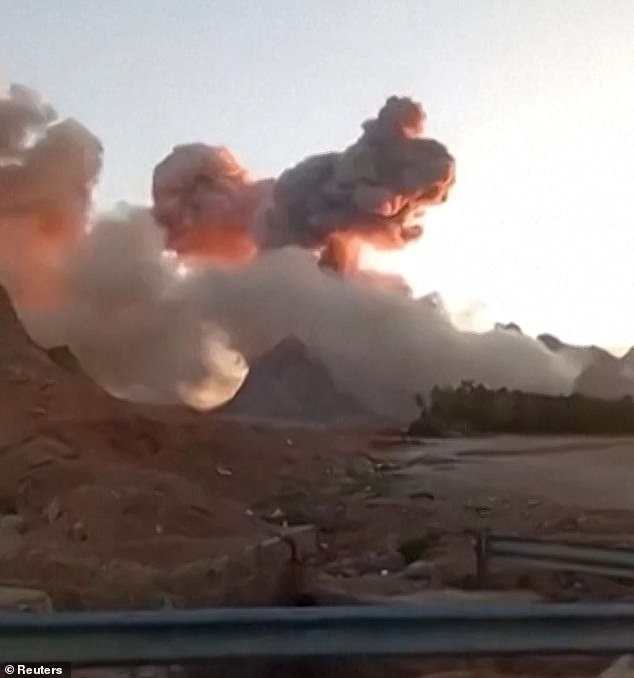
Smoke was seen rising following an explosion at a missile base near the city of Baharestan in Iran last week
American officials warned that Tehran is deliberately preserving its missile strength to maintain pressure throughout a prolonged conflict and to retain leverage once hostilities end.
According to the NYT report, Washington can not be certain how many missile launchers have been destroyed, as Iran has deployed decoys.
While underground bunkers and silos may appear damaged, launchers can be quickly recovered from rubble and used for attacks, the report added.
Several underground ‘missile cities’ have reportedly been carved into mountains, forming a dispersed web of hardened sites that support the country’s ballistic missile capability.
The Islamic Republic has spent years constructing these cavernous bunkers to shield its vast missile arsenal from destruction, experts say.
Speaking to the Statesman, analyst Shanaka Anslem Perera said: ‘The mountain does not care how many sorties are flown above it.
‘The railway does not care how many portals are sealed. The geology is the defence, and the geology has been there for 300 million years.’
Penetration depth varies depending on whether a target is covered by soil, concrete, or dense rock.
Granite, in particular, absorbs and disperses explosive energy, reducing the effectiveness of even the largest conventional munitions.
According to RUSI, penetrating hardened underground facilities may require multiple strikes on the same point, detailed intelligence on internal layouts, and sustained follow-up attacks to prevent rapid repair.
And all of this must be carried out while suppressing air defences and coordinating attacks across multiple dispersed sites.
Speaking to Globes, tunnelling expert Dr Amichai Mittelman said: ‘The mountains in Iran provide a level of protection 50-100 meters thick of rock that is hard to crack even by heavy bombs.’
Meanwhile, experts told The Telegraph earlier this week that the slowdown in attacks may reflect a tactical shift, with Iran adapting its approach and becoming more adept at concealing mobile launchers after use.
The Pentagon said it hit 11,000 targets in the opening five weeks of the war, while Israeli forces reported three-quarters of Iran’s launchers had been destroyed by March 7.
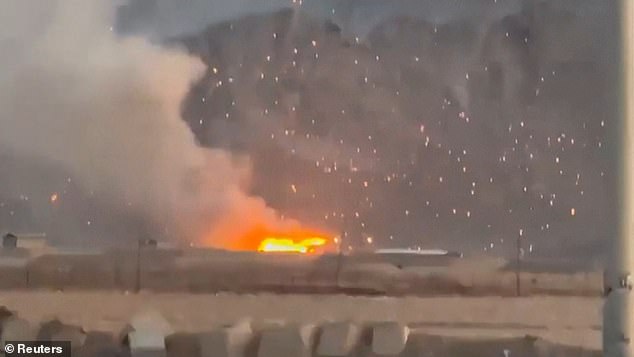
Explosion at missile base in Iran on April 2, 2026
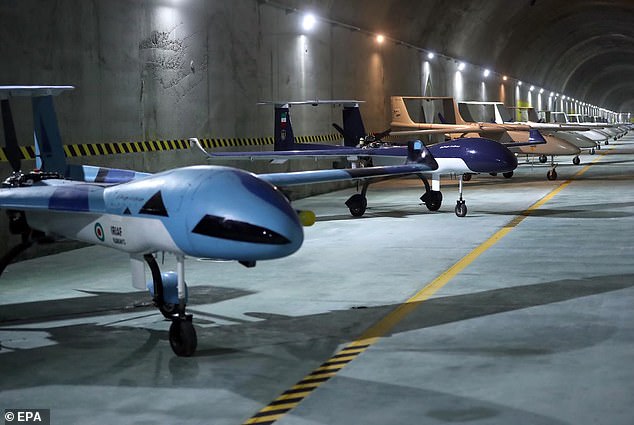
A handout photo made available by the Iranian Army in 2022, shows drones in an underground drone base, in an unknown location in Iran
Yet continued strikes by Iran’s Revolutionary Guard raise doubts over how close allies are to neutralising the threat.
Missile launches have dropped sharply – from hundreds per day at the outset to fewer than 40 more recently, with roughly 20 aimed at Israel daily.
Meanwhile, Iran continues to unleash between 50 and 100 drones each day across the region, most of which are intercepted.
Military analysts have cautioned that efforts to hunt down remaining launch systems may yield ‘diminishing returns’, particularly given Iran’s vast terrain and long-standing network of concealed ‘missile cities’.
On Monday, US defence secretary Pete Hegseth said: ‘Yes, they will still shoot some missiles, but we will shoot them down.’ He added: ‘They will go underground, but we will find them.’
The report came after CNN also cited a US intelligence assessment that around half of Iran’s ballistic missile launchers are still intact despite over a month of US-Israeli strikes across the country.
Some of the remaining missile launchers are not believed to be currently accessible, due to having been buried under rubble amid the waves of airstrikes.
In response to the CNN report, White House spokeswoman Anna Kelly said: ‘Iranian ballistic missile and drone attacks are down around 90 per cent, their navy is wiped out, two-thirds of their production facilities are damaged or destroyed, and the United States and Israel have overwhelming air dominance over Iran.’
But despite claims of air superiority, US special forces were deployed to rescue the pilot of a downed F-15E, while a search continued for the missing weapons officer.
Iranian authorities are reportedly offering rewards of around £50,000 for information leading to his capture.
In Dubai, debris from an intercepted drone struck a US tech office overnight. Authorities confirmed the incident caused no injuries, with only shrapnel hitting the building.
In a post shared on X, Dubai’s media office said: ‘Authorities confirm that they responded to a minor incident caused by debris from an aerial interception that fell on the facade of the Oracle building in Dubai Internet City. No injuries were reported.’
Tehran has previously warned it could target American technology firms operating across the Middle East.