Far from beginning and ending with an early decapitation campaign, the US-Israeli attack on Iran escalated quickly into a full-fledged regional war. This has dashed initial expectations of a short conflict and resulted in a potentially attrition-style campaign that US military officials now admit has “Iran in the driving seat”.
In the eight months since the June 2025 US-Israeli war on Iran came to a ceasefire, Tehran gave clear warnings to the US that any military action would result in a full-scale regional war and attempted takedown of the global economy. Nevertheless, the US staggered into the war, apparently through a mixture of Israeli manhandling and Trumpian bravado.
When Israeli fighter jets executed the 86-year-old Khamenei, reportedly without informing Washington, they forced the US into what US Secretary of State Mark Rubio described as a “preemptive” action. Trump claimed he was unaware that Iran might react by closing the Straits of Hormuz, despite Iranian officials threatening to do so at every public opportunity. It is this obstinacy towards reality, this cognitive dissonance and easy dismissal of the opponent, that made me wonder whether perhaps this misjudged war also had some cultural roots. Having lived and studied in Tehran between 2004 and 2007, here are my thoughts.
My Iran
In 2004 I arrived in Tehran to attend an extraordinary MA course in Contemporary Iranian Studies offered by the Islamic Republic’s own Foreign Ministry. For a year, a parade of regime-aligned academics, top diplomats and deep state operatives taught us classes alternating between the pedestrian and the captivating but which opened intellectual windows and fostered intriguing debates into the country and its regional role. My thesis supervisor was current Foreign Minister Abbas Araghchi.
At first, we eyed our professors as cartoonish regime figures, and they probably regarded us as aspiring spies. But the initial mistrust loosened into a well-paced antagonism, bordering at times on joviality. By year’s end, I had been immersed in the IRI worldview in a succession of strangely impromptu classes. Among our professors were the Shah’s last ambassador to London, diplomats who had been close to Islamic Republic founder Ruhollah Khomeini, a veteran of the Iran-Iraq War trenches whose gassing still manifested itself in throaty coughs, and an international relations expert belonging to a younger, more unbuttoned generation. Together, they took us through the looking-glass by quoting passages about Iran from CIA analysts’ books, criticising the Islamic Republic’s policy mistakes, or gossiping about posing for photographs with Israeli delegates at undisclosed Track II conferences in Europe. I learned a lot, adjusted to reading between the lines and, slightly voyeuristically, learned to piece together how the regime views itself.
The course, and two further years spent in Iran, helped me recognize subtlety and discernment and reframed my view of “other” societies. I spent the rest of my time there reporting on the country, exhibiting my photography in Tehran’s rich gallery scene, and observing a country’s efforts to acquire modernity without sacrificing essence. Alas, during a reporting trip for the troubled 2009 elections, the authorities unjustifiably imprisoned me for three weeks, before releasing me without a charge. I have not returned since.
Anatomy of a misjudgement
Three weeks into the conflict, far from capitulating, Tehran is “executing a deliberate strategy of methodically opening, controlling and escalating fronts across the region, turning the US and Israel into reactive players, and shaping the battlefield,” according to Lawk Ghafuri, an Iraqi analyst.
Israeli sources, cellphone videos and commercial satellite material all confirm that Tehran has accurately struck a variety of military, civilian, technological and petrochemical targets across the region. Iran has apparently not only managed to outmanoeuvre its opponents but to absorb damage while following its adversaries up each step of the escalation ladder. On Iranian city streets, daytime normality among the bombing gives way to nightly demonstrations by flag-waving Iranians, many of whom were on the other side of the divide in January, protesting regime mismanagement and corruption. State media dubbed it the “imposed war”, in an echo of the 1980 Iraqi invasion of Iran, a US-backed Iraqi invasion of Iran that lasted for eight years, produced at least a million dead on both sides, inflicted a massive energy shock on the West, and provided the Islamic Republic’s foundational event.
Sound familiar?
How could this war’s instigators have so misjudged the consequences of their actions?
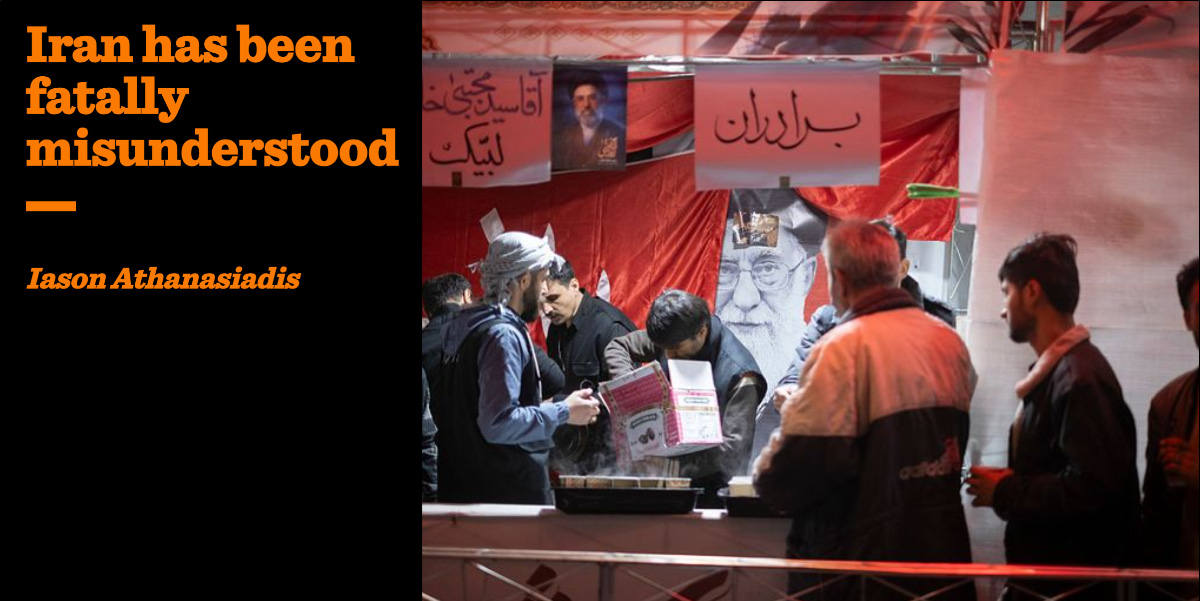
A recent pro-Palestinian, regime-sponsored rally in Tehran exposed eye-widening reactions to an airstrike. When a missile struck a building adjacent to the demonstration, people remained unflinching and broke out into spontaneous cries of “God is great” which rippled through the large crowd. Several top officials were in attendance: the President walked casually, and seemingly without security, the head of the judiciary briefly paused when the bomb exploded but insisted on completing an interview, and Ali Larijani, the recently-assassinated head of Iran’s Supreme National Security Council, processed with no greater protection than a pair of sunglasses. These are markedly unwestern levels of personal unconcern.
So how could this war’s instigators have so misjudged the consequences of their actions?
Calling Iran an empire of evil is common in both the Israeli and US media spheres, and part-and-parcel of the propaganda intended to remove Iran as a Russian-Chinese foothold in an energy-rich region. The media focus on the Islamic Republic’s documented human rights abuses is how Westerners are sensitised, albeit largely unsuccessfully, into consenting to what is ultimately geopolitical competition. That consent typically endures as long as daily lives remain unaffected. But it appears as if, at some point, the American and Israeli security leaderships began taking their own rhetoric at face value, leading them to dismiss Iran’s clear signalling of its threatened reactions and reinforce expectations that the regime would fold like a paper tiger.
Imposing Western norms on un-Western climes
Both Israel and the US are postcolonial settler societies. They occupy territories formerly run by the British Empire, which had been inhabited by indigenous communities that were either expelled or absorbed in negligible quantities into the new, immigration-based social superstructure. Both countries sourced their populations through worldwide emigration flows attracted on the basis of shared affinities and a common narrative: Judaism in Israel’s case; capitalism and the pursuit of freedom in America’s. Their dynamism stems from this vigorous social variegation, which offers the economy a wealth of globally-sourced talent.
But a bias towards 20th century modernity, the pursuit of happiness and a US-dominated world is largely alien to the social arrangements of a post-revolutionary Islamic Republic — itself uneasily balancing on top of the historical behemoth that is Persia. While American inattention to history might have resulted in 2003 in handing the region over to Iran in the aftermath of Washington’s removal of regimes in Kabul and Baghdad, the Israelis are more knowledgeable about their adversary.
Both Israel and the US suffer from a type of denigratory underestimation of Iran. Despite ample evidence to the contrary, they cognitively struggle with the idea that Iran can be both an Islamic Republic (associations with medievalism and ignorance) alongside one of the world’s most scientifically sophisticated countries, as amply evidenced by its nuclear and missile program, highly-educated population and consistent innovation in the fields of technology, nanotechnology and medicine. Not to mention the unflattering comparison between the Phds held by top Iranian regime figures and President Donald Trump’s merry band. This self-inflicted blinkering does not play to the advantage of those wielding it, as illustrated by the surprise that greeted Iranian weekend strikes against the Israeli town of Dimona and perhaps the Indian Ocean Diego Garcia base too.
The urge to impose a western behavioural baseline when dealing with other cultures is particularly tempting since the Internet accelerated westernization. Civilizations that resisted this flattening urge found themselves isolated, notably Afghanistan, Yemen and Iran. While the first two are among the world’s poorest nations, Iran’s ample hydrocarbons allowed both the Shah and the Islamic Republic to guarantee Iranians a relatively high standard of living. But decades of western sanctions, a US-endorsed invasion of Iran by Iraq, and the mismanagement of the economy by often non-specialist, ideological cadres resulted in deteriorating living standards and a sense of victimization.
The polity that emerged out of the 1979 revolution was itself the product of a maladapted modernity. It manifested as a reaction to clumsy modernisation drives in the aftermath of World War Two by Iran’s two-generational Pahlavi dynasty. The rise in oil receipts meant that the crowds that deposed the Shah in 1979 had never had it materially better. What they were reacting against was a repressive regime which they judged was imposing a vulgar Westernization on their cities while so closely allied to the US and Israel as to restrict Iran’s sovereignty. The Iranian Revolution was a nativist reaction to accelerated change and, while it contained strong leftist elements, the Islamists inevitably offered the average Iranian a culturally more reassuring prospect. Shiite Islam’s vigorous justice element made support to the Palestinians an ideological cornerstone of the new regime. When coupled with the historical Iranian thrust for regional hegemony, it was to be expected that regional Shia groups such as Lebanese Hezbollah, Iraq’s Kata’ib Hezbollah and Yemen’s Houthis would be nurtured.
However much the Islamic regime in Tehran sought to tone down the traditional Persian identity at the expense of the new religious one, the deep dignity that is Iran’s greatest characteristic persevered and adapted to the exigencies of geopolitics. While the new regime sought to roll back the Shah’s Persianizing policies (a form of historical revisionism evident in language usage and cultural formation that sought to legitimise his dynasty through evoking the imperial Persian past), its initial efforts to impose Islam in public life and sideline traditional Persian feasts became so controversial that it backed off. I was always struck by a large wall-mural in central Tehran’s Haft-e Tir Square quoting Ayatollah Mohammad Beheshti, an early founder of the Islamic Republic: “Let America become angry, and let it die from its anger.” Initially it seemed nonsensically aspirational. Later, I interpreted it as expressing a latent Iranian tendency to scrutinize the opponent while remaining calm and unmanifested, then use their own weaknesses against them.
“Directness of speech is frowned on as being crude and indelicate,” wrote Antony Wynn, the biographer of British explorer, consul and spy Sir Percy Pykes. “Things are said obliquely and through subtle suggestion, for it is only to donkeys that one should have to spell out the truth.” Little has changed today.
Fire and bluster
The Iranians are in no mood to settle
By the third week of the war, the action has settled into a rhythm of daily hammering that was so damaging to Israeli infrastructure and the world economy that both instigators sought to escalate their way out of each successive phase they initiated: striking regime security bases to foment urban uprisings; urging armed ethnic groups to turn their weapons against the authorities; expanding the range of targets to civilian infrastructure; targeting regime leaders with a track record of negotiating with the international community; and preparing for a multi-front assault on Iran using multiple proxies.
The Iranians are in no mood to settle. They have seized the Straits of Hormuz, not by mining the waters but through imposing a safe route that involves an identification procedure and potential transit fee charge and “security taxes”. In doing so, they have essentially applied reverse sanctions on the West.
Iranian officials have repeatedly rejected US backchannel invitations for negotiation, including President Trump’s claim during his spectacular Monday stepdown from the threat of bombing Iranian electricity facilities that the two sides were close to a deal. Their capacity to absorb punishment has perplexed Trump, who asked aides why Iran had yet to capitulate. One response was offered by Foreign Minister Abbas Araghchi, my former supervisor and a soft-spoken diplomat whose Phd at Kent University was supervised by Marxist scholar David McLellan. When asked whether he did not fear a US invasion, he beamed and invited Washington to send troops.
This is not just bluster. Iran developed its decentralized asymmetric warfare strategy after observing in 2003 the collapse of Saddam’s top-down military command structure. The only time the US landed troops in Iran since the revolution was the little-recalled 1980 Tabas incident, when a failed rescue attempt during the US Embassy hostage crisis resulted in dead Americans and destroyed helicopters in the Iranian desert. Current plans involve seizing Iran’s main oil facility in the Persian Gulf and holding it as a negotiating chip, though it is unknown how this will be achieved given that Iranian missiles struck a dozen US bases in the war’s first stage, pushing their logistical network a thousand miles back to Djibouti and reportedly forcing a significant troop pullback from Iraq. Iran seems to be establishing one of its conditions for the war to end: the withdrawal of the US military from the entire region.
“They won’t be able to land those marines on Kharg (Island),” Omid Souresrafil, an Iranian analyst and author of Revolution in Iran: The Transition to Democracy, told me over the phone from Australia. “The vessel carrying them has to approach within Iranian missile range to put out the amphibian vessel that will take them ashore: you’ll have dead bodies in the water.”
For an Israel that has embarked since October 2023 in a spectacular regional settling of accounts, the confrontation with Iran appears essential to its zero sum view of the world. It is all rather reminiscent of the visit by King Croesus, an Anatolian king, to Delphi in advance of a campaign against Persia. Were he to attack, the oracle told him, “a great empire shall be destroyed”. Interpreting it as a guarantee of victory, Croesus dragged his Lydian empire to its demise in a catastrophic campaign.
Although Israel recognises that Iran, being the size of a continent, is no pushover, its rush into war is perhaps motivated by the seductive prospect of having a future ally of considerable heft. It is a gamble, and one which could perhaps end up becoming existential for Israel.