A Second World War shipwreck lying at the bottom of the Thames and loaded with 1,400 tonnes of explosives has become a ‘sitting duck’ for an Iranian drone attack that would cause ‘mass loss of life’ across the south east, experts have warned.
The SS Richard Montgomery crossed the Atlantic without incident and was on its way to support Allied forces in Normandy when the weather turned and she was ordered to anchor off Sheerness, Kent.
But on August 20, 1944 the American Liberty-class cargo ship dragged her anchor and ran aground on a sandbank around 250 yards from the Medway Approach Channel.
A major salvage operation was launched to unload the vessel’s deadly cargo, but not all the munitions could be retrieved before the 7,200 tonne ship cracked and sank to the bottom of the river.
For the last 81 years the ship has remained untouched under the waves – with a deadly selection of explosives still retained in her cargo.
Alongside highly explosive general purpose bombs are white phosphorous bombs – which can cause severe, agonising, and often fatal burns to any individual that comes into contact with them – as well as fragmentation bombs, designed to scatter shrapnel over a wider area.
There are even cluster munitions and bombs as large as 1,000lb and 500lb.
But analysts have warned that if the ship were to be targeted by drones – and her fragile masts then toppled onto the incendiary load – the resulting explosion could create untold catastrophe.
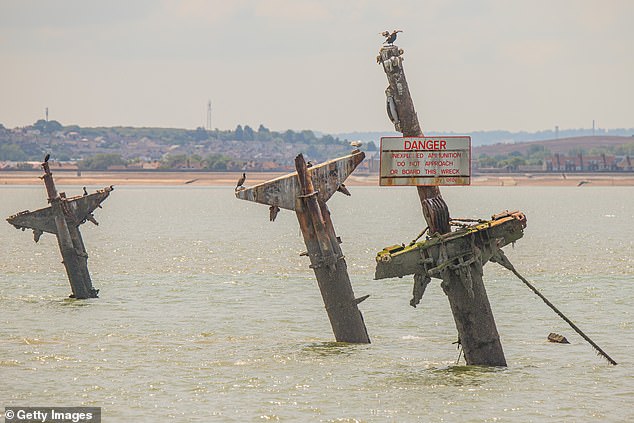
The SS Richard Montgomery shipwreck lying at the bottom of the Thames has become a ‘sitting duck’ for an Iranian drone attack, experts warn
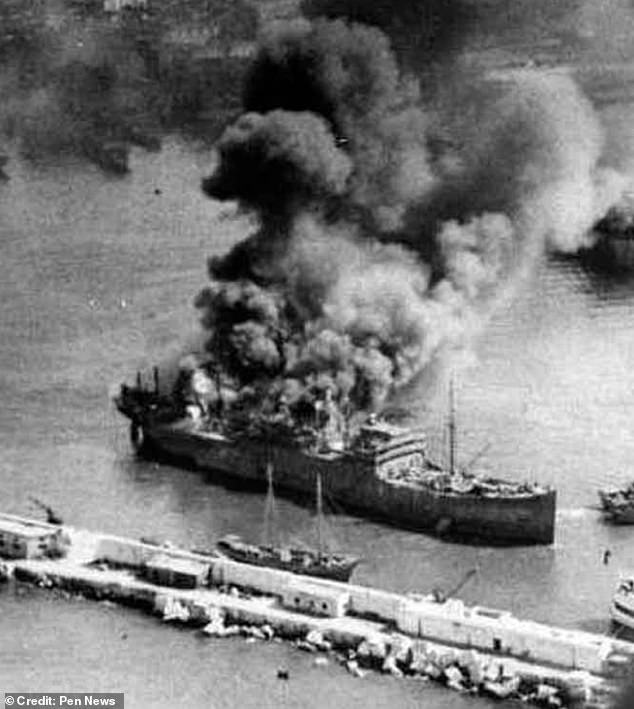
The SS Richard Montgomery crossed the Atlantic without incident, but ran aground off the coast of Kent on on August 20, 1944
Experts say the debris from the wreck could be hurled up to 1.8 miles into the air, damaging buildings for miles around.
Sheerness, a town with a population of around 13,000 people, would be utterly levelled, with any survivors facing the prospect of a deadly tsunami crashing towards them and waves reaching 30ft to 40ft high.
A smaller tsunami could also barrel its way up the Thames towards London, destroying everything in its path.
Parts of North Kent and South Essex would be left decimated by rapid flooding, while Britain’s largest liquefied natural gas terminal on the Isle of Grain, would be lost under tonnes of water.
While the prospect of an Iranian missile hitting the UK capital has mostly remained theoretical, the risk became far more real this week following a strike on a British military base in the Chagos Islands.
Two ballistic missiles were fired towards Diego Garcia, a base in the Indian Ocean jointly operated by the US and the UK, last Friday night.
Sources reported that one of the missiles failed in flight, while the other was intercepted by a US warship – but the significance of the attempt was hauntingly obvious.
For the first time, Iran had shown it not only has long-range missiles in its arsenal, but ones that were capable of reaching a distance of around 4,000km, the IDF confirmed in a statement on Saturday.
‘The Iranian terrorist regime poses a global threat. Now, with missiles that can reach London, Paris or Berlin,’ it added.
Successive governments over the last eight decades have remained alive to the risk posed by the ‘doomsday wreck’, which continues to deteriorate, but the prospect of sabotage by drones is a newer type of threat.
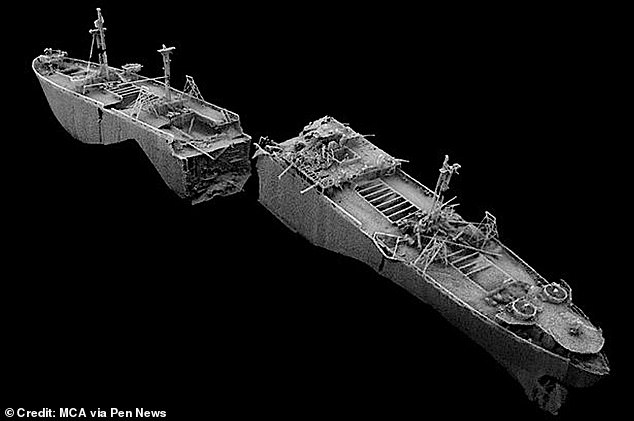
A survey of the ship undertaken last June revealed the hull of the vessel is deteriorating
The wreckage has long been subject to a strict maritime exclusion zone enforced by the Ministry of Defence, while a new order imposed last June stopped aircraft flying within one nautical mile of the sunken remains or lower than 13,100ft in the restricted airspace.
Retired paratrooper Major Andrew Fox told The Telegraph: ‘The wreck is at risk of drone sabotage because it is a fixed, conspicuous target.’
Meanwhile Professor David Alexander, an expert in emergency planning and risk management, described the vessel as ‘a sitting duck’.
Other experts have also cited the prospect of Iran – or Russia – using basic drones flown by skilled operatives or ‘proxies’ to carry out such an operation.
The suggestion that Iran is using petty criminals to carry out attacks on British soil was made earlier this week following a firebomb attack on four Jewish community ambulances in north London.
Lord Beamish, the head of parliament’s intelligence and security committee, told the Today programme on BBC Radio 4: ‘The Iranian regime, whether it be the IRGC [Islamic Revolutionary Guard Corps] or Iranian security services, do attack dissidents, people who criticise the regime, and target the Jewish community and they do that increasingly not directly, but through proxies.
‘What you’re dealing with here is not necessarily just organised crime groups but also people who are just paid.’
The Department for Transport said the condition of the wreck remains ‘stable’ and the site is monitored around the clock.
A spokesman said: ‘Our priority will always be to ensure the safety of the public and to reduce any risk posed by the SS Richard Montgomery.
‘We have been clear that pilots and operators, including drones, must not fly in a limited area around and above the site, which is standard for no-fly zones across the country.
‘The condition of the wreck remains stable, and the site is rigorously monitored 24/7.’
A UK Civil Aviation Authority spokesperson said: ‘Restricted airspace was introduced, last year, above the World War II wrecked vessel, SS Richard Montgomery.
‘This restriction, requested by the government, is to ensure the safety of all inbound air traffic and to prevent any potential incidents from the unexploded bombs on the ship. This impacts aircraft routes into London City and Biggin Hill airports.’
What is the SS Montgomery and why is it dangerous?
The SS Richard Montgomery was a US Liberty Ship built in 1943 to transport cargo across the Atlantic
The 7,200-tonne vessel safely crossed the Atlantic on convoy HX-301 without incident and was ordered to anchor off Sheerness.
The vessel was carrying some 7,000 tonnes of munitions and it was due to carry on to Cherbourg to unload its cargo.
However, on August 20, 1944, the Montgomery dragged her anchor and ran aground on a sandbank around 250 yards from the Medway Approach Channel.
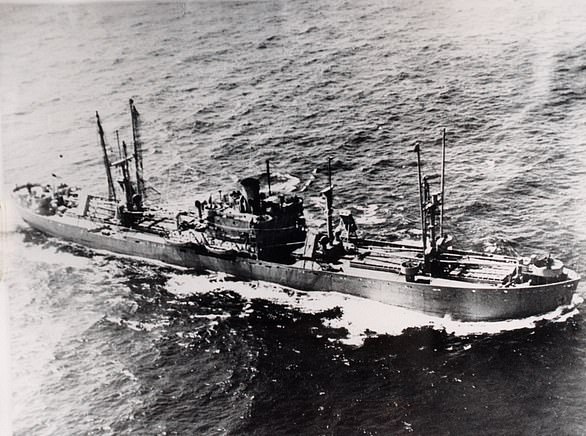
The SS Richard Montgomery, pictured, sank in 1944 off the coast of Kent carrying 7,000 tonnes of munitions that were due to be shipped to Cherbourg for invasion of Europe
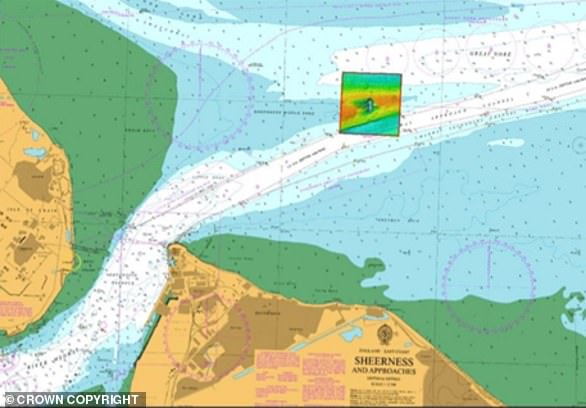
The SS Richard Montgomery dragged its anchor on August 20, 1944 and ran aground on a sandbank before her hull cracked and started flooding
A major salvage operation was launched to unload the vessel’s deadly cargo although, within 24 hours cracks began appearing across the hull and the forward areas began flooding.
By September 25, the salvage operation had to be abandoned after the entire vessel flooded.
The Richard Montgomery was one of 2,700 Liberty ships built during the war.