
IRAN has declared “total war” against the West as it looks to rebuild its nuclear arsenal while strengthening ties with Hamas.
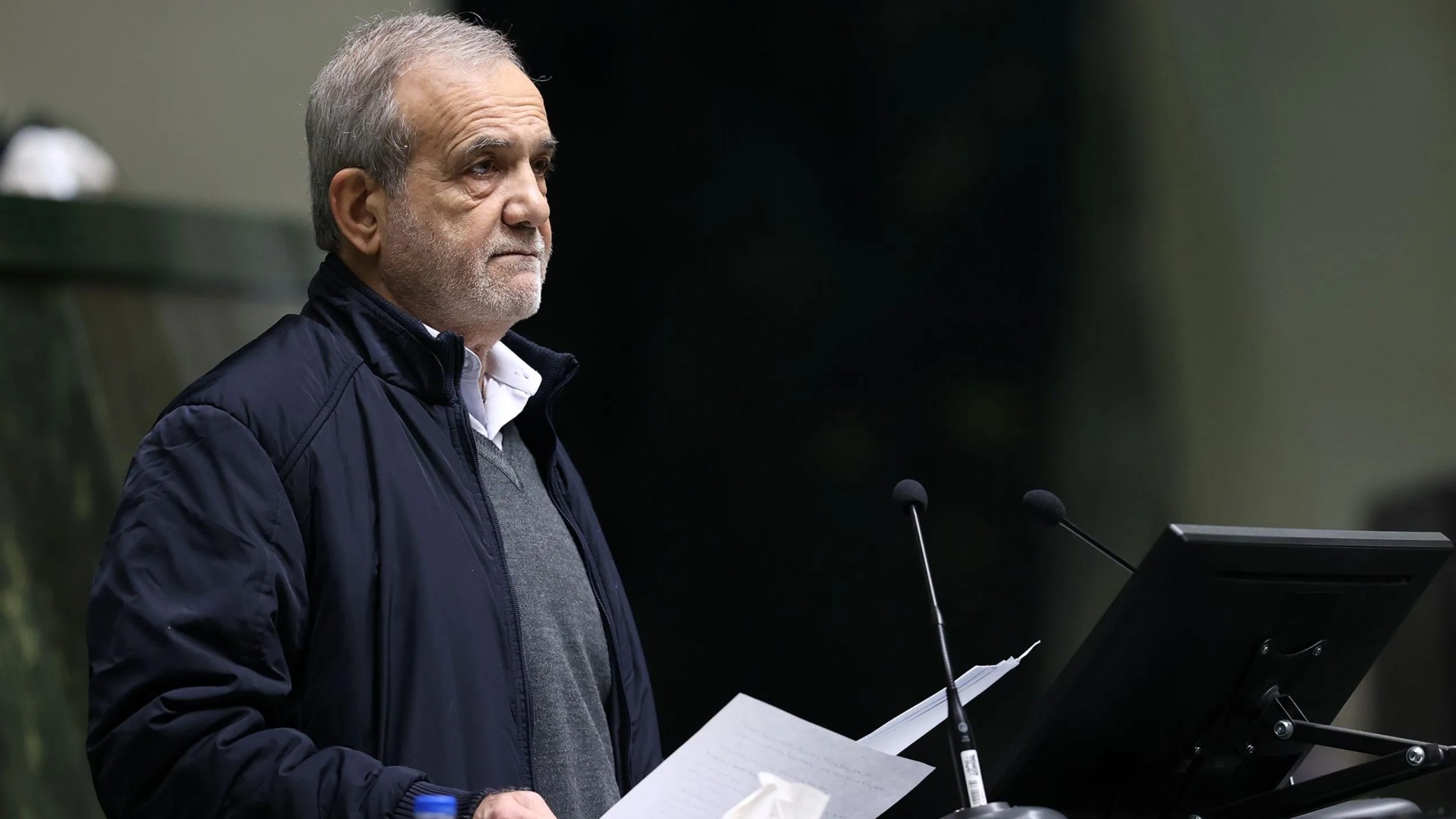
The Iranian President, Masoud Pezeshkian, made this inflammatory statement during an interview with state media on Saturday.
In my opinion, we are at total war with the United States, Israel and Europe,” declared Pezeshkian,” he declared.
“They want to bring our country to its knees.”
In reference to the war with Iraq in the 1980s, Pezeshkian said: “This war is worse than the one launched against us by Iraq. On closer inspection, it is far more complex and difficult.

“Here, they are besieging us from every aspect they are creating problems for us in terms of livelihood, culturally, politically and security-wise.”
Despite the apparent strain, Pezeshkian claimed that Iran’s military was in rude health after its conflict with Israel in June.
“Our beloved military forces are doing their jobs with strength and now, in terms of equipment and manpower, despite all the problems we have, they are stronger than when they attacked.”
These wild claims come after the United Nations placed sanctions on Iran due to its continued pursuit of nuclear weaponry.
Doubts remain whether Iran successfully removed some of its uranium – potentially hiding nuclear material elsewhere – before targeted strikes in June.
The uranium in question is enriched to 60 per cent – way above levels for civilian usage but slightly below weapons-grade.
That material, if further refined to 90 per cent, would theoretically be sufficient to produce more than nine nuclear bombs.
Tehran admitted that Operation Midnight Hammer – which saw American B-2 Spirit bombers drop more than a dozen GBU-57 Massive Ordnance Penetrator bunker buster bombs – did cause “excessive and serious” damage.
But it was not clear immediately if the strikes – which hit Iran’s nuclear facilities – were able to wipe out the entire stockpile of enriched uranium.
Satellite imagery showed trucks moving out of the Fordow nuclear enrichment plant in the days leading up to the attack.
However, President Donald Trump dismissed such speculation, saying: “Nothing was taken out… too dangerous, and very heavy and hard to move!”
He added that satellite images showed trucks at the site only because Iranian crews were attempting to shield the facility with concrete.
Trump claimed that the strikes had “obliterated” Iran’s nuclear capabilities and “completely destroyed” the facility.
This growing concern is set against the backdrop of elections within Hamas.
Tehran-backed candidate, Khalil al-Hayya, is expected to beat Hamas chief Khaled Mashaal in a vote to become the head of the groups political bureau.
The Palestinian politician is thought to be a close ally of Iran and would naturally have a similar stance toward Israel.
The election is held among Hamas’ general Shura council, composed of 50 members.
It was originally scheduled for earlier this year, but the terror group postponed the vote until the war in Gaza came to an end.
Meanwhile, Benjamin Netanyahu is set to travel to the US on Monday to meet with Donald Trump in Mar-a-Lago.
It is thought the Israeli Prime Minister will put forward a plan to launch new strikes against Tehran after conflict between the two nations earlier this year.
The 12-Day War began on June 13 when Israel launched Operation Rising Lion.
The Israelis also orchestrated Operation Red Wedding, killing 30 of Iran’s top military chiefs.
Iran retaliated by launching daily salvos of ballistic missiles at Israel, but failed to hit any strategic targets.
Less than a fortnight later, Trump joined the bombing campaign against Iran.
Iran, which vowed to hit US military bases across the Middle East, sought its revenge by launching missiles at Al-Udeid Air Base – America’s biggest military station in the region.
But Tehran seemingly cooked up a fake attack after passing warnings to its Qatari allies, which allowed all US service personnel and aircraft to be moved out of harm’s way.
Trump dubbed the expected response “weak” before announcing that a ceasefire deal had been reached between the Israelis and Iranians on June 22.
The total sum of fighting resulted in roughly 1,100 Iranian deaths, while missiles strikes killed 28 people in Israel.
Israelis sources claim the Islamic Republic is now working night and day to repair its air defences and rebuild it ballistic missile program.
The meeting between Netanyahu and Trump is also thought to have serious ramifications for the Gaza peace deal.
Many top White House aides believe that Netanyahu is deliberately trying to sabotage the already strained peace framework.
“It’s felt for some time like the Israelis have buyer’s remorse,” an anonymous official said.
“Implementing the Gaza deal is hard enough, but the Israelis sometimes do things that make it even harder.”