Japanese scientists have created an onion that does not make the eyes water when it is chopped, and 180 tonnes are expected to be sold this year.
Researchers spent 20 years creating the onion, known as the Smile Ball, which doesn’t smell like a regular onion and is much sweeter.
Cultivated in the northern island of Hokkaido, the onion’s popularity is growing, with it first being developed in 2012 before first hitting the shelves in Japan in 2015.
A Japanese team led by Dr Shinsuke Imai first identified the previously undiscovered enzyme that causes eyes to water when cutting into an onion, publishing the findings in the British scientific journal Nature in 2002.
The enzymes released when cutting the onions create a volatile gas which reacts with the natural moisture of the eye to form a mild sulfuric acid.
The body then creates tears in an attempt to flush out the irritant.
Dr Shinsuke’s team subsequently bred a vegetable that both looks and tastes like an onion but doesn’t produce an acid in human eyes.
The creation won Ig Nobel Prize in 2013, a parody of the Nobel, a satirical award that honours bizarre scientific achievements.
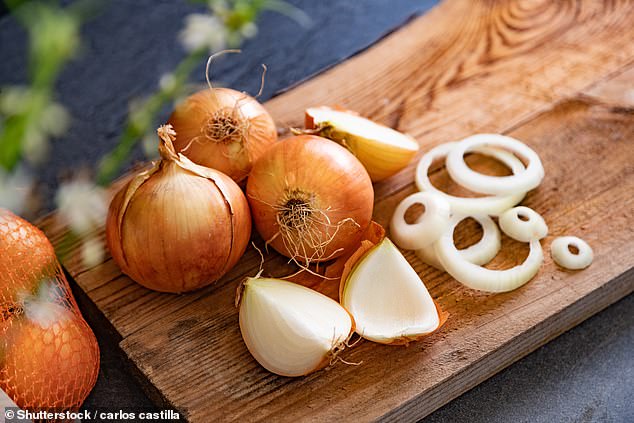
Experts say you may have been storing your onions wrong, as they reveal why you should never put them in the fridge (stock image)
Noriya Masamura, of the company House Foods Group, which been at the forefront of the research into non-pungent onions, told Mainichi newspaper: ‘Roughly chop them into pieces about five to seven millimetres thick, toss with a little salt, dried herbs and olive oil, and you’ll taste their sweetness and they’ll pair perfectly with white wine.’
The Smile Ball, which costs around 70p for a large bulb, is different to the US-grown Suniuon, which also claims to reduce tears when cutting onions.
Sunions, in Waitrose for £1.60 for a packet of three, were created through natural cross-breeding and are a product of more than three decades of farming, research and development.
An onion farmer in Kuriyama, Tamotsu Nishino, 43, who has been producing Smile Ball onions since 2015, added: ‘Hearing consumers say they want to buy them again or want more is encouraging.
‘Masamura and his team provide detailed data on growing conditions and offer advice, which has broadened my knowledge.’
In Britain, onions are one of the most-eaten vegetables, with the average adult consuming roughly 65 per year.