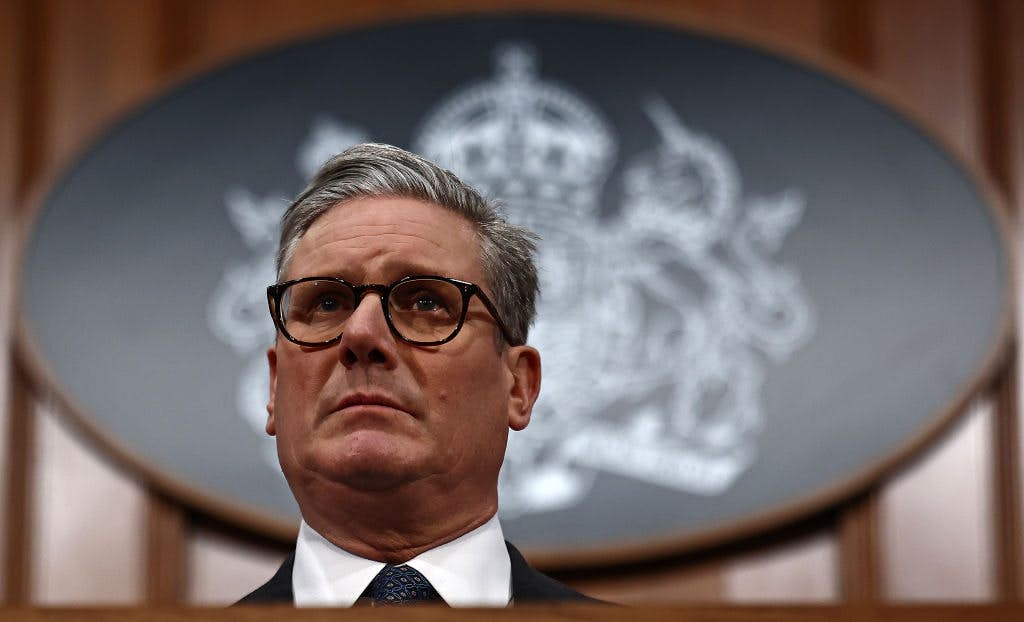

As is so often the case, Sir Keir Starmer’s has made a political compromise over Iran that will satisfy no one. The government had declined to participate in the initial American strikes on legal grounds and indeed denied the use of British bases for that purpose.
But on Sunday evening, the government declared that the United Kingdom would participate in the interception of “drones or missiles targeting countries not previously involved in the conflict”, as well as to “facilitate specific and limited defensive action against missile facilities in Iran which were involved in launching strikes at regional allies”.
All of this was communicated through what was obviously a very highly lawyered-up statement, which invoked the inherent right to self-defence under international law as the basis for its action.
Starmer’s decision to only defend “regional allies unlawfully attacked by Iran and who have not been involved in hostilities from the outset” creates severe difficulties, not only for Sir Keir but for the generals and field officers who have to do the shooting.
Does this mean that, if an Iranian drone flies west, British commanders will have to wait to see whether it is aimed at Israel — which does not fall within the Prime Minister’s description of the countries that he will protect using force — or Jordan, which opposed the strikes on Iran, but got no credit from the ayatollahs?
Or for that matter, will the Prime Minister wait for the Iranian legal justification for striking Jordan, if there is one — after all, Jordan does host United States air bases — before deciding whether to protect Jordan? How about the Sovereign British Base Areas, which Iran or its proxies have attacked, given that Iran will doubtless argue they have played a part in supporting American efforts in their initial strikes, even if only indirectly?
How will the United Kingdom be defining “limited defensive action against missile facilities in Iran?” As Policy Exchange has previously pointed out, the distinction between offensive military action and defensive military action is not a clear cut one. In order to strike Iranian missile facilities, the United States will need to strike at Iranian air defence systems, its command structure, and much else. Which of these will the government allow and which ones will it refuse to facilitate?
These are not hypotheticals. Having chosen to back himself in the dead corner of timorous legalist hair splitting, Starmer must live and die by the strict legalist hair splitting. This is not surprising coming from a government which has given its often extreme interpretations of international law a centrality — some would say fealty — to its decision-making process unprecedented in British history, as Policy Exchange has pointed out.
The appointment of Lord Hermer, an international law maximalist and the first attorney general to deliver a foreign policy speech in anyone’s memory, is another example of this tendency. His legal risk guidelines, which mention international law an extraordinary 24 times, advise government lawyers to scrutinise policies through the lens of international law and its “application and development”, even when there is little or no risk of the policy being challenged in a court, a radical break from practice of past governments. And as a member of the National Security Council, Hermer can directly shape the UK’s most important foreign policy decisions.
One difficulty for Starmer is that his peers in the Anglosphere have refused to follow him. The prime ministers of Canada, Australia, and New Zealand, none of whom is an international reprobate, all supported the first American wave of strikes. Messrs Carney, Albanese, and Luxon all presumably had access to the same sort of high-quality legal advice provided by international lawyers in the common law tradition, yet they arrived at an assessment dramatically opposite to the Prime Minister’s.
Were their lawyers any less good than Lord Hermer, King’s Counsel? What seems more likely is that, having received similar advice to Starmer as to the pure questions of law that are involved, they concluded they could still offer political support to the United States. They considered other factors such as Iran’s flouting of repeated United Nations efforts to stop it from acquiring the A-bomb, its support for Hezbollah and other terrorist organisations, its oppression of the people of Iran, and its threats to destroy the world’s only Jewish state in a genocidal nuclear war — none of which featured in the UK’s published summary of the legal position.
And it’s not only the CANZ of CANZUK: Friedrich Merz and Friedrich Merz have also backed the initial strikes. As Merz put it, when it came to Iran’s nuclear program “international legal assessments will have relatively little effect. This is all the more true if they remain largely without consequence… therefore, now is not the time to lecture our partners and allies”. International law is important, but it is not a suicide pact either.
International law appears to be driving foreign policy, instead of providing context in which policy can be made
There isn’t much evidence that the Starmer government has followed its allies in considering these questions, as opposed to viewing its narrowly-focussed legal advice as the beginning and the end of the question. In other words, international law appears to be driving foreign policy, instead of providing context in which policy can be made. Yet surely it was predictable that the ayatollahs would lash out against all comers in the Middle East. Why was the government caught flat-footed by the Iranian reaction?
The last king’s counsel to reach the height of British politics was H H Asquith. In 1915, defending the legality of blockading of Germany, he declared that “In dealing with an opponent who has openly repudiated all the restraints, both of law and of humanity, we are not going to allow our efforts to be strangled in a network of juridical niceties.”
The arguments as to the legality of the United States’ attacks on Iran are not straightforward; but the fact that Iran, like the Second Reich, has ignored all the restraints of law and humanity is impossible to deny. In the second year of his premiership, Sir Keir Starmer still has not learned that the practice of law and running a country are two very different activities.